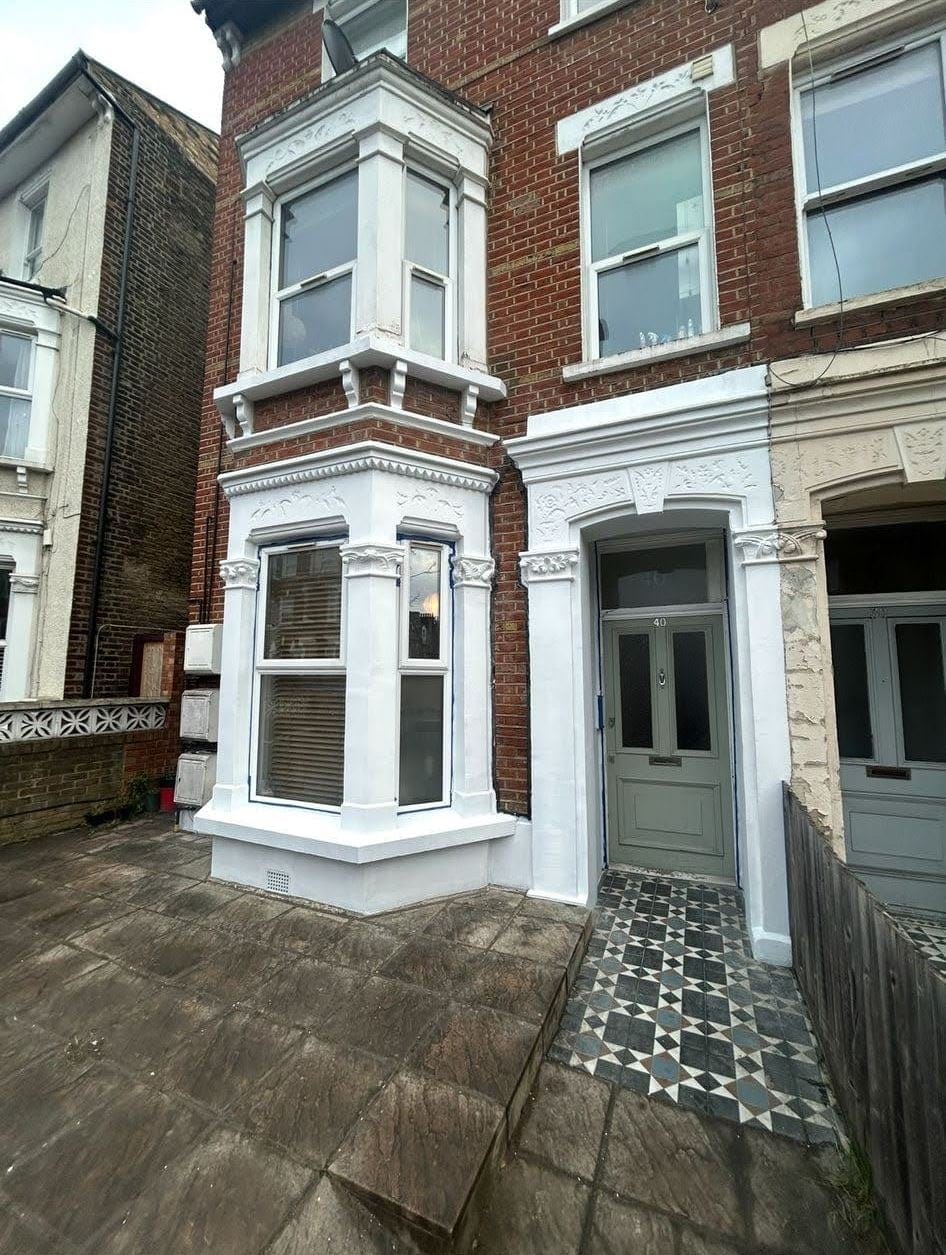
Exterior Painting and Decorating in South London
Paint fails from behind, not from the front. Almost all of the work — and all of the difference — is in what happens before the first coat.
- Free quote and a fixed price in writing
- Preparation, product and number of coats written into the quote
- Not VAT registered — no VAT added to your quote
- 9.45/10 on Checkatrade from 53 reviews
Roofing is what this business does. Painting comes with it: once the scaffold is up for a roof, the front elevation, the sash windows and the fascias are right there, and doing them then costs a fraction of hiring access again later.
Almost every failed exterior we are called to look at failed for a reason that had nothing to do with the paint that was used. The wall was wet. The old coat had gone chalky. Something above it was leaking into one stripe of render. Paint is a thin film asked to sit on top of all that, and it will only ever be as good as the surface underneath it and the reason the surface is in that state.
What we paint
We work by the elevation or by the room rather than by the touch-up. Masonry paint fades in ultraviolet light, so a patched repaint rarely stays matched — a fresh panel beside an eight-year-old one shows for years. Filling and small making-good come with the job.
- Exterior masonry and render
- Stucco fronts, sand-and-cement render, roughcast, pebbledash and painted brick. Washed, stabilised, cut in by hand.
- Windows, doors and exterior joinery
- Sashes and casements, front doors, frames, cills and porches. Stripped to sound timber, repaired where the rot is small, primed and finished.
- Fascias, soffits, bargeboards and rainwater goods
- Timber fascias, and cast or plastic gutters and downpipes. Same access as roof work, so worth doing on that visit.
- Railings, gates and garage doors
- Wire-brushed back, rust treated and primed before anything else goes on, or the rust keeps coming through.
- Interior rooms and ceilings
- Walls, ceilings, skirting, architrave and door frames. Furniture moved and sheeted, floors covered, cleared up each day.
- Small plaster repairs and filling
- Cracks, blown patches and old fixings made good before decorating, not filled over on the day.
- Soffits, bargeboards and porch timber
- The timber at roof level that gets painted while the scaffold is up, rather than needing access of its own later.
Why paint peels off a South London terrace
Most houses around here are solid-wall — a brick and a half thick, London stock, lime mortar, no cavity. A wall built that way takes water in during a storm and dries back out through its own face. It has no other route out.
Ordinary acrylic masonry paint is a plastic film. Put enough of it on a solid wall and water still gets in — a hairline crack, an open joint, a failed cill — but it can no longer get back out. It sits behind the film until frost or a hot day lifts the paint off in sheets, usually taking the top few millimetres of render with it. People blame the paint. The paint was the wrong paint for that wall.
The second cause is chalking. Old masonry paint breaks down in sunlight: the binder goes and the pigment is left on the surface as a loose powder. Run your hand down a tired south-facing wall, and if it comes away white, that is what has happened. A new coat bonds perfectly well to the powder, and the powder is bonded to nothing.
The third is not a paint problem at all. A blocked gutter, a split hopper, a cracked cill or failed lead over a bay puts a slow trickle into one part of a wall, and nothing stays on wet masonry however much you spend. If the peeling is a stripe running down from one point, look up before you buy paint. We do roofs, leadwork and rainwater goods too, so we can tell you which of the three you have.
Preparation, and the coating that goes over it
On an exterior, the painting is the short part. Four days out of five are washing, scraping, filling, stabilising and priming. A wall gets a low-pressure wash or a hand scrub with a fungicidal wash left to work, not a lance held close enough to strip the render. Everything loose comes off and is feathered back. A chalky surface gets a stabilising solution that soaks in and binds the powder. Hairline cracks take a flexible exterior filler; anything wider than about 2 mm is a rendering repair and we price it as one.
BS 6150 is the code of practice for painting buildings, and the part worth knowing as a homeowner is the classification in BS EN 1062-1. Masonry coatings are graded for how much water vapour they let out — V1 high to V3 low — and how much liquid water they let in, W1 high to W3 low. On a solid Victorian wall you want the breathable end of that, V1 and W3, which means a mineral or silicate paint. On a cavity-walled house with sound render it matters far less and a good trade acrylic is fine.
Two coats over sound prepared work, three where the colour changes a long way or the surface is thirsty. A quote that does not name the product and the number of coats is not a quote.
Sash windows, doors and outside joinery
Timber rots from the bottom up and from the joints in. Water stands on the bottom rail of a sash, works into the end grain at the mortice and tenon, and the wood stays wet under the paint for months. Paint over that and it blisters within a season, because the moisture is pushing out through the film.
So the sequence is: strip back to sound timber, cut out anything soft, fill small areas with a two-part resin or splice in new timber where it is bigger, and re-putty where the linseed putty has shrunk away from the glass, because that gap is the other way in. Bare knots get knotting solution, or the resin bleeds through as brown rings inside a year. Everything bare is primed, end grain twice, because cut ends drink water far faster than the face.
Paintwork last decorated before 1992 is treated as though it contains lead, because it may. Lead was not prohibited in domestic paint here until then, and most Victorian and post-war joinery has some under the later coats. That rules out dry sanding and a hot-air gun run too hot: chemical stripper, low heat, wet abrading and sheeting up instead. It is slower, and it is not the corner to cut in a house with small children.
Not everything is worth painting. A bottom rail gone soft all the way through, or a cill you can push a screwdriver into, is joinery rather than decorating, and we will say so rather than hand you a good finish over rotten wood.
Rooms, ceilings and new plaster
New plaster is the one that catches people out. It is thirsty and has to be properly dry first — four to six weeks on a skim over new blockwork, less over old — and the first coat has to be a mist coat, emulsion thinned by about a fifth with water so it soaks in and keys. A full-strength coat sits on top of the suction and comes away in sheets the first time anyone puts masking tape on the wall.
Mould is the other one. Black spotting in the corner of a bedroom or behind a wardrobe is condensation, not dirt. Emulsion over it looks right for about six weeks and then comes back through. It has to be killed with a fungicidal wash, and then the reason the wall is cold and the room is wet has to be dealt with — ventilation, a cold bridge, or a gutter or roof problem overhead.
Interior woodwork is a choice now rather than a default. Since the VOC limits came in for decorative paints in 2010, white oil gloss yellows badly in rooms that get little daylight — behind a door, inside a cupboard, along a north-facing skirting. Water-based satin and eggshell stay white and dry in hours, but mark more easily on a banister or a kitchen door handled daily. We will say which we would use where.
Weather, access and sharing the scaffold
Exterior painting has a season. Masonry and outside woodwork want a surface above about 5°C and rising, dry, with enough daylight left to touch dry before the temperature falls. In London that means April to October. A coat put on late in an October afternoon is still soft when the dew falls, and it shows for the life of the paint.
Access is a large part of the cost. Ground floor and most first-floor windows on a terrace are a tower job. A second-floor front, a parapet, a gable or the whole face of a three-storey house needs scaffold, which costs the same whatever trade is standing on it.
Which is the argument for doing it in one go. If we are already scaffolded for a re-roof, a chimney or new fascias, the decorating costs you labour and materials and not the access a second time. Worth asking at the roof survey rather than a year after the scaffold has gone.
Questions
What people ask
about painting & decorating
01What affects the cost of painting the outside of a house in London?
The starting point is how much wall there is and how many coats it needs. Access and condition move the price far more than the paint does: badly flaking masonry that needs stripping and stabilising can add a great deal on its own.
02How long does exterior masonry paint last?
Eight to twelve years on a sound, properly prepared wall, and rather less on a south or west elevation that takes the weather. Where it fails inside five years the cause is almost always preparation — a coat put over chalking paint, or over a wall that was still wet from a leak nobody had traced.
03Why is the paint peeling off the front of my house?
Three usual causes. Water getting in from somewhere else — a blocked gutter, a split hopper, failed lead over a bay — and pushing the paint off from behind. Or a new coat applied over old paint that had gone chalky, so it never bonded to anything solid. Or an impermeable plastic coating on a solid brick wall that needs to dry through its face. The pattern usually tells you which: a stripe means a leak, a whole elevation means the paint.
04Can you paint pebbledash, and should I paint bare brickwork?
Pebbledash paints perfectly well, but budget for it: the texture uses far more paint and takes noticeably longer to work into properly. Bare brick is a different question. Painting it is close to permanent — stripping it later is expensive and often damages the face of the brick — and it commits you to repainting every eight years or so. On sound London stock we would usually talk you out of it.
05What months can you paint outside in London?
Realistically April to October. Masonry and exterior woodwork want the surface above about 5°C and rising, dry, and with enough daylight left to touch dry before the temperature drops. A coat put on late in an autumn afternoon is still soft when the dew falls and it will show permanently. We would rather move a date than paint into bad weather.
06Do I need permission to paint the outside of my house?
Normally no — repainting an ordinary house is not development. Two exceptions matter here. A listed building needs listed building consent, including for a change of colour. And some conservation areas carry an Article 4 direction that removes the usual freedom, which is common enough in Southwark, Lambeth and Wandsworth to be worth one phone call to the borough before you start. If you own a flat, check the lease as well: external decoration is usually the freeholder's.
07Is it safe to sand old paint on Victorian windows?
Not dry, no. Lead was only prohibited in paint for domestic use in the UK in 1992, and most older joinery has some of it under the later coats. Dry sanding or a hot gun run too hot puts lead into the dust and the air. The work is done with chemical stripper, a low-temperature hot-air gun, wet abrading and everything sheeted up and cleared away.
08Do you do interior decorating as well, and what about newly plastered walls?
Yes — rooms, ceilings, skirting, architrave, door frames and small plaster repairs. New plaster needs to be properly dry first, four to six weeks over new blockwork, and the first coat must be a mist coat of thinned emulsion so it soaks in and keys. Full-strength paint straight onto fresh plaster sits on the surface and peels off in sheets later.
09Is the paint included in the price?
Ask for that in writing whoever you use, because it is the commonest reason two quotes for the same house are not comparable. Ours names the product, says how many coats, and says whether we are supplying it or you are. A three-coat quote and a two-coat quote for the same wall should not look the same, and they usually do until you read them.
10Can you decorate while you are working on the roof?
Often, and it is the cheapest time to do it. Scaffold costs the same regardless of which trade is using it, so fascias, soffits, rainwater goods and high exterior woodwork cost far less when the access is already up for a re-roof or a chimney. It is worth raising at the roof survey.
Free quote
What needs paint, and how much.
We will come and look, photograph what we find, and give you a fixed price in writing. No call-out fee, no obligation.