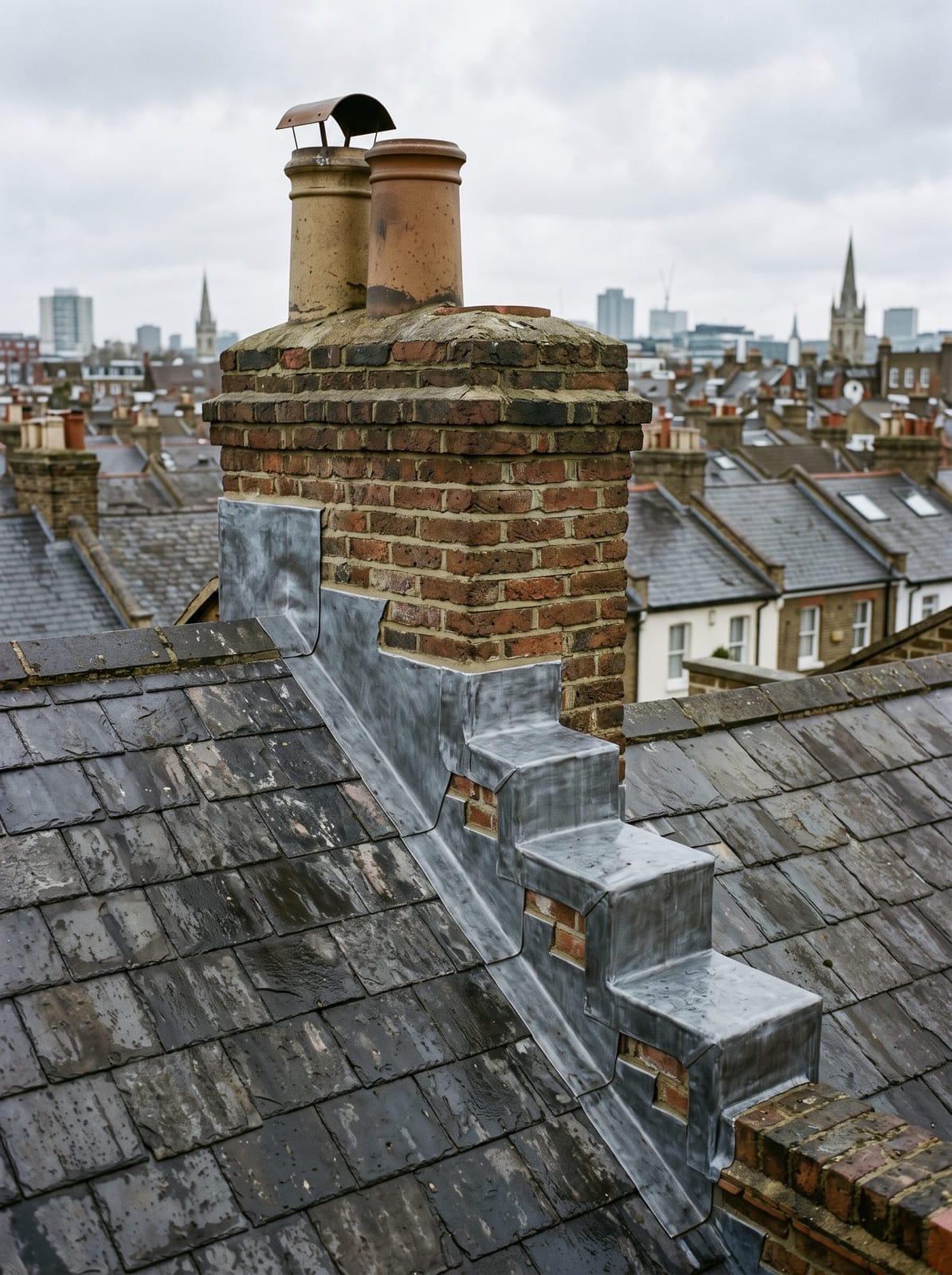
Leadwork and Lead Flashing in South London
Lead does not wear out. It fails where somebody stopped it moving — and that is a fixable mistake.
- Free survey and a fixed price in writing
- The lead code and piece lengths named on the quote
- Not VAT registered — no VAT added to the price you are quoted
- 9.45/10 on Checkatrade from 53 reviews
Left alone and detailed properly, a lead flashing will outlast the slates around it. What fails is almost never the metal. It is a length cut too long to move, a mortar fillet where lead should have been, or a strip of flashing tape stuck over the top of somebody else's guess.
We repair and replace lead across Camberwell, Peckham, Dulwich, Herne Hill, Brixton and the rest of South London — chimney flashings, valleys, parapet gutters, dormer cheeks. Most of it is half a day to a day on site. We will show you which piece has actually failed and why, with photographs, before you have spent anything.
Where the lead is on your roof
Lead does one job. It carries water across a join that two materials cannot make watertight on their own. On a South London terrace there are usually five or six of those joins, and they leak in roughly this order.
- Apron flashing
- The strip across the front of a chimney where the stack comes out of the slope. It takes the most water of anything on the roof and it is usually the first thing to split.
- Step flashing and soakers
- Up the sides of a stack or a wall abutment. Soakers are small pieces tucked under each slate; the step flashing covers them and steps up the mortar joints. Where a roofer has skipped the soakers and run one long strip instead, it leaks.
- Back gutter
- The tray behind a chimney, where water piles up before it splits either side. Hidden, awkward to reach and the source of most chimney leaks nobody can find.
- Valleys
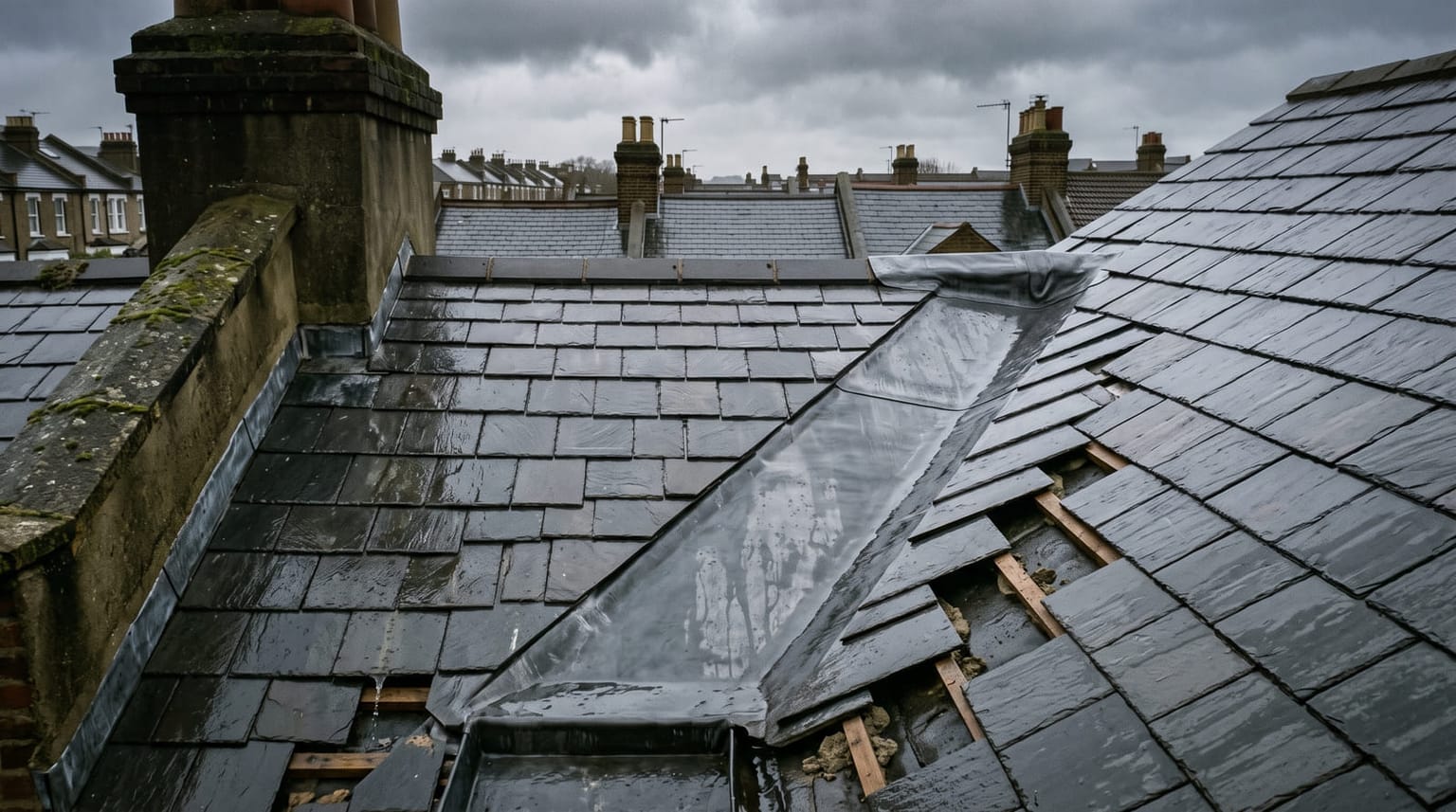
- Where two slopes meet. Open lead valleys carry a lot of water off a big roof and split down the middle when they have been laid in over-long lengths.
- Parapet and box gutters
- The hidden gutter behind a front parapet on a butterfly roof — the standard M-profile Victorian terrace across SE5, SE15, SE22 and SW9. Originally lead-lined, often patched in felt at some point, and the worst leak we get called to.
- Dormer cheeks and tops
- The sides and the flat top of a dormer. Lead can be dressed round a corner and up a curve in a way nothing else will follow, which is why it is still used there.
Why lead splits
Lead moves. A metre and a half of it grows and shrinks by a couple of millimetres between a frosty night and a July afternoon, and it does that every day for decades. Given room to move, it lasts a century. Held so it cannot, it works itself to death along one line and cracks. Almost every failed flashing we lift is that.
BS 6915 is the British Standard for lead sheet on roofs and walls, and its rules exist for exactly that reason: pieces no longer than about 1.5 metres, laps of at least 100 mm between them, fixed at the top so the bottom is free to slide. The metal is not the variable. The detailing is.
- Over-long pieces
- A five-metre valley cut from one length, or a flashing run the full width of a stack. It splits in a straight line, usually inside ten years, and it will do it again if it is replaced the same way.
- A mortar fillet instead of lead
- A triangle of cement where the roof meets the stack. Quick and cheap, and it cracks, because cement and brick move at different rates. Water then runs straight into the joint behind it.
- Mastic and flashing tape
- Buys a winter. It hides the split, holds water behind it against the brick, and leaves the next roofer more to strip off.
- Fixed at both ends
- Nails or clips top and bottom. Restraint is what tears lead — a properly fixed flashing is deliberately loose along its lower edge.
- Corrosion from underneath
- Lead in a closed, unventilated space — the underside of a dormer top, a boxed-in gutter — corrodes from below, where condensation and acids off the timber sit against it. It looks perfect from above right up until it perforates.
- Theft
- Lead is worth money by the kilo and a bay roof or a parapet is reachable. Common enough across South London that it changes what we recommend on some houses.
How lead should be fitted
Lead is specified by code, which is really its thickness. Code 4 is 1.80 mm, Code 5 is 2.24 mm, Code 6 is 2.65 mm. Code 4 is right for step and apron flashings. Anything that carries water rather than just shedding it — a valley, a back gutter, a parapet gutter, a dormer top — wants Code 5 or heavier. Dropping a code saves a little on a chimney and costs you the job fifteen years early.
The rest is detailing, and it is all checkable. Pieces at 1.5 metres or less, lapped 100 mm. A chase raked out about 25 mm into the mortar joint, never cut into the face of a soft London stock brick. The lead turned into the chase, wedged with rolled lead clips and then pointed up. Soakers under every slate on a side abutment. Corners dressed to shape with a bossing stick rather than beaten thin.
New lead is bright, and as it weathers it sheds a white carbonate that runs down brickwork and stains it badly. Patination oil, wiped on the day it goes up, stops that. It takes ten minutes, and a good half of the flashings in London never get it.
Our quotes name the lead code, the number of pieces and the girth, so the specification is on paper before anyone starts. If a quote you have been given says only 'renew lead flashing', ask what code and how many pieces. The answer tells you a great deal about who you are dealing with.
Repair, weld, or strip it out
Lead is worth repairing far more often than most roofing. A single split in an otherwise sound flashing can be lead-welded — a strip of the same metal fused into it, not stuck on top — and that repair is permanent rather than temporary. It costs a fraction of a replacement, so it is the first thing we look for.
Replacement is the honest answer when the piece was the wrong length or the wrong code to begin with, when the surface is thin and crazed with fine cracks across a whole face, or when the mortar joints have failed and the chase has to be raked out and repointed anyway. Patching any of those is money you will spend twice.
One thing we cannot tell you from the ground, or from inside the loft: what the timber under a parapet or box gutter is like. Lead hides a rotten board perfectly. We say so at the survey rather than after, and if we open it up and find rot we photograph it and ring you before we go any further.
Checking it before we come off the roof
A flashing that looks right and still leaks is worse than one that visibly failed, because you find out about it in November. So we test the finished detail with water before we pack up — a hose run over a chimney for a quarter of an hour, with someone watching inside, finds a gap that rain would take a month to reveal.
You get photographs of the finished work, close enough to see the laps and the wedging, not just a shot of the roof from the pavement. If the same leak comes back, we come back to it.
Questions
What people ask
about leadwork & flashing
01What affects the cost of lead flashing repair in London?
Access is the biggest variable. Whether the work is reached from a ladder, a tower or a scaffold moves the price more than the lead does, and a scaffold on the footway needs a council licence. Where a scaffold is needed, it is quoted separately. After that comes how much has to come off to get at the lead, the masonry behind it, and the code and quantity of lead, which is sold by weight. Rot under a gutter or a dormer top turns the job into carpentry first, and nobody can price that until it is opened up.
02Can lead flashing be repaired, or does it all have to come off?
Often it can be repaired. A clean split in lead that is otherwise the right code and the right length can be lead-welded, which fuses new metal into the old and lasts as long as the sheet around it. Replacement is the right call when the piece is too long, too thin, or crazed with fine cracks across a whole face.
03My chimney leaks but the flashing looks fine from the ground. What else could it be?
Usually the back gutter, which you cannot see from below and which collects the most water. After that: cracked flaunching around the pots, an open joint in the stack letting rain soak through soft brick, a redundant flue with no cowl, or condensation inside an unlined flue. We check those before quoting for lead you may not need.
04How long should lead flashing last?
Correctly detailed lead is measured in decades, not years — it will normally outlast the tiles or slates around it. Badly detailed lead fails on a much shorter clock: over-long pieces tend to split within about ten years, and a cement fillet used instead of lead often cracks within five.
05Is lead on a roof dangerous?
Not to live under. Rolled lead sheet is stable and sits outside the building. The sensible precautions are practical ones: wash your hands after handling offcuts, keep children away from scrap, and do not drink or water vegetables with rainwater collected off a lead roof or a lead-lined gutter.
06Why has my new lead gone white and streaked the brickwork?
That is lead carbonate, which forms as new lead weathers and washes down the wall as a chalky white stain. It is preventable, not inevitable. Patination oil wiped over the sheet on the day it is fitted stops it forming. The staining itself can usually be cleaned off the brick, but it takes work.
07Can you not just seal it with flashing tape or mastic?
We can, as a temporary measure to stop water coming in tonight, and sometimes that is the sensible thing while a proper repair is scheduled. As a permanent fix it fails, because it traps water behind it against the masonry and hides the split that caused the leak. We will say which of the two we are doing.
08Do you need scaffolding for leadwork?
Not always. A chimney flashing on a two-storey house can often be reached with a ladder and a roof ladder. A valley, a parapet gutter, a full stack re-lead or anything on a third storey normally needs a tower or a scaffold to be done safely and properly. We tell you which at the survey, before the price, not after.
09Lead has been stolen from my roof before. What can be done?
Where theft has already happened once, replacing like for like is worth thinking about. Options are marking the lead with a forensic property-marking kit and signing it, or fitting a non-lead alternative on the exposed, reachable areas and keeping lead where it cannot be got at. We will price both so you can compare.
10What if the leak comes back?
We come back to it. We water-test the finished detail before leaving the roof and photograph the work, so there is a record of what was done and how. Ask us for the guarantee terms when you get the quote, and check they are on the paperwork before any money changes hands.
Free quote
We find where it lets in.
We will come and look, photograph what we find, and give you a fixed price in writing. No call-out fee, no obligation.