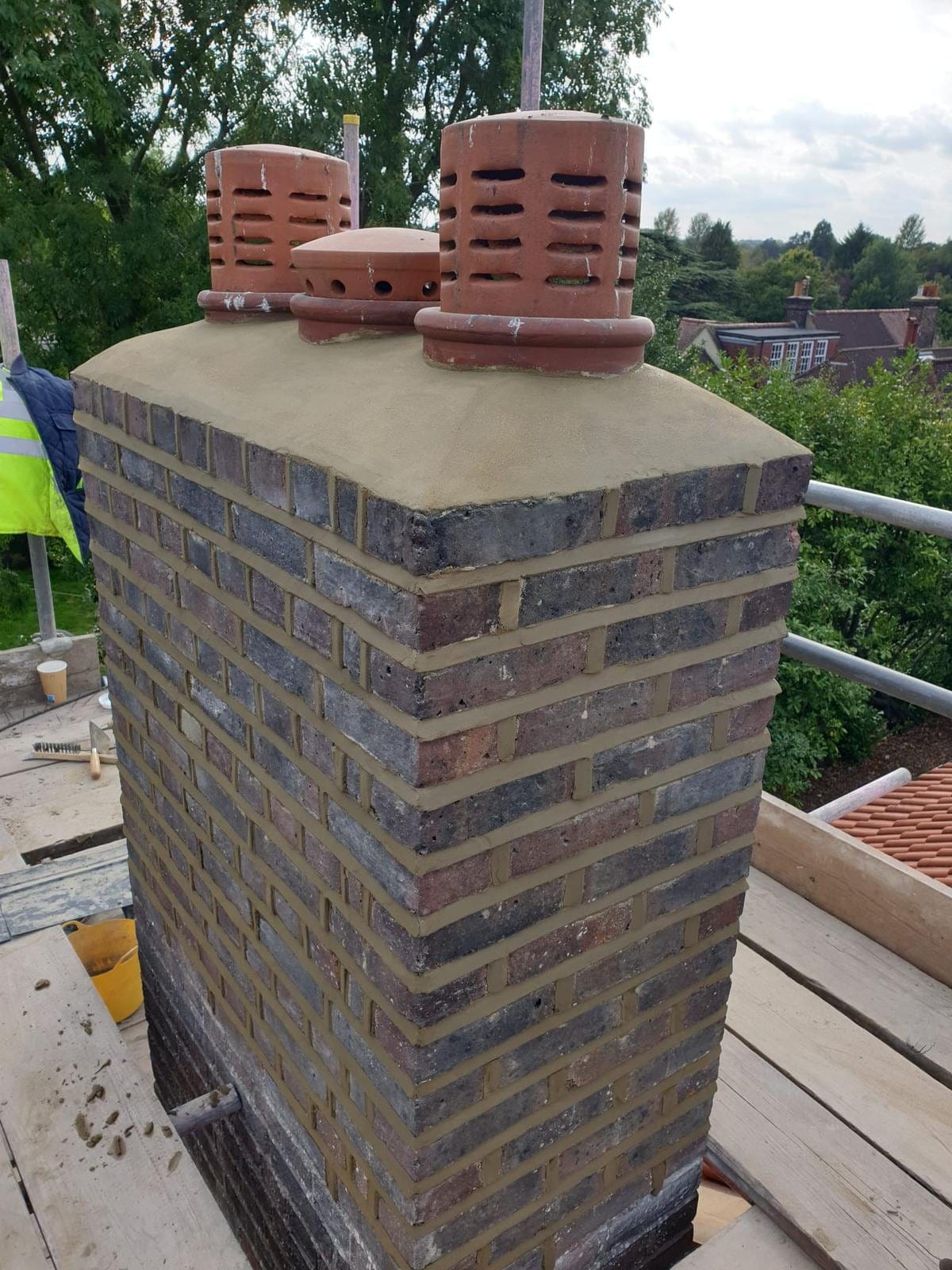
Chimney Repairs, Rebuilds and Removal in South London
Most stacks that look finished only need repointing, new flaunching and new lead. We will tell you which yours is before you spend anything.
- Free survey and a fixed price in writing
- Photographs of the stack from the scaffold, whether you book or not
- Access priced as its own line, not hidden in the total
- 9.45/10 on Checkatrade from 53 reviews
A chimney stack is the only brickwork on your house with weather on all four sides and no roof over it. Rain soaks into it, frost gets behind the pointing, and on most South London terraces a hundred and forty years of coal smoke has been working on the mortar from the inside as well. Stacks do not fail suddenly. They fail quietly, and then one January a length of pointing lands in the gutter.
We repoint, re-lead, rebuild, cap and take down chimneys across Camberwell, Peckham, Dulwich, Herne Hill, Brixton and the rest of South London. Most of what we are called to turns out to be pointing, flaunching and lead — a day or two on a stack that looked, from the pavement, like it needed pulling down. When it genuinely does need rebuilding, you get the photographs that say so before you get the price.
Why chimney stacks fail
Everything above the roofline is exposed masonry. Water soaks into soft London stock brick, sits there, and expands when it freezes, taking the face off the brick and opening the joints. The higher and the more exposed the stack, the faster it goes — a tall stack on a three-storey terrace weathers harder than the same brickwork four metres lower down.
There is a second mechanism most people have never heard of, and it is the one that makes stacks lean. Years of coal and gas leave sulphates in an unlined flue. Damp carries them into the mortar, where they react and the joints slowly swell. Because one face of the stack stays wetter than the others, that side grows more, and the stack bends away from plumb — usually towards the weather side. A stack that leans is not a pointing problem. The mortar has gone all the way through and it wants rebuilding.
The third cause is a previous repair. Someone repoints a Victorian stack in a hard sand-and-cement mix, and water that used to escape through the soft joint now has nowhere to go but through the brick. The faces blow off a course at a time. On London stocks the mortar should be weaker than the brick, not stronger, which normally means a lime-based mix.
What we do to a chimney
Almost every stack we attend needs some combination of the following. None of it is exotic work. It is careful bricklaying and careful leadwork, done at height, and it is the leadwork that most jobs get wrong.
- Repointing the stack
- Joints raked out to sound mortar — usually 20 to 25 mm, deeper where the weather has got in — brushed, wetted and repointed in a mix matched to the brick. On Victorian stocks that is lime, not cement.
- Flaunching and pots
- The flaunching is the sloped mortar cap that holds the pots and throws water off the top of the stack. It cracks, water runs straight down inside the brickwork, and the stack stays wet all winter. We cut the old cap off, re-bed the pots and cast a new one with a proper fall.
- Lead flashing
- A stack through a pitched roof needs four separate pieces: soakers between the slates, an apron at the front, stepped flashing up both sides and a back gutter behind. Code 4 lead for most of it, Code 5 for the back gutter. Individual pieces are kept short — around 1.5 m — because lead moves as it warms and long lengths split at the fixings.
- Cement fillets we take off
- A mortar fillet where lead should be is the commonest bodge we find. Cement and brick expand at different rates, so the fillet cracks within a couple of winters and the crack takes water straight into the roof. We cut them out and lead the junction properly.
- Rebuilding above the roofline
- Taken down course by course to sound brickwork, rebuilt in reclaimed stocks to match, new tray, new lead, new flaunching, pots re-set. Two to four days on a typical terrace stack once the scaffold is up.
- Capping a disused stack
- A capped flue still has to breathe. Sealed top and bottom it sweats, and the damp comes out on the chimney breast in the bedroom. We fit a vented cap or a capping cowl and leave an air brick at the bottom.
- Cowls and bird guards
- For downdraught, rain down an open flue, or jackdaws. Fitted at the same time as anything else that needs doing up there, because the access is the expensive part.
- Storm damage
- We make a loose or cracked stack safe first, photograph everything for your insurer, then price the permanent repair separately.
Chimney leaks: where the water actually gets in
A damp patch on a bedroom ceiling near a chimney breast is almost never coming through the bricks in a straight line. Water gets in at the top through cracked flaunching, or at the roof line through failed lead, then runs down inside the stack or along a rafter and appears somewhere else entirely. Chasing the stain rather than the source is why some chimney leaks get half-fixed for years.
The four we find most often are a cracked cement fillet where lead should be, a back gutter that has split or silted up behind the stack, missing soakers on a stack that has been re-roofed around, and a stack so saturated that it is simply wet through. The last one is worth naming because no amount of sealant fixes it — it needs the pointing and the flaunching sorted so the brickwork can dry.
There is also a leak that is not a leak. A capped, unventilated flue in an old house condenses inside and stains the breast in patterns that look exactly like rain coming in. We check for that before selling anyone a stack repair.
Repoint, rebuild or take it down
The test is how deep the failure goes, not how bad it looks. If the bricks are sound and the joints have weathered back, that is repointing and new flaunching — a day, and the stack has another twenty or thirty years in it. If the brick faces are spalling across several courses, or the stack is visibly out of plumb, the mortar has failed through the full thickness and repointing it is money thrown at a wall that will move again.
Rebuilding above the roofline costs more than repointing but far less than most people expect, and it resets the clock. Taking the stack down instead is the cheaper option and often the sensible one on a house where nobody has lit a fire since the 1970s — but it changes the look of a terrace, and on a shared stack it is not a decision you can make on your own.
If we are already re-roofing the slope, the honest advice is to deal with the stack while the scaffold is standing. Coming back to a chimney on its own means paying for the access twice.
Taking a stack down
Removing a stack down to below the roofline is roofing work: the brickwork comes down, the hole is closed with new rafters or noggins where needed, the roof is re-slated or re-tiled across it and the flue is capped and vented below. One to two days on a terrace, plus the scaffold and a skip.
Two things stop people mid-job. The first is that most London stacks sit on the party wall and are shared with next door — half a stack cannot come down without agreement, and it normally means a notice under the Party Wall etc. Act 1996 and a conversation with your neighbour before anything is booked. The second is building control: taking out brickwork that carries load, or that supports a neighbour's flue, is notifiable, and on anything structural you need a structural engineer's drawing before a council or an approved inspector will sign it off.
Removing the chimney breast inside the house is a different job again — steelwork, plastering, ceilings, and Part A of the Building Regulations. We will tell you plainly whether what you want is a roof-level job or a structural one, and we do not pretend the second is a morning's work.
What we do not do
We are roofers and bricklayers. We do the stack, the weathering and the roof around it. We do not line flues, fit stoves or gas appliances, or sign off flues for use — that is HETAS and Gas Safe territory and we hold neither. If you are bringing a fireplace back into use, get it swept and tested by someone who does, and let us do the masonry.
We do not sweep chimneys either, and we will not quote for a stack we have not looked at. Photographs from the pavement do not show a back gutter or the state of the joints on the far face. The survey is free; the guess would not be worth having.
Chimney work we have done
All projects →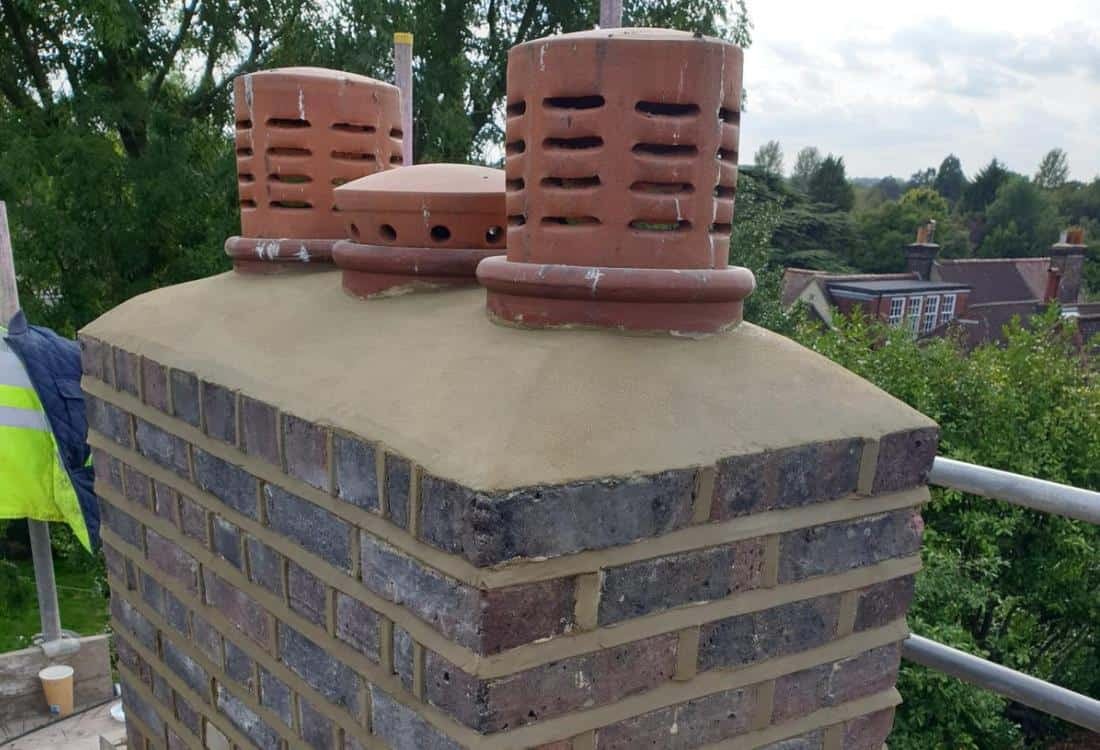
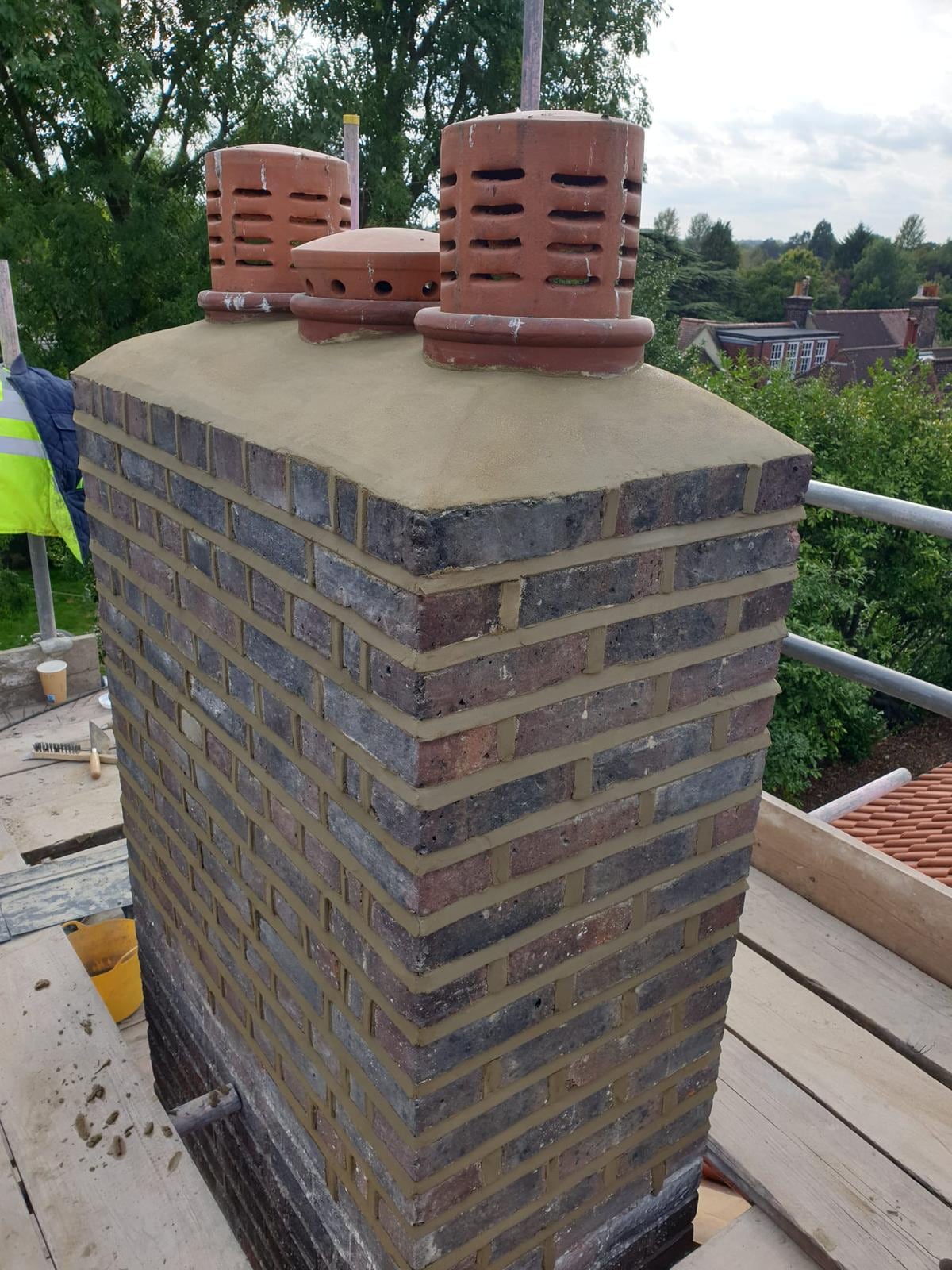
Chimney rebuild
Questions
What people ask
about chimneys
01What affects the cost of chimney repair in London?
Access is usually the largest single item, and on most terraces that means a scaffold. After that, most jobs run from recasting the flaunching and re-bedding the pots at the cheaper end to a full repoint of a tall stack at the dearer end. New lead flashing costs more where a back gutter is involved, and rebuilding a stack above the roofline costs more than repointing it. We are not VAT registered, so there is nothing to add on top.
02Why is my chimney leaking when the roof is fine?
Because the stack is a hole in the roof with brickwork round it. Water comes in through cracked flaunching at the top, through a failed cement fillet or split lead where the stack meets the slates, through a back gutter that has silted up behind it, or straight through brickwork that is saturated. The roof either side can be perfect and you will still get a stain on the bedroom ceiling.
03My chimney is leaning. Is it dangerous?
Take it seriously. A lean usually means sulphate attack has swollen the mortar joints all the way through, so the stack is weaker than it looks and it will keep moving. It is rarely about to fall, but it will not straighten and it cannot be repointed back into shape. The answer is a rebuild above the roofline, or removal. If it has moved suddenly after a storm, call us and we will make it safe first.
04Can you repoint a chimney without scaffolding?
Rarely, and we would not want to. You cannot work safely on four faces of a stack from a ladder, and you cannot reach the back gutter at all. A small stack on a low rear roof can sometimes be done from a tower. Anything on a two- or three-storey front slope needs a scaffold, and we would rather tell you that at the survey than after.
05Do I need permission to remove a chimney stack?
Usually some. Removing brickwork that carries load or supports a neighbour's flue is notifiable to building control, so it goes through the council or an approved inspector, often with a structural engineer's drawing. If the stack sits on a party wall — most London terraces — you also need to serve notice on your neighbour under the Party Wall etc. Act 1996. In a conservation area or on a listed building, check with the council before you commit to anything, because stacks are part of what the designation protects.
06We never use the fireplace. Should we cap the chimney or take it down?
Capping is cheaper and reversible. It keeps the stack as part of the roofline, which matters on a terrace where every other house still has one, and it stops rain and birds getting in. The condition is that it must be vented top and bottom — a sealed flue condenses and you get damp on the breast inside. Take the stack down if the brickwork has failed and a rebuild is not worth it to you, and only after you have squared it with the neighbour if the stack is shared.
07Do you line flues or fit wood burners?
No. We do the masonry, the flaunching, the pots and the weathering, and we make the roof around a stack watertight. Flue liners, stoves and gas appliances are HETAS and Gas Safe work and we are not registered for either. If you are bringing a fireplace back into use, have it swept and tested first by someone who is, and we will do the brickwork side.
08There are birds nesting in my chimney. Can you fit a guard?
Yes, but not while the nest is active. Nesting birds and their nests are protected while in use, so an occupied jackdaw nest has to be left until the young have flown. After that the flue can be cleared and a bird guard or cowl fitted.
09How long does chimney work take?
Repointing or new flaunching is a day. New lead is half a day to a day. A rebuild above the roofline is two to four days, plus a day either side for the scaffold to go up and come down. Weather stops brickwork — mortar will not cure properly in a hard frost — so a winter job can sit for a few days, and we would rather wait than lay work that will fail.
10Which areas do you cover?
Camberwell and the surrounding South London postcodes: Peckham, Dulwich, Herne Hill, Brixton, Clapham, Streatham, Tooting, Balham, Wandsworth, Battersea, Putney, Fulham, Wimbledon, Brockley and West Norwood. We travel further for larger jobs, including out towards Kingston and New Malden.
Free quote
Photograph the stack for us.
We will come and look, photograph what we find, and give you a fixed price in writing. No call-out fee, no obligation.