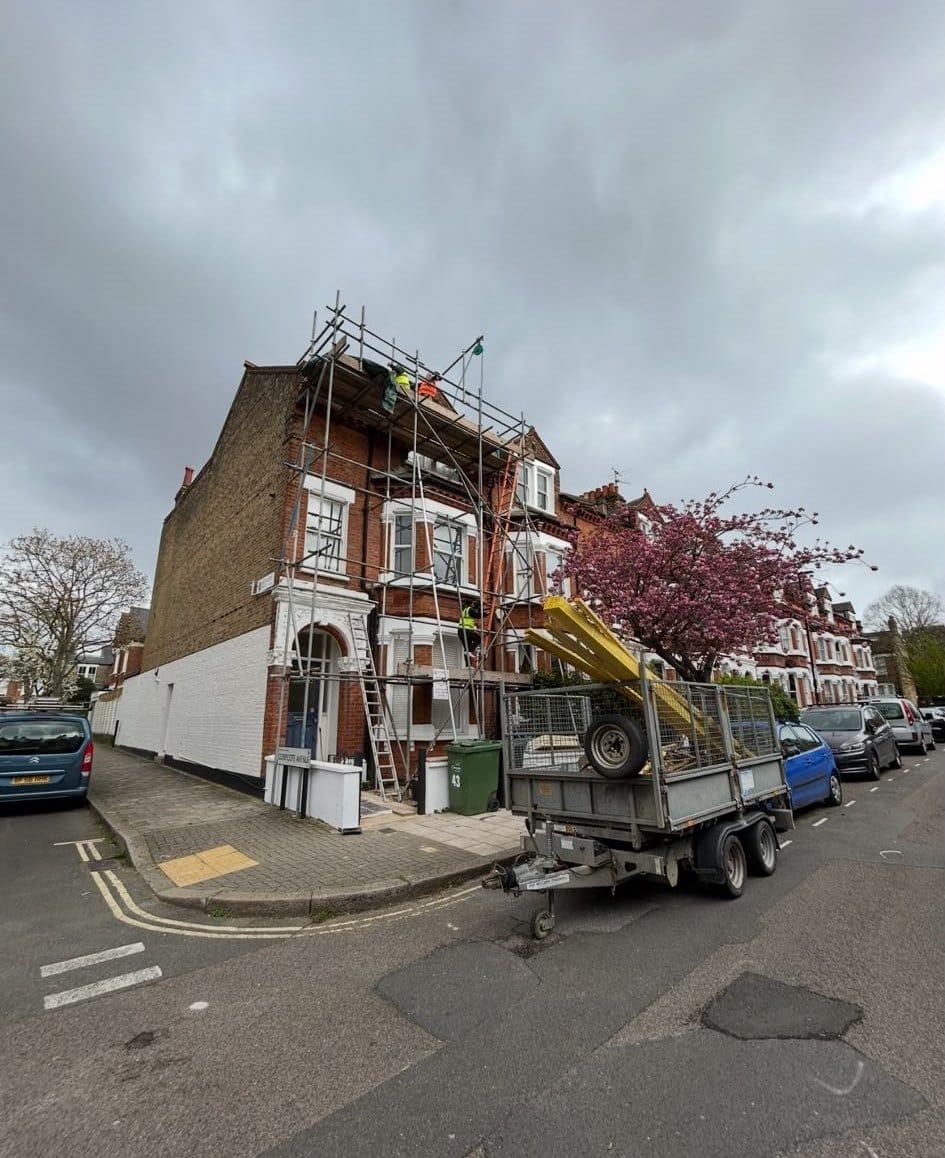
Roof Surveys and Inspections in South London
A survey should tell you what has failed, what has not, and what can safely wait. Ours tells you all three, in writing, with the photographs behind it.
- Free survey and a fixed, itemised price in writing
- Photographs of everything we find, whether you book or not
- Not VAT registered — no VAT added to the figure you are given
- 9.45/10 on Checkatrade from 53 reviews
A roof survey turns a worry into a list. Most people book one because something has already happened — a stain spreading across a bedroom ceiling, a slate on the path after a windy night, or a homebuyer's report with one vague paragraph about the roof and no detail in it. What they want is someone to go up, look properly, and come back down with facts they can act on.
We survey roofs across Camberwell, Peckham, Dulwich, Herne Hill, Brixton, Clapham, Tooting and the rest of South London. Two different jobs get called a survey and they are not the same thing. One is the free look we take before quoting work. The other is a written condition report you commission on its own, usually because you are buying, letting or planning a budget, and that one carries a fee.
The free survey that comes before a quote
Nothing is charged for the survey that leads to a quote, and there is no call-out fee for pricing work. We look, we photograph what we find, we tell you what it means, and you get a fixed, itemised price in writing. If the answer is that nothing needs doing this year, that is the answer, and it costs exactly the same as the other one.
You keep the photographs either way. That is deliberate. A homeowner holding twenty clear pictures of their own roof can get a second quote on equal terms and compare like with like, and a roofer who would rather you did not have them is telling you something about the quote.
We usually survey within a few days of the call. If there is water coming in now, that is a different conversation and the emergency line is the one to use.
What we actually look at
Roofs fail in a small number of places, and a survey that skips any of them is not worth reading. This is the run we work through, outside and in.
- The covering
- Slate or tile, and how much of it has moved. We count what has slipped and what has cracked rather than calling it 'several', because the number is what decides a repair against a re-roof.
- The fixings underneath it
- Nail sickness is the quiet killer on South London roofs. Steel nails corrode inside the roof and tiles start letting go a few each winter. A tile that lifts under a hand where it should be solid tells you more about the roof's remaining life than the tile's own condition does.
- Ridges, hips and verges
- Cracked mortar bedding lets water straight into the roof space and drops ridge tiles into gardens. Under BS 5534 mortar alone is no longer accepted as the fixing for a ridge tile — there has to be a mechanical fixing behind it — so we note where an old bedded ridge is now the weakest part of the roof.
- Valleys and parapet gutters
- The commonest serious leak we are called to in a Victorian terrace. Butterfly roofs hide a central valley gutter behind the front parapet where no one can see it, and when its lining splits the water goes into the middle of the house rather than off the edge of it.
- Flashings and the chimney
- Lead splits along a fold because it expands and contracts every day the sun hits it, which is why BS 6915 limits how long a single piece may run. We check step and apron flashings, the back gutter behind the stack, the flaunching around the pots and the mortar joints in the brickwork.
- Eaves, fascia, soffit and gutters
- Water running down a wall gets blamed on the roof more often than anything else. A gutter running backwards, a split downpipe or a soaked fascia is cheap to put right and worth ruling out before anyone quotes for roofing.
- Inside the roof space
- Daylight through the covering, staining down rafters and purlins, torn or perished underfelt, and rot where the rafter feet sit on the wall plate. We also check the loft is ventilated: condensation in a cold loft soaks the insulation and looks exactly like a leak from below.
- Any flat sections
- Blisters, open laps and ponding on felt or a membrane, and whether the deck still feels solid underfoot. Built-up felt laid to BS 8217 has a working life; once it is brittle and the laps are lifting, patching it is a delaying tactic and we will say so.
What a homebuyer's survey leaves out
A RICS home survey, Level 2 or Level 3, is a whole-house report and the roof is one section of it. The surveyor looks from the ground, from an upstairs window and from the loft hatch, normally with binoculars. They do not put a ladder up, they do not walk the roof and they do not lift anything. That is not a failing — it is the scope they were engaged on, and it is written into the report.
It is also why so many of those reports end with a line recommending further investigation by a roofing contractor before you exchange. That sentence is the gap we fill. We go up, inspect at arm's length, and come back with photographs, a condition against each element and a realistic range for any work, so you can price it into your offer instead of guessing at it in the dark.
If the roof is sound we write that down too, and that report is worth just as much. Knowing you are not buying an expensive problem is the whole point of asking.
What we cannot tell you without opening something up
Every honest survey has a limit and it is worth knowing exactly where it sits. We can report on everything we can see, reach and touch. We cannot see through a covering, and nobody can.
Battens only tell their story when slates come off them. On a flat roof we can read the surface and press for softness, but the state of the deck and any insulation below it stays a fair guess until a section is cut. Rot in a rafter end buried in a wall is invisible until the eaves are opened up. So the report says two things: what we found, and what we would want to expose to be certain, with what that would cost you.
The other half of that honesty is the direction it points. Most of the roofs we look at need a repair, not a replacement, and a survey that always ends in a new roof is a sales call with a clipboard. The threshold we use is how much of a slope has actually failed, not how old the roof is. Scattered slipped slates over sound battens is a repair. Nail fatigue and perished felt across a whole slope is not, and patching that spends the money twice.
Reports for landlords, freeholders and managing agents
The other reason people commission a report has nothing to do with fear and everything to do with planning. If you own a converted house in Herne Hill with three flats under one roof, a single failure means three sets of ceilings, three unhappy leaseholders and work that has to be agreed and funded before it can start.
A condition report gives you something to budget against: the elements listed in order of urgency, what can safely be left for two or three years, and roughly what each will cost when its turn comes. On a block, the parts we look hardest at are the parapets and the internal outlets, because those are what flood flats and nobody can see them from the street.
We also do the periodic version — a check every couple of years and after any storm that has taken tiles off roofs in the street. The cheap time to find a slipped tile is the autumn before it lets water in, not the January after.
Questions
What people ask
about roof surveys
01Do you charge for a roof survey?
Not for the survey that comes before a quote. That one is free, there is no call-out fee for pricing work, and you keep the photographs whether or not you book anything. A written condition report is a different job — one you commission on its own for a purchase, a letting or a budget — and it carries a fee because of the time it takes to inspect properly and write up.
02What affects the cost of a written roof report?
A larger or more complicated roof costs more to report on than a normal terraced or semi-detached house, and a converted house or small block is priced per building. Beyond that, what moves the fee is access, how much of the roof can genuinely be reached, and how detailed the report needs to be — a photo set with a summary costs less than a schedule of every element with costed remedial work against each one.
03How is this different from the survey I am getting when I buy the house?
A RICS home survey is a whole-house report and the roof is one section of it. The surveyor inspects from the ground, from a window and from the loft hatch, usually with binoculars, and does not put a ladder up or walk the roof. It is a sound report within that scope, and the scope stops at the gutter. A roofing inspection goes up and looks at the covering, the fixings, the flashings and the valleys at arm's length, which is the only way anyone can tell you whether the roof has five years left or twenty-five.
04My homebuyer report says the roof needs further investigation. What does that mean?
It means the surveyor could see enough to be concerned and not enough to be specific — usually slipped or delaminating slates, a valley they could not see into, or a chimney they could not get near. It is a standard sentence, not a verdict. An inspection turns it into a list: what has failed, what has not, what putting it right would cost and whether any of it is urgent. On a purchase that figure is often worth negotiating with, and occasionally it is worth walking away from.
05Can you survey a roof you cannot get onto?
Partly, and we will tell you which parts. From a ladder at eaves level, from inside the roof space and from a neighbouring vantage point, most of a normal two-storey roof can be read reliably. A third storey, a butterfly roof behind a parapet or a mansion-block roof usually needs a tower, a scaffold or a lift to be inspected properly. Where that is the case we say so and price it, rather than writing a report on a roof we have only squinted at from the pavement.
06Do you do drone surveys?
A drone earns its place on roofs nobody can safely reach — high parapet gutters, church and block roofs, awkward valleys — and the photographs are genuinely useful. What it cannot do is lift a slate, press a deck or feel whether a tile is still held by its nail, and those are the checks that separate a roof with a problem from a roof at the end of its life. Anyone flying commercially in the UK needs a CAA operator ID and the right flyer credentials, so ask to see them from whoever offers you one. Where a drone is the right tool for your roof, we will say so at the survey.
07How long does a survey take and when do I get the report?
An hour or two on site for a typical house, longer where there is a lot of roof or a run of parapets and valleys to work through. A written report normally follows within two to three working days, and faster where you are up against an exchange date. The free pre-quote survey is quicker: we generally talk you through the findings on the day and send the written quote shortly after.
08Will you tell me I need a new roof when I do not?
No, and it is the right question to ask every roofer who climbs onto your roof. Most of what we survey needs a repair. The honest test is how much of a slope has failed rather than how old the covering is: scattered slipped slates over sound battens is a repair, while nail fatigue and perished felt across a whole slope is not. We hand over the photographs the judgement rests on, so you can weigh it yourself or take it to somebody else.
09How often should a roof be inspected?
Every couple of years suits a house in normal condition, plus a look after any storm that has taken tiles off roofs in the street. Anything with a valley or a parapet gutter is worth checking each autumn, because a blocked one holds water above your ceiling instead of shedding it off the edge. Flat roofs want an annual look once they are past ten years old, which is when felt turns brittle and laps start to open.
10Which areas do you cover?
Camberwell SE5 is the base and more of our work is within a few miles of it than anywhere else — Peckham, Dulwich, East Dulwich, Herne Hill, Brixton, Brockley, West Norwood, Clapham, Streatham, Tooting, Balham, Wandsworth and Battersea. We also survey across Putney, Fulham, Wimbledon, Kingston and New Malden, and travel further for larger jobs.
Free quote
Book a look at the roof.
We will come and look, photograph what we find, and give you a fixed price in writing. No call-out fee, no obligation.