EPDM Rubber Roofing in South London
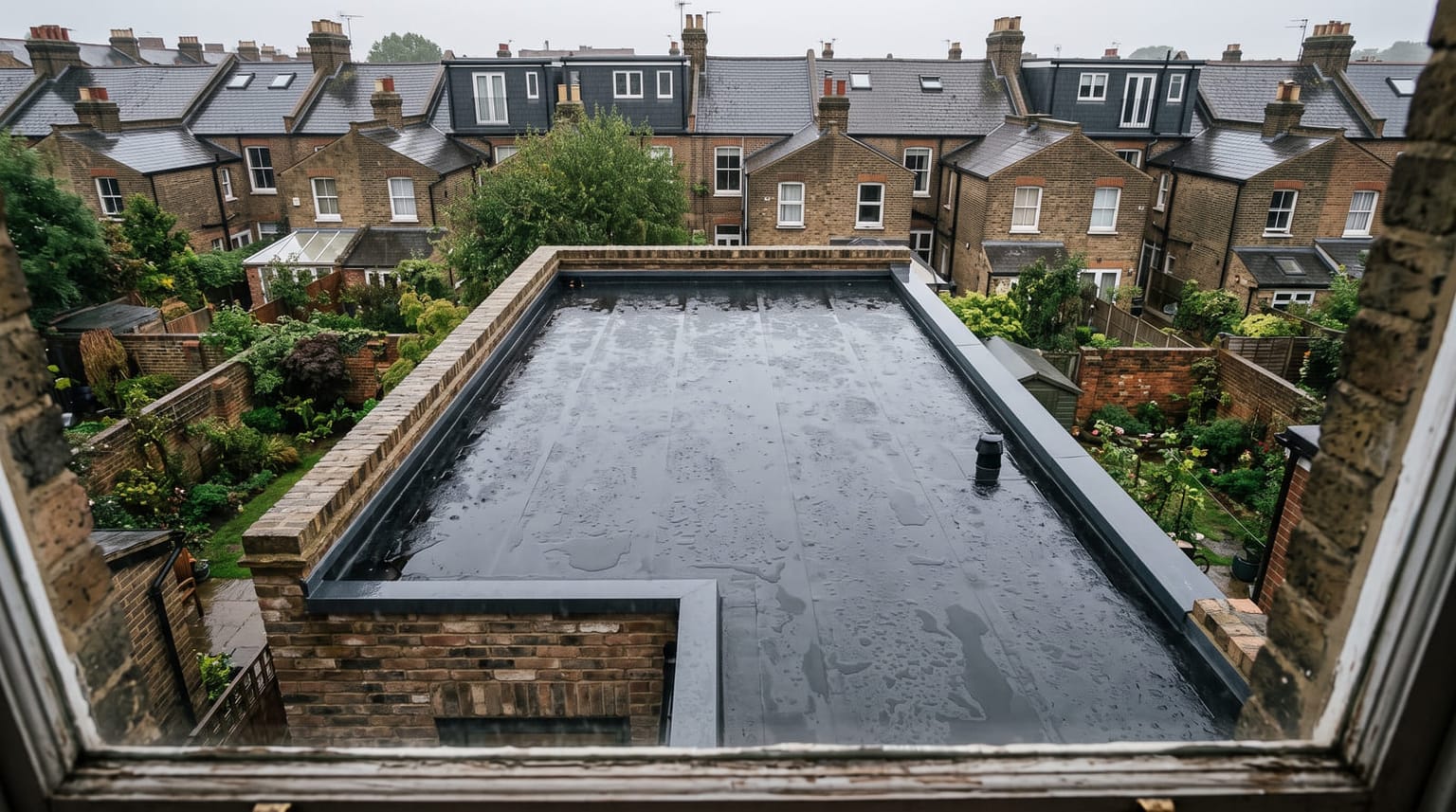
One sheet of rubber, glued down cold, with no joints in the middle of the roof to open up later.
- Free survey and a fixed price in writing
- One sheet where the roof allows it — and we say when it does not
- Not VAT registered, so there is nothing to add to the quote
- 9.45/10 on Checkatrade from 53 reviews
A flat roof does not leak because it is flat. It leaks because whatever was laid on it has aged out — the felt has gone hard and split at a lap, or the boards underneath got wet years ago and nobody looked. EPDM is the way of not having that conversation again for a very long time.
We fit rubber roofs across Camberwell, Peckham, Dulwich, Brixton, Clapham and the rest of South London, mostly on rear extensions, garages and garden rooms, and mostly over felt that has done its twenty years. Most are one or two days. Before we start we will tell you whether your roof takes a single sheet or needs a joint, because that is the one thing that decides how long it lasts.
What EPDM is, and why it goes down in one piece
EPDM is a synthetic rubber, made up into roofing sheet at 1.2 mm or 1.5 mm thick. It comes on a roll, gets cut to your roof on the ground and is bonded to the deck with a water-based adhesive. No blowtorch, no hot bitumen, no naked flame anywhere near your fascia boards or the soffit.
The rolls are wide. Most South London extensions, garages and garden rooms are under six metres across, which means the whole roof is one piece of rubber with nothing joined in the field at all. That matters more than any other fact about the material. A flat roof leaks at its joints, and a roof with no joints in the middle has nothing there to leak.
Manufacturers put the design life at forty years or more, and EPDM has been on British roofs since the 1970s, so the early ones are still being inspected rather than replaced. It does not go brittle in frost or soften in a July heatwave. It stays flexible across the whole range a London roof sees, and it moves with the deck instead of tearing across it.
Why felt fails, and what rubber does differently
Bituminous felt fails by chemistry. Bitumen holds light oils that keep it pliable; sun and time drive those off and what is left oxidises and hardens. Once it is hard it can no longer follow the deck as the deck expands and contracts, so it splits — almost always first at a lap, or where it turns up against a wall.
Blisters are a separate fault with the same cause underneath. Moisture trapped in or below the felt turns to vapour when the sun hits the roof, lifts the layers apart and raises a dome. A blister is not itself a leak. It is a thin, stretched, unsupported patch waiting for a foot, a ladder or a branch.
Rubber has no oils to lose, so none of that happens to the sheet. We will be straight with you about the alternative, though: a proper three-layer torch-on felt roof laid to BS 8217 is a decent roof and will give you fifteen to twenty-five years for less money on the day. Felt's real problem is that it is the system most often laid cheaply — two layers where the specification says three, narrow laps, upstands cut short.
What goes under the membrane
Almost all of the cost and nearly all of the risk in a rubber roof sits beneath the sheet. This is what a full replacement involves, and what your quote should itemise line by line, whoever you buy it from.
- Stripping the old covering
- Off comes the felt, and the deck gets looked at properly for the first time in decades. This is where surprises live, so we photograph what we find and ring you with a price before we go any further.
- Deck repairs or a new deck
- 18 mm OSB3 or ply, screwed down, joints staggered and supported. A deck that gives underfoot has already failed, and nothing will bond to it reliably.
- Insulation and vapour control — the warm deck
- Rigid PIR laid on top of the boards over a vapour control layer, so the cold side of the build-up sits above the timber and nothing condenses inside it. Current Building Regulations expect around 0.18 W/m²K on a renovated flat roof, which in practice means 120–150 mm of PIR.
- Fall and outlets
- BS 6229 asks for a design fall of 1:40 so the finished roof still drains at 1:80 once everything has settled. Where the old roof was laid dead flat we build the fall back with tapered insulation or timber firrings, and we put the outlet where the water actually goes.
- The membrane
- A 1.2 mm or 1.5 mm EPDM sheet, deck-bonded with water-based adhesive, and contact adhesive where it has to hold on a vertical at the upstands and corners.
- Upstands, trims and details
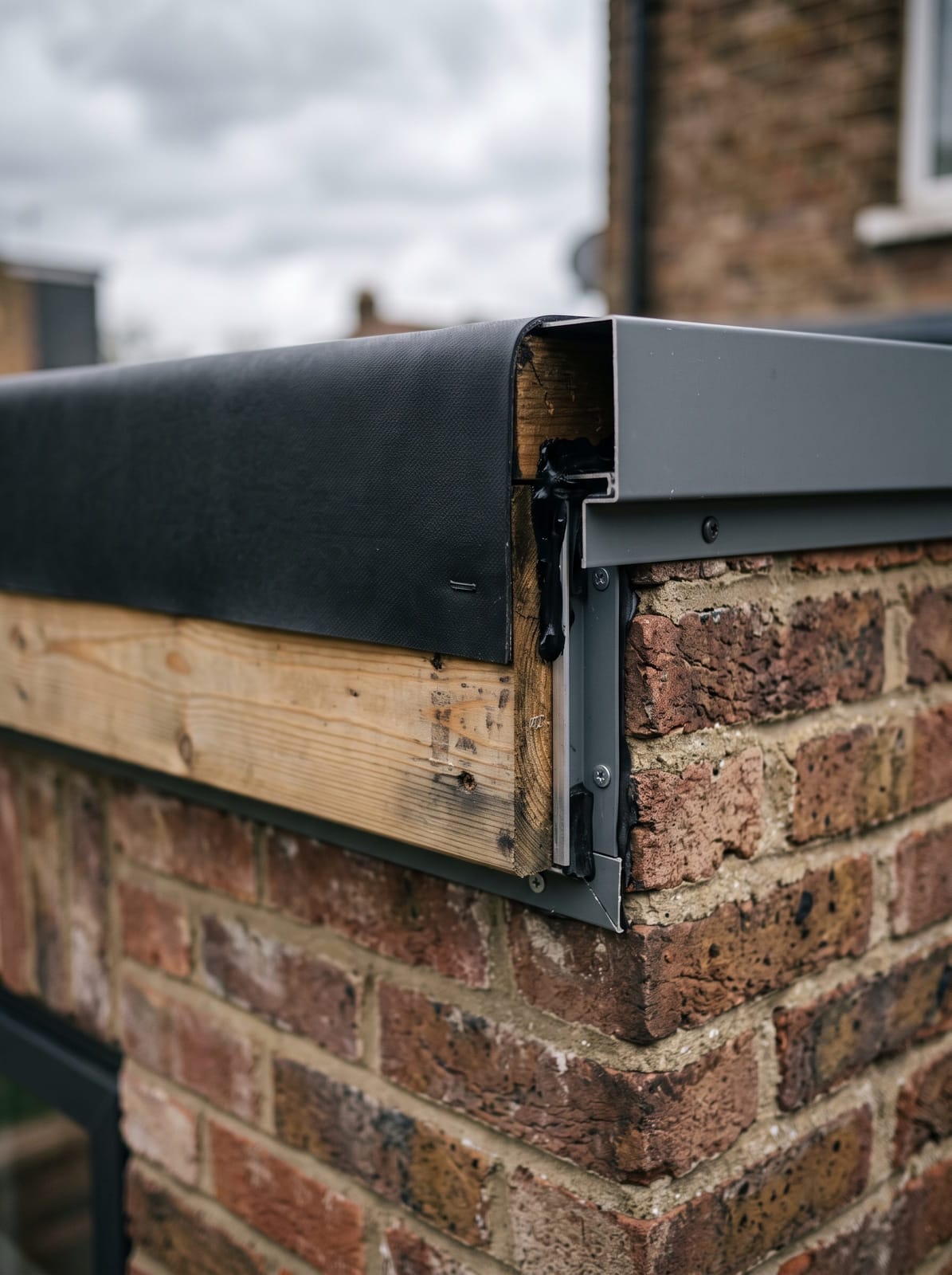
- 150 mm of upstand where the roof meets a wall, pre-formed corner pieces rather than folded ones, a drip trim at the eaves, and a built kerb with the membrane dressed up and over it at any rooflight.
Where rubber roofs actually fail
The sheet itself almost never fails. Everything we get called to on other people's rubber roofs is at an edge, a corner or a hole in it.
- Seams on oversized roofs
- Past about six metres in one direction, a roof needs a joint, made with primer and seam tape. Done properly on a clean dry sheet it holds. Done in a hurry or in the damp it is the first thing to open. If your roof needs a seam we tell you at the quote, not on the day.
- Adhesive on a damp deck
- Water-based adhesive will not bond to a wet board. It looks right when it goes off and lets go a winter later. The deck has to be dry, which is why a wet week moves a start date.
- Upstands that are too short
- Rubber taken 50 mm up a wall and finished with a bead of mastic is not a detail, it is a countdown. Driving rain finds it, and so does a blocked outlet the first time the roof backs up.
- No fall, or an outlet in the wrong place
- EPDM tolerates standing water far better than felt does, but ponding still collects silt, grows algae and hides where the real problem is. If water sits on your roof after a shower, the fall or the outlet is wrong and adding membrane will not cure it.
- Boots, ladders and dropped tools
- It is a rubber sheet, not a paving slab. A dropped scaffold clip will nick it. The repair is a patch and twenty minutes, but only if somebody notices, which is the argument for looking at a flat roof once a year.
When we would not put rubber on your roof
If you intend to use the roof — a terrace, a balcony, anywhere with furniture and planters — rubber on its own is the wrong finish. It will take maintenance foot traffic and nothing beyond it. Either we lay paving pads over a protection layer, or we fit GRP fibreglass, which gives you a hard walkable surface in the first place.
If the roof is a warren of pipes, upstands and awkward junctions, a liquid system follows the shape better than any sheet will. And if the covering you have is sound apart from one split, that is a flat roof repair and not a new roof. We would rather patch it, tell you roughly how long it has left and come back in a few years than sell you a system you do not need yet.
How long it takes, and what the weather decides
A garage roof is usually a day. An extension is two, or three if the deck has to come off and go back. We measure and photograph first, quote with the deck, insulation, trims and outlet priced separately, and give you a start date rather than a window.
The deck must be dry before the adhesive goes down, so a genuinely wet forecast moves the start of the job rather than the finish of it. Once the sheet is bonded and the edges are trimmed the roof is watertight that evening — which is the practical advantage over fibreglass, since GRP has to cure and a shower part-way through the cure spoils it. Rubber goes down in cool weather that fibreglass cannot be laid in at all.
Questions
What people ask
about epdm rubber roofing
01What affects the cost of an EPDM rubber roof?
Whether the deck survives, first. A sound deck is a re-cover; a soft one is a strip and a rebuild, and nobody can tell you which from the ground. A warm deck is the biggest single addition and is normally required when the whole covering is replaced. Upstands, a rooflight kerb and pipes through the roof matter more than area, and access, a skip and a suspended parking bay are real costs on a South London terrace. You get one fixed figure after we have looked, with the deck, insulation, trims and outlet itemised.
02How long does a rubber roof last?
Manufacturers put the design life of EPDM at forty years or more, and sheets laid in Britain in the 1970s are still in service. It has no bitumen oils to lose, so it does not harden and crack the way felt does. Nearly every failure we are called to on a rubber roof is at a corner, an upstand or a seam rather than anywhere in the sheet.
03Is rubber better than felt?
For most extensions, garages and garden rooms, yes, for two reasons: it goes down in one piece with no joints in the middle of the roof to open, and it does not oxidise and split with age. Felt is cheaper on the day, and a proper three-layer torch-on roof will give you fifteen to twenty-five years. Its weakness is how often it is laid short — two layers instead of three, narrow laps, low upstands — and it needs a blowtorch on your roof to lay at all.
04Should I have EPDM or fibreglass?
Fibreglass if you will walk on the roof, or if it is full of corners, pipes and awkward junctions, because GRP is a hard walkable finish that follows shapes a sheet cannot. Rubber if the roof is a plain rectangle, if it is large, or if the weather is against you — GRP needs a dry day above about five degrees to cure and rubber does not. Both comfortably outlast felt.
05Can you lay rubber over my existing flat roof?
Sometimes. If the old felt is firm and dry across the whole roof we can board over it and bond the membrane to the board, which saves the strip and the skip. If the deck is soft anywhere, or there is any sign of trapped moisture, we strip it — laying a forty-year membrane over a wet deck buries the problem rather than fixing it. We can only tell you which after we have been up and had a proper look.
06Do I need Building Regulations approval for a new flat roof?
Usually yes, where the covering is being replaced rather than patched. Replacing more than half a flat roof's surface counts as renovating a thermal element, which triggers an insulation upgrade to around 0.18 W/m²K — in practice a warm deck with 120–150 mm of PIR on top of the boards. A like-for-like re-cover on a bare deck is rarely the quote to accept. We will tell you at the survey whether your roof falls under it.
07Is the work guaranteed?
There are two separate things here and firms often blur them into one number. The membrane carries the manufacturer's own warranty, which depends on the system fitted and on the installer being registered with that manufacturer. The workmanship guarantee is a separate promise about how it was laid. Ask us for both sets of terms when you get the quote, and be wary of anyone quoting a single figure that covers both.
08Can I have a rooflight or use the roof as a terrace?
A rooflight is straightforward: we build a timber kerb, dress the membrane up and over it and fit the unit to that. A terrace needs more. Rubber takes maintenance foot traffic but not furniture and daily use, so it needs paving pads over a protection layer, or GRP instead. Tell us at the survey if a terrace is the plan, because it changes the whole build-up and the price.
09How long does the job take, and what happens if it rains?
A garage roof is usually a day, an extension two, and three if the deck comes off and goes back. The deck has to be dry for the adhesive, so a wet forecast moves the start date rather than the finish. Once the sheet is bonded and the edges trimmed the roof is watertight that evening, and we do not leave a roof open overnight.
10Which areas do you cover for flat roofing?
The yard is in Camberwell, so most of this work sits in the SE postcodes around it — SE5, SE15, SE22, SE24 and SE4. Brixton, Clapham, Streatham, Balham, Tooting, Wandsworth and Battersea are all inside the same ring, and we will travel to Putney, Fulham, Wimbledon, Kingston and New Malden for a full replacement rather than a patch.
Free quote
One sheet, one price.
We will come and look, photograph what we find, and give you a fixed price in writing. No call-out fee, no obligation.