Flat Roofing in South London
Extensions, garages, dormer tops and bay roofs — laid with a fall that actually drains, and a deck we have looked at first.
- Free survey and a fixed, itemised price in writing
- Deck replacement priced per square metre before we lift anything
- Photographs of the deck before the new covering goes down
- 9.45/10 on Checkatrade from 53 reviews
A flat roof is not flat. It is built with a slight fall so that water runs to an outlet, and almost every flat roof problem starts with that fall being too shallow, pointed the wrong way, or never cut in at all. Water sits, the covering ages under it far faster than it should, and in the end it finds the one lap or upstand that was not quite right.
We replace and repair flat roofs across Camberwell, Peckham, Dulwich, Brixton, Clapham and the rest of South London — rear extensions, garages, dormer tops, bay window roofs, garden rooms and small terraces. Four coverings do nearly all of this work and they are not interchangeable. Which one suits your roof depends on its size, its shape, whether anyone walks on it, and what the weather is doing the week we lay it.
What actually goes wrong with a flat roof
Flat roofs rarely fail because the material was poor. They fail at a detail — a lap, an upstand, an outlet, a fall that was never there. These are the six we find most often, and five of them are visible from a ladder if someone bothers to look.
- Ponding
- Water still standing forty-eight hours after rain means the fall is wrong or the outlet is blocked. Standing water will not go through a sound membrane on its own, but it concentrates UV, holds grit, and freezes and expands into any weakness that is already there.
- Blisters in felt
- Bitumen felt traps moisture between its layers. In sun that moisture turns to vapour, pushes the layers apart and lifts a bubble. Tread on a blister once and it splits, and then you have a hole where the roof was thickest.
- Split laps and seams
- Felt and rubber both move as the temperature swings. That movement concentrates at the joins, so a lap rolled badly on a cold morning is the first thing to open. On a big roof the seams are where we look before anywhere else.
- Upstands that stop too low
- Where a flat roof meets a wall the covering should be dressed at least 150 mm up it and capped or tucked into a chase. A good share of the extension leaks we chase are an upstand that stops at about 75 mm behind a smear of mastic.
- A soft deck
- Chipboard and thin ply go spongy once water gets past the covering, and you can usually feel it underfoot before you can see it. Nothing laid over a soft deck lasts, whatever it cost.
- Blocked or undersized outlets
- One leaf-packed outlet turns a whole roof into a pond. Older extensions often have a single 50 mm outlet doing the work that two should be doing, with no overflow if it clogs.
The four coverings, and which one suits your roof
Most South London extension roofs still have old felt on them, and all three modern alternatives outlast it. Price per square metre is only part of the choice. Size, shape, whether anyone stands on it and the time of year all push the answer one way or the other.
- EPDM rubber
- One sheet of synthetic rubber bonded to the deck. Roll widths are wide enough that most domestic roofs go down with no seam in the middle at all. Manufacturers put its design life at forty years or more, it stays flexible in frost, and there is no flame involved.
- GRP fibreglass
- Glass matting and resin laid wet and cured into one continuous shell, with the trims bonded into it. Genuinely seamless, hard enough to walk on, and the best finish for balconies and fiddly shapes. It needs a dry day above about 5°C to cure properly, so we watch the forecast rather than promise a date.
- Torch-on felt
- Two or three layers of reinforced bitumen membrane to BS 8217, torched down and lapped. It is the cheapest to lay and the shortest-lived: fifteen to twenty-five years is a fair expectation, not thirty. Hot works next to a timber fence or a neighbour's shed need care and we plan them properly.
- Liquid systems
- Resin and reinforcing fleece rolled over a sound existing roof. This is the sensible answer to a roof full of pipes, kerbs and awkward corners where sheet material would have to be cut about. It is only ever as good as what is underneath, so we survey and moisture-test before we quote it.
What a replacement includes
Our quotes itemise the same things every time, because these are the things that decide whether the roof lasts. Strip the old covering back to the deck and take it away. Check every board and replace what is wet or soft, usually in 18 mm OSB3 or exterior ply. Build the fall to the outlet — BS 6229 asks for a design fall of 1:40 so the finished roof still drains at 1:80 once the timbers have taken up their deflection.
Then the insulation where it is needed, the covering itself, and the details that do the actual work of keeping water out: edge trims cut square, upstands dressed at least 150 mm against every wall and capped, outlets clear and sized for the area they drain, kerbs made up around rooflights. Skip hire and access are their own lines on the quote, not buried in a rate.
Warm deck, cold deck and building control
A cold deck puts the insulation between the joists, below the boards. It is how most 1970s extensions were built and it is why so many of them have damp, blackened timbers — the deck sits on the cold side and condensation forms in it. A warm deck puts rigid PIR insulation on top of the deck, under the covering, so the boards stay warm and dry. It costs more and it lifts the roof line by 100 to 150 mm at the edge, which sometimes means the fascia or a door head has to be reworked.
Re-covering more than about a quarter of a roof is notifiable to building control. Renew more than half of it and Approved Document L treats the roof as a renovated thermal element: the new build-up has to reach roughly 0.18 W/m²K, which on a flat roof means a warm deck in practice. We will tell you at the survey which of those your job triggers and what has to be submitted before we start.
Repair or replace, and what we cannot see until it is open
The test is not how old the roof is. It is how much of it has failed and whether the deck under it is sound. One split lap, a couple of blisters and a firm deck is a repair, and we will tell you that rather than quote you for a new roof. Failures spread across more than about a third of the surface, or boards that give underfoot, are not a repair — patching that is money you will spend again within two winters.
The honest limit is that nobody can tell you the state of a deck from standing on top of it. So we price the covering and give you a stated rate per square metre for board replacement. If we lift the felt and find wet chipboard, you already know what the extra costs, and we photograph it and ring you before we carry on. It is also why a price given over the phone, by someone who has not been up, is worth very little.
Flat Roofing work we have done
All projects →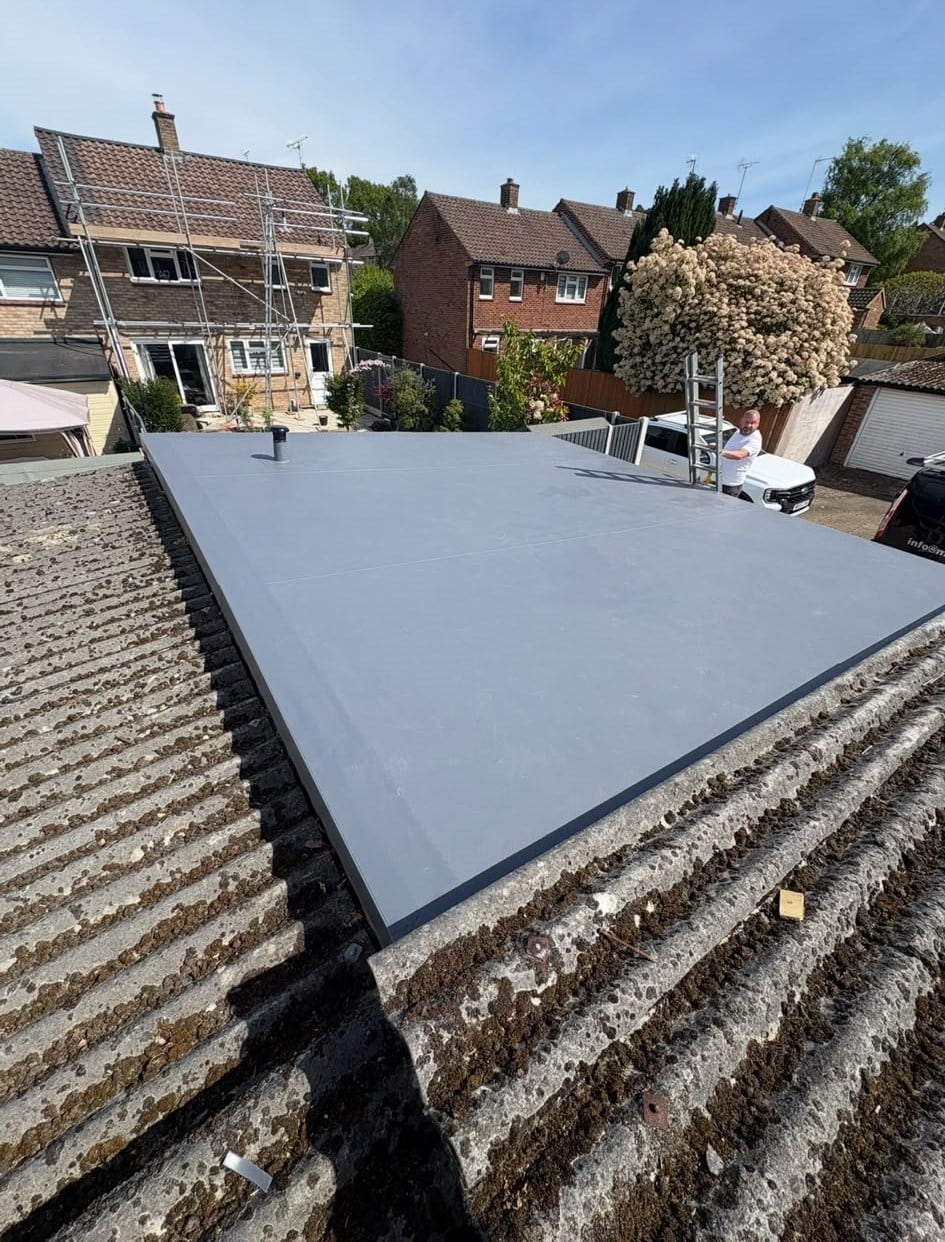
GRP flat roof
Questions
What people ask
about flat roofing
01What affects the cost of a flat roof replacement?
The covering first: felt is the cheapest to lay, rubber sits in the middle and fibreglass at the top. Then the deck, which nobody can price properly from the ground, so we quote a rate per square metre for board replacement before we lift anything. A warm deck adds material and height at the edge. Rooflights, kerbs, pipes and upstands add labour, and a plain rectangle is cheaper per square metre than a small roof with four corners. Scaffold and a skip are separate lines on the quote, and in South London access, parking and waste disposal are real costs.
02Which is best — felt, rubber or fibreglass?
For a large plain roof, EPDM rubber: it goes down in one sheet with no seam in the middle and manufacturers put its design life at forty years or more. For a roof you walk on, or one with awkward corners and a balcony finish, GRP fibreglass: it cures into a single hard shell. Felt is the cheapest and the shortest-lived at fifteen to twenty-five years, and it is still a reasonable choice on a garage you do not intend to keep forever. We will tell you which we would put on your roof and why.
03Can you lay a new roof over the old felt?
Sometimes, with a liquid system or an overlay board, and only if the deck underneath is dry and sound. We check it with a moisture meter and by walking it before we agree to overlay anything. If the boards are soft anywhere, covering them just buys a year and hides the rot while it spreads.
04What is a warm roof, and do I need one?
A warm roof puts rigid insulation on top of the deck, under the covering, so the timber stays warm and dry rather than sitting on the cold side where condensation forms. A cold roof puts it between the joists, which is how most older extensions were built and why their timbers rot. Building regulations generally call for insulation to about 0.18 W/m²K once you renew more than half of a roof, and on a flat roof that means a warm deck. It adds cost and about 100 to 150 mm of height at the edge.
05Why does my flat roof hold water after it rains?
Either the fall was never built into the deck, or it has settled out of it, or the outlet is blocked or sits in the wrong place. Water still standing two days after rain is ponding, and it shortens the life of any covering. Sometimes we can build the fall back with tapered insulation on a warm deck; where the joists themselves have dropped, it needs firring pieces or a new deck.
06How long does the work take?
A garage roof is one to two days. A rear extension is two to four, depending on the deck and whether a warm build-up is going on. GRP needs a dry day above about 5°C to cure, so in winter we plan around the forecast; EPDM can go down in cooler weather, which is often the deciding factor between October and March.
07Do I need building control approval for a new flat roof?
Re-covering more than about a quarter of a roof, or changing to a different type of covering, is notifiable to building control, and the insulation rules bite once more than half of it is renewed. Straightforward like-for-like repairs are not. We will tell you at the survey which category your job falls into rather than leaving you to find out afterwards.
08How long should a flat roof last?
Torch-on felt fifteen to twenty-five years. GRP fibreglass twenty-five to thirty. Manufacturers give EPDM rubber a design life of forty years or more. Liquid systems fifteen to twenty-five, depending on the resin and what they were laid over. In every case the number assumes the fall drains and the outlets are kept clear — a ponding roof will not reach the low end of its range.
09Can you repair my flat roof instead of replacing it?
If the deck is firm and the failure is one seam, a couple of blisters or a lifted upstand, yes, and that is what we will quote for. If water is standing across the roof, or the boards give underfoot, a repair is a false economy and we will say so. A rough rule: once more than about a third of the surface has gone, replacing it costs less over ten years than repairing it twice more.
Free quote
We measure it, then price it.
We will come and look, photograph what we find, and give you a fixed price in writing. No call-out fee, no obligation.