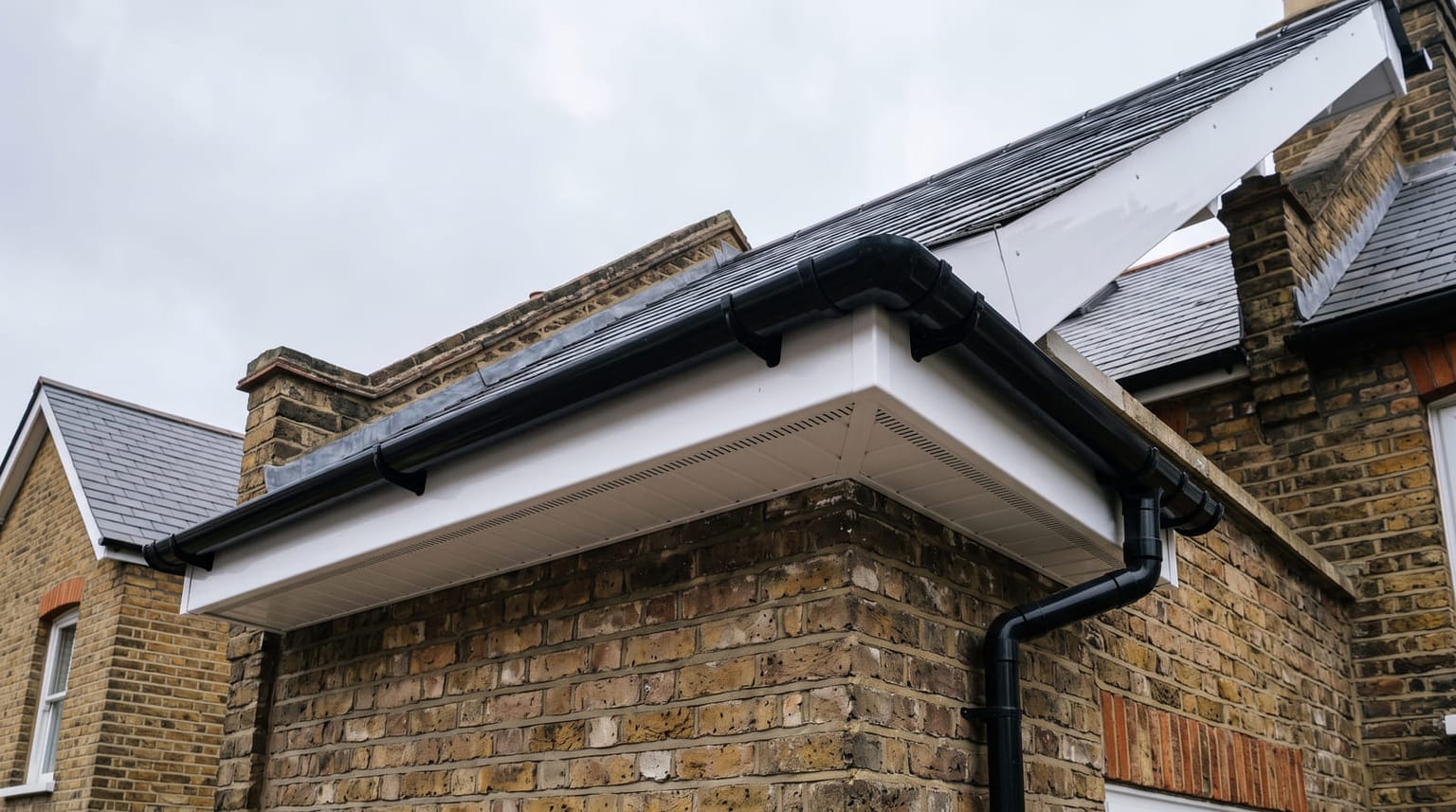
Gutters, Fascias and Soffits in South London
Most overflowing gutters need clearing and re-hanging, not replacing. That costs a fraction of a new gutter.
- Free survey and a fixed, itemised price in writing
- Not VAT registered — no VAT added to the price you are given
- Photographs of the whole run, whether you book or not
- 9.45/10 on Checkatrade from 53 reviews
A gutter is the cheapest part of a roof and does the most damage when it fails. A hundred millimetres of plastic and a row of brackets stand between a whole roof slope of rainwater and the top of your wall. When the run blocks, or the fall goes, that water stops leaving down the pipe and starts leaving down the brickwork.
We clear, repair, re-hang and replace gutters, downpipes, fascias and soffits across Camberwell, Peckham, Dulwich, Brixton, Clapham, Tooting and the rest of South London. Most of what we are called to is a clear and a re-fix rather than a replacement, and we will tell you which yours is before you have spent anything.
What a blocked gutter actually does
Water that overflows a gutter does not fall clear of the house. It runs off the back edge, down the wall, and it does it again every time it rains. On a Victorian solid-wall terrace there is no cavity to stop it, so the brickwork stays wet, the damp works inwards, and you get a dark patch on an upstairs wall that nobody can trace back to the roof.
The second thing it does is quieter. Water standing behind the gutter soaks the top edge of the fascia board, which is the one edge nobody ever paints properly. The timber stays wet, wet rot gets into it, and the rafter feet behind go soft. By the time a gutter is visibly sagging, the thing that was holding it up has usually already gone.
Then there is winter. Saturated London stock brick freezes and the face spalls off in flakes, and brick repairs cost far more than clearing the gutter would have.
Not every gutter is at the eaves, either. Many South London terraces have butterfly roofs — two slopes falling inwards to a valley gutter hidden behind the front parapet. It is lined in lead or felt and usually has one outlet, so when that outlet blocks the whole valley fills and comes through a ceiling. No gutter clean from a ladder will reach it. If that is your roof, start on our roof repairs page.
What we do
This is small, unglamorous work, worth doing before something expensive happens. It divides into six jobs.
- Gutter clearing
- By hand from a ladder or tower, into a bag rather than onto your borders. We flush the run through afterwards and check the downpipe and the gully at the bottom, because a clear gutter above a blocked gully still overflows.
- Re-hanging and resetting the fall
- A gutter has to fall towards its outlet — around 1:350 to 1:600, which is roughly 3 mm over a metre. Plenty are hung dead level or falling the wrong way, so water stands in them and the joints weep. Moving the brackets costs a fraction of a new gutter and fixes the same complaint.
- Joints, unions and brackets
- uPVC moves several millimetres along a long run as it warms and cools. If the gutter was pushed past the insertion mark in the union when it was fitted, that joint splits in the first hard frost. We replace the unions and seals and set the expansion gaps properly.
- New guttering and downpipes
- Half-round, square or ogee in uPVC, or a deep-flow section where a large roof area is overwhelming a standard 112 mm gutter. Brackets at 800 mm to 1 m centres, closer either side of every joint, and downpipes run to the gully rather than to the paving.
- Fascias, soffits and bargeboards
- Rotten timber taken out rather than covered over, rafter feet cut back to sound wood, new boards fitted and the gutter re-hung off them. Eaves ventilation put back at the same time.
- Cast iron
- De-rusted, patched, re-jointed and repainted where the section is still sound, or replaced in cast iron or cast aluminium where it is not. Plastic is not the only answer on a period terrace.
Clear it, re-hang it, or replace it
The honest order is cheapest first. A gutter that overflows in heavy rain and is dry the rest of the time is almost always blocked, and clearing it costs a small fraction of replacing it. A gutter that weeps at the joints in light rain has either lost its seals or lost its fall, and re-hanging it deals with both.
Replacement earns its money when the plastic itself has gone. uPVC turns chalky and brittle after about twenty to twenty-five years of sun, then cracks along the top edge, and no new seal will hold it. The same is true when the profile is obsolete and no current union fits, or when the fascia behind has rotted and there is nothing solid to screw a bracket into. On cast iron, replace when the back of the run has rusted through rather than merely pitted.
Where we cannot tell you the answer from the ground, we say so. Whether the rafter feet are sound is not knowable until a fascia comes off. We photograph what is behind it and ring you before going further, rather than adding it to the invoice at the end.
Fascias, soffits and the argument about capping
The fascia is the board fixed across the ends of the rafters, and it carries every gutter bracket on that elevation. The soffit closes off the underside of the eaves; the bargeboard is the same idea running up a gable. Their job is to keep weather off the ends of your roof timbers, and when they fail the timbers are next.
There are two ways to do them in uPVC. Capping means screwing a thin board over the existing timber and leaving that timber in place. It is quick, it is cheaper, and on sound dry boards it is perfectly reasonable. On wet boards it seals the damp in, and the new gutter brackets end up screwed into rot. Full replacement means stripping the timber out, cutting the rafter feet back to sound wood and fitting new 18 mm board. It costs more, and it is the only version we will quote where the existing boards are soft.
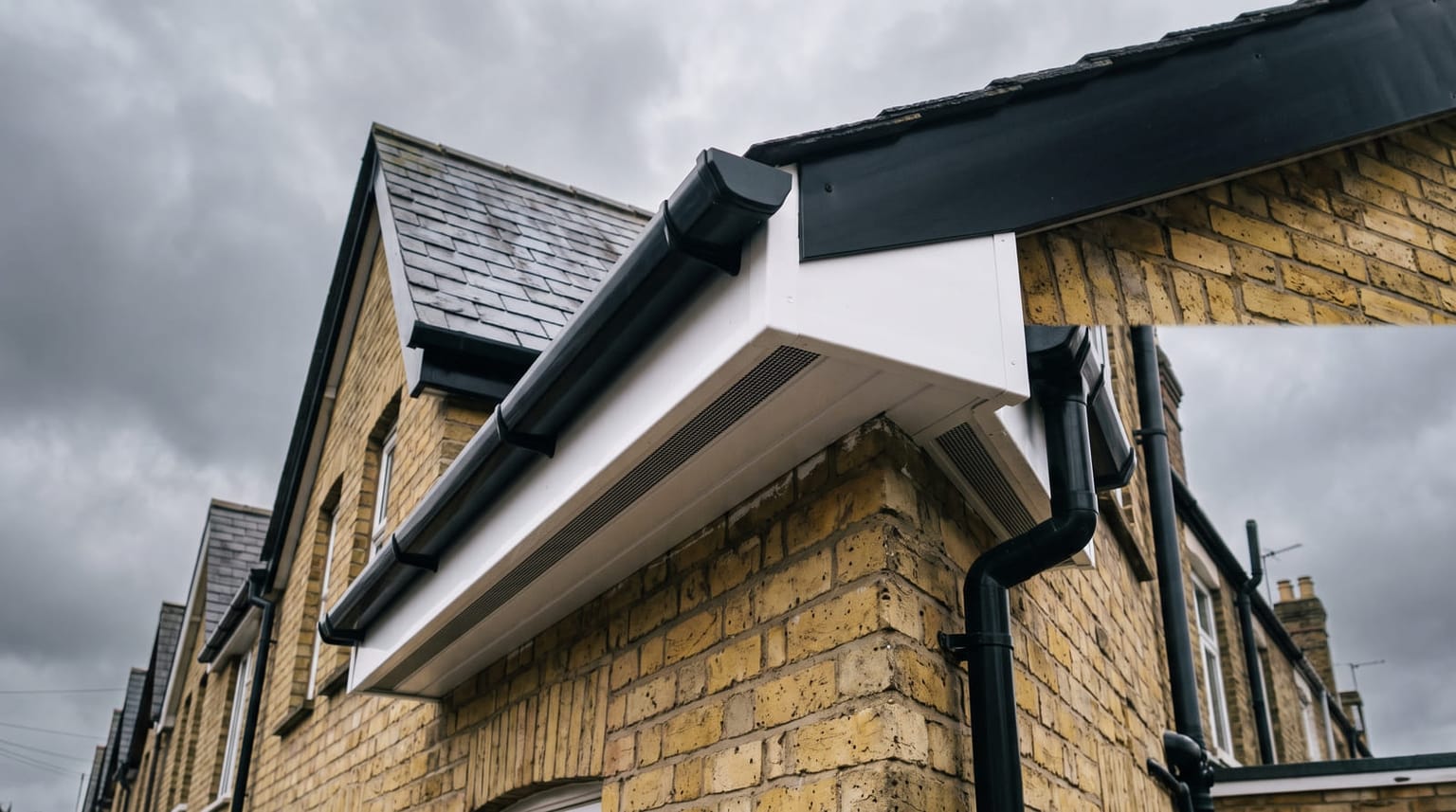
One thing gets missed on nearly every fascia job we are asked to look at afterwards. A cold loft has to breathe at the eaves — the equivalent of a continuous 10 mm opening along both sides on a normal pitched roof, more on a shallow one. Fit solid soffits over the old vents and the loft stops ventilating. The condensation turns up on the underside of the felt that winter, drips onto the insulation, and gets blamed on the roof covering. Vented soffit board or over-fascia vents cost very little and go in while the boards are off.
uPVC, aluminium and cast iron
uPVC does most of this work in South London and there is nothing wrong with it. A 112 mm half-round gutter with a 68 mm round downpipe handles a normal terrace slope. A larger or steeper roof, or a long run on a single outlet, wants a 115 to 117 mm deep-flow section instead — the commonest reason a brand-new gutter still overflows is that it was sized for a smaller roof than the one above it. Twenty to twenty-five years is a fair working life.
Aluminium sits in the middle. Extruded or roll-formed sections in a powder-coated finish, dearer than plastic, with no chalking and nothing to repaint. It suits a house where the ogee profile matters but a full cast iron replacement is out of reach.
Cast iron is what most Victorian and Edwardian houses had first, and it deserves more thought than it gets. It rusts from the inside, where wet leaf litter sits along the bottom of the run, so a gutter that looks finished from the pavement is often only pitted. De-rusted, patched, re-bedded and repainted, it goes another twenty years for a fraction of the cost of replacing it. In a conservation area or on a listed building the original profile may be the only thing you are permitted to put back, and your council is the only body that can confirm it.
How the job runs
Someone comes and looks. We photograph the whole run — the gutter, the back of it, the fascia, the downpipe and the gully — and you keep those photographs whether or not you book. Then a written price, itemised per elevation, with access as its own line rather than buried in a rate per metre.
On the day, anything longer than a metre or two is worked from a tower or a scaffold, because nobody hangs a gutter to an accurate fall from a ladder that gets moved every two metres. Debris is bagged and taken away, not dropped into the garden. If we take a fascia off and find soft rafter feet, we stop, photograph it and call you before doing anything that changes the price.
Clearing and repairs are a morning or a day. Gutters, fascias and soffits right around a semi is two to four days, plus however long access takes to go up and come down.
Questions
What people ask
about gutters, fascias & soffits
01What affects the cost of replacing guttering in London?
Access, more than anything. A rear elevation that needs a scaffold adds to the price on its own, and the scaffold is shown as a separate line on the quote. After that it is length: new uPVC guttering is priced by the metre, supplied and fitted, and one elevation of a typical terrace is around 8 metres.
02Can you just clear my gutters, or do they need replacing?
Clearing first, almost always. If the gutter overflows only in heavy rain and is dry otherwise, it is blocked, and a clear costs a fraction of a replacement. Replacement is the honest answer when the plastic has gone chalky and cracked, when the profile is obsolete and no union fits, or when the fascia behind it has rotted and there is nothing solid to fix a bracket to.
03How often should gutters be cleared?
Once a year for most South London houses, in late autumn once the leaves are down. Twice a year if you have a plane, sycamore or lime overhanging the roof, or if the roof has moss on it, because moss slides into the gutter every time it rains. A gutter that fills within months of being cleared usually has the wrong fall as well as debris in it.
04Do I need scaffolding for gutter or fascia work?
For a gutter clear or a single joint on a two-storey house, no — that is a ladder job. For a whole run, a new fascia, or anything at third-storey height, yes, a tower or a scaffold. It is not only a safety matter: a gutter has to be hung to a consistent fall of a few millimetres per metre, and that cannot be judged accurately from a ladder that gets moved every two metres.
05Can you cap over the old fascia boards instead of taking them off?
Where the timber underneath is sound and dry, yes, and it is cheaper. Where it is soft, capping over seals damp timber behind plastic and screws your new gutter brackets into rot. We will tell you honestly which you have — usually by probing the board at the survey — and we will not quote capping over wet timber.
06My gutters are cast iron. Do I have to change them for plastic?
No, and often you should not. Cast iron rusts from the inside where debris sits, so a run that looks finished is frequently only pitted, and de-rusting, patching and repainting it gives another twenty years or so. In a conservation area or on a listed building the original profile may be the only thing permitted, and your council is the only body that can confirm that.
07Water is running down my wall. Is it definitely the gutter?
Not necessarily, and it is worth ruling out the cheap causes first. A blocked or missing gully at the bottom of the downpipe, a cracked downpipe socket, a failed rendered sill, a leaking overflow pipe and a slipped slate above the eaves all produce the same stain. We check the whole path from roof edge to drain before quoting new guttering.
08Do gutter guards work?
Sometimes. Brush and mesh guards do keep leaves out under a broadleaf tree, which is where they earn their keep. Under conifers, or on a roof shedding moss, the debris is fine enough to sit on top of the guard and mat, and you end up clearing the guard instead of the gutter. They also make a proper clear-out slower. We will fit them if you want them and say when we think they will not help.
09Will new soffits stop my loft breathing?
They will if solid board is fitted over the existing eaves vents, and this is a common problem after a cheap fascia job. A cold pitched roof needs the equivalent of a continuous 10 mm opening along both eaves, more on a shallow pitch. Vented soffit board or over-fascia vents restore it, cost very little, and go in while the boards are off.
10Which areas do you cover?
This is our most local work, because one gutter run is rarely worth a long trip: Camberwell, Peckham, East Dulwich, Dulwich, Herne Hill, Brockley, West Norwood, Brixton, Clapham, Streatham, Balham and Tooting. Wandsworth, Battersea, Putney, Fulham and Wimbledon we cover too, and a whole house of fascias, soffits and guttering is worth the run out to Kingston or New Malden.
Free quote
We walk the run and price it.
We will come and look, photograph what we find, and give you a fixed price in writing. No call-out fee, no obligation.