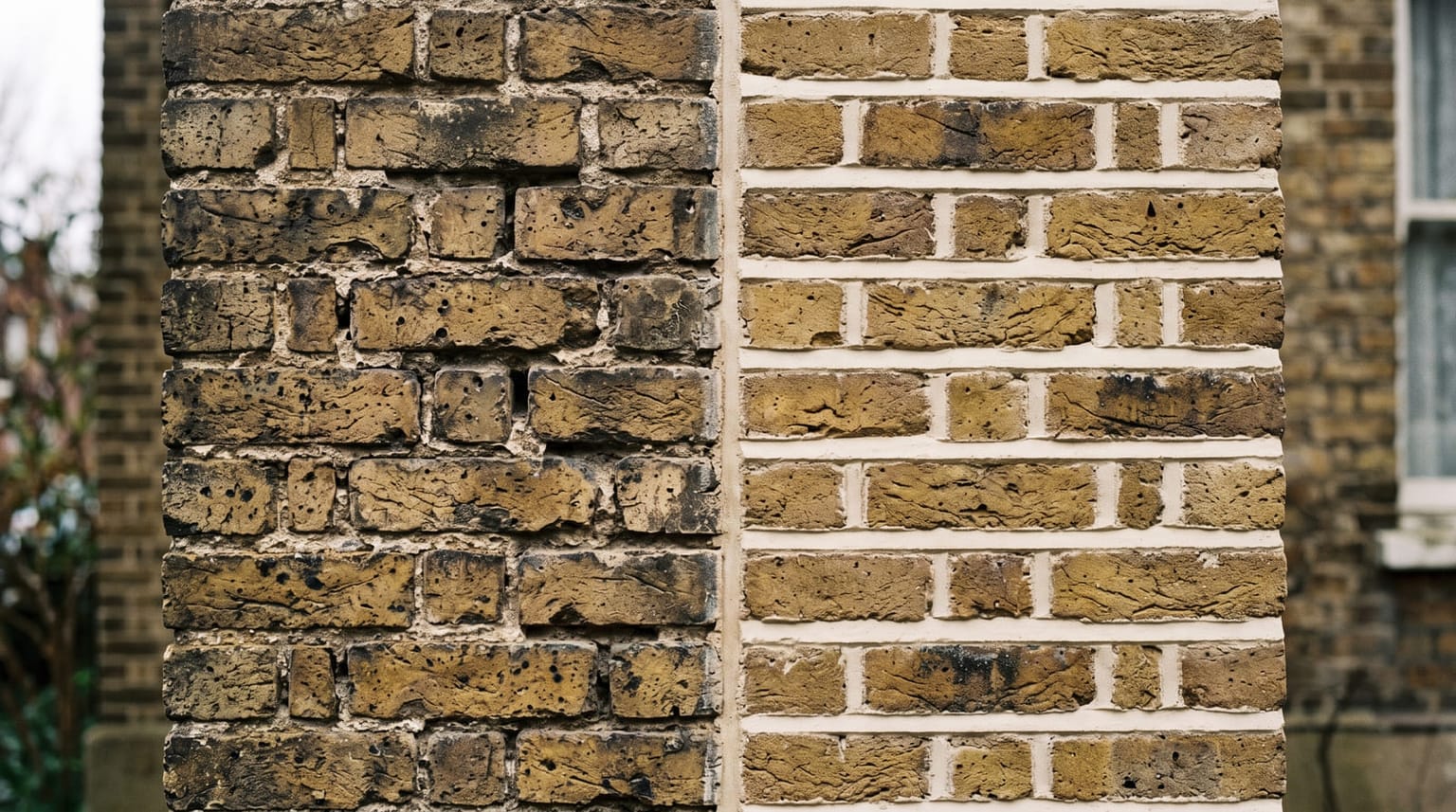
Brickwork Repairs and Repointing in South London
The jobs you keep meaning to get sorted. Most of them are half a day, and nearly all of them get dearer the longer they wait.
- Free quote and a fixed price in writing
- We say when a crack needs an engineer rather than a bricklayer
- Mortar matched to the brick, not the other way round
- 9.45/10 on Checkatrade from 53 reviews
Every house has a list. The crumbling pointing on the side return. The crack over the kitchen window. The garden wall leaning further each winter. None of it is an emergency, so none of it gets done, and all of it lets water into a wall built to stay dry.
We do this work across Camberwell, Peckham, Brixton, Dulwich and the rest of South London. Harrington is a roofing firm, and this is the masonry and making-good that comes up around a roof — it is normal for us to be on a roof in the morning and repointing the stack it sits on the same afternoon.
What counts as a small building repair
These are the jobs too small to interest a builder and too specific for a handyman. If it involves brick, mortar, render or plaster, and it is letting water in or looking wrong, it belongs here.
- Repointing brickwork
- Failed joints raked out and replaced with a mix matched to the brick. Whole elevations, or just the weathered courses.
- Cutting out and replacing damaged bricks
- Spalled or frost-blown bricks cut out one by one and replaced with matched or reclaimed stock, bedded in the same mortar as the wall.
- Cracked and hollow render
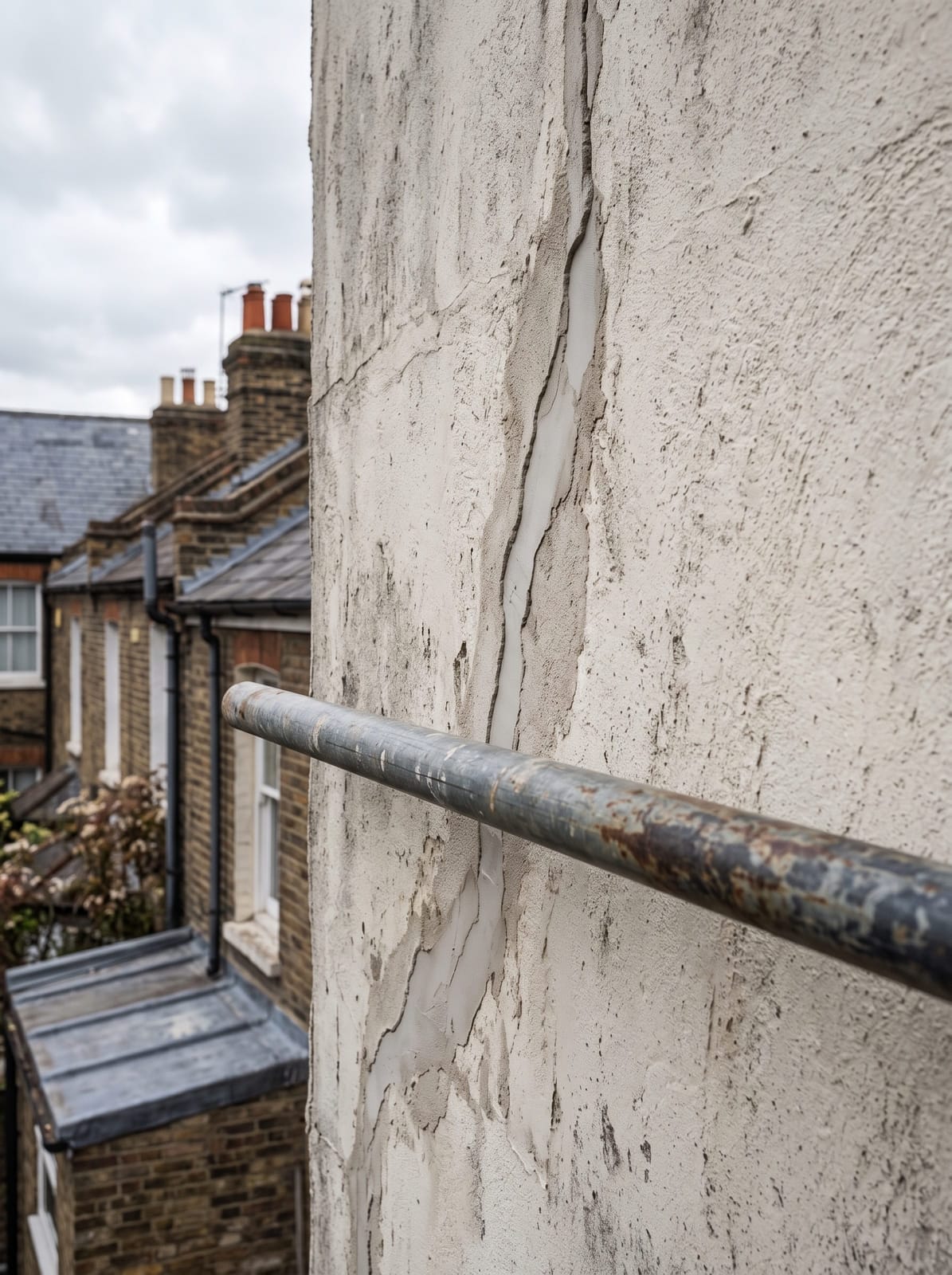
- Cut back to sound render, meshed across the joint and rebuilt in coats. We do not skim over a hollow patch and hope.
- Making good plaster inside
- The cracked ceiling line, the scar behind a removed radiator, the reveal damaged by a leak once it has dried out.
- Lintels and openings
- Propping, cutting out a failed lintel over a window or door, fitting a steel one and rebuilding the brickwork above.
- Garden and boundary walls
- Leaning or collapsed sections rebuilt, copings reset, missing piers replaced, joints repointed.
- Outbuildings and garden structures
- Garages, coal stores, bin stores and lean-tos — walls, roofs, and the junction between the two where the water usually gets in.
- Concrete repairs
- Steps, thresholds, shed bases and the broken lip along a garage door.
Why pointing fails, and why hard cement makes it worse
Mortar is meant to be the weak part of the wall. It takes the movement and the weather so the bricks do not have to. A wall breathes: rain gets into the face and should come back out through the joints, carrying salts with it. That is why old mortar goes crumbly near the top of a wall and under the windows — those parts take the most rain. The joint is doing its job by wearing out.
The damage gets done when someone repoints in a hard sand-and-cement mix. Cement mortar is stronger and far less permeable than a London stock brick. Water still gets in, but it can no longer leave through the joint, so it leaves through the brick face. The first frost turns that trapped water to ice and takes the front off the brick. You end up with crisp new pointing standing proud between a hundred spalled bricks.
So the mix matters more than the neatness. Soft London stocks and anything Victorian usually want a natural hydraulic lime mortar — NHL 2 or NHL 3.5, depending on how exposed the wall is. Harder machine-made brick from the 1930s on is normally fine in a gauged cement, lime and sand mix. Either way the joints get raked back to about two and a half times their width, roughly 20 to 25 mm on a standard joint, with a proper mortar rake and never an angle grinder skidding across soft brick.
Cracks — the ones that matter and the ones that do not
Most cracks in a South London house are not structural. Brickwork moves with heat and damp, plaster shrinks, and a settlement crack that opened forty years ago and stopped is just a line in a wall. The useful test is width and behaviour, not how alarming it looks.
Surveyors classify cracks on the BRE's scale. Hairline up to about 1 mm is category 0 or 1 — decoration. Up to 5 mm is category 2, cosmetic damage, and normally a rake-out and repoint. From 5 to 15 mm you are into category 3, where doors and windows start to stick and the repair means cutting out and replacing brickwork. Above 15 mm it stops being a bricklaying job.
So does anything still moving. Diagonal stepped cracking near a corner, a crack that has visibly opened since you first noticed it, or one running through bricks rather than around them can mean subsidence, a failed lintel, or a tree drawing water out of London clay. Those need a structural engineer, and we will not repoint over one — filling a live crack hides the evidence the engineer needs, and it comes straight back through the new mortar.
Render, plaster and what a damp patch is telling you
Render fails from behind. Tap along it with a knuckle: sound render gives a dull thud, failed render rings hollow. That hollow patch has let go of the brick and is holding water against it, so skimming over the top does nothing. We cut back to a solid edge, key the brickwork, mesh across the joint and build the coats back — which is why a render patch takes half a day, not an hour.
Hard sand-and-cement render on a solid nine-inch wall causes the same trouble as hard pointing, for the same reason. It cracks, water gets in behind it, and the render then stops the wall drying out. If a whole elevation is crazed and drumming, patching is money down the drain — that is a strip and start again, a bigger job than this page, and we will say so rather than sell you eight patches.
Inside, plaster that keeps failing is a symptom. Blown plaster low on a wall with a tide mark and white salty bloom is water arriving from somewhere, and re-skimming buries the problem for about a year. Before we replaster we want to know the source — a blocked gutter, a cracked downpipe, ground built up above the damp-proof course, a failed flashing. Fix that, let the wall dry, then make good. That order is not us being difficult; it is the only order that works.
Garden walls, outbuildings and steps
Garden walls fail at the top and the bottom. At the top, a missing or cracked coping lets rain straight into the middle of the wall, where it freezes and pushes the courses apart. At the bottom, most old boundary walls sit on a shallow footing or none at all, and the clay under South London shrinks and swells with the seasons — worse where there is a tree nearby. That is what makes a wall lean rather than crack.
So a leaning wall is rarely fixed by pointing it. Once it has gone past the vertical it needs taking down to a sound course and rebuilding, which is often cheaper than it sounds because the bricks clean up and go back. We will tell you how far down it has to come before we quote, and we will say when only a few courses need to move.
Outbuildings are their own trade. A brick garage or a Victorian coal store usually leaks at the wall-to-roof junction rather than through either one, and that wants lead or a proper flashing detail rather than a tube of mastic. One warning worth having: a garage or shed roof from before 2000 may be asbestos cement. It is safe intact and dangerous broken up, so if we suspect it we stop and it gets tested before anyone touches it.
How this fits with the roof, and what we will not take on
Half of what we do is roofing, and the two trades overlap constantly. A wet wall on a chimney breast is usually a flashing or flaunching fault, not a pointing fault. A green stain down a rear elevation is a leaking gutter joint. A damp patch under a bay is often the little flat roof above it. If we are already on the roof, the pointing on the stack and the parapet gets looked at on the same visit, because the scaffold is the expensive part and it is already there.
There is work we do not do, and it is worth saying plainly. We do not design structural repairs — anything needing a beam calculation, underpinning or a subsidence claim goes to a structural engineer first, and we work to their drawing or not at all. We do not inject chemical damp-proof courses or sell damp guarantees. We do not remove asbestos. And a full re-render of a house is not a small repair, whatever it is called on the quote.
What we will do is look, tell you which list your job is on, and put a written price on the part we can genuinely fix. If two things on your list are worth doing and two are not, you will hear that.
Questions
What people ask
about building repairs
01What affects the cost of repointing?
Access moves the price more than the size of the wall does. The front elevation of a two-storey terrace normally needs a scaffold, and the scaffold is a cost on top of the pointing itself. Lime mortar on a soft period wall is at the dearer end.
02Does the whole house need repointing, or just some of it?
Usually just some of it. Mortar weathers fastest where the rain hits hardest — the top few courses, under the sills, the exposed gable, the chimney stack. The sheltered side of a house is often sound after a century. A roofer or bricklayer who quotes a whole house without pointing at the specific failed areas is selling you square metres.
03Is the crack in my wall serious?
Width and movement decide it. Hairline up to about 1 mm is decorating. Up to 5 mm is normally a rake-out and repoint. Above about 5 mm, or a stepped diagonal crack that runs through bricks rather than around them, or any crack you can see has widened since you noticed it, needs a structural engineer before anyone points it. Filling a live crack hides the evidence and it comes back.
04Why did my brickwork start crumbling after it was repointed?
Almost certainly it was pointed in a hard sand-and-cement mix on soft brick. Cement is less permeable than a London stock, so water that gets into the wall can no longer escape through the joint and leaves through the brick face instead. One frost and the face pops off. Putting it right means cutting out the cement, replacing the worst bricks and repointing in something softer.
05Why does the damp keep coming back after replastering?
Because the plaster was never the problem. Blown plaster with a tide mark and white salt bloom is water arriving from somewhere — a blocked gutter, a cracked downpipe, ground built up over the damp-proof course, a failed flashing. Skimming over it buries the symptom for about a year. Find the source, fix it, let the wall dry, then make good.
06Can you match my bricks and my mortar colour?
Usually. Yellow London stocks are widely available reclaimed, and most Victorian and Edwardian facings can be matched closely enough that the repair disappears within a season of weathering. Some interwar and 1960s bricks are no longer made and the honest answer is a near match, which we will show you before we bed anything in.
07Do you take on small jobs, or is there a minimum?
Small jobs are exactly what this work is — two metres of pointing, a loose coping, a cracked step. The efficient way to buy them is to group several into one visit, because the travel and the set-up cost the same whether we do one thing or six. Send us the whole list and we will price the lot, then tell you which parts are worth doing now.
08Do I need permission to repair a garden or boundary wall?
Repairing a wall as it stands normally needs nothing. Rebuilding it higher does — one metre is the permitted-development limit where it fronts a road used by vehicles, two metres elsewhere. If the wall sits on the boundary line and is shared, the Party Wall etc. Act 1996 applies and your neighbour needs written notice before work starts. We will flag it; the notice is yours to serve.
09Can you do the roof and the brickwork on the same visit?
Yes, and it usually saves money — it is the same firm and largely the same crew. If a scaffold is going up for a roof, the stack pointing, the parapet and the render around it should be done while it is there. The access is the expensive part.
Free quote
Show us what has come loose.
We will come and look, photograph what we find, and give you a fixed price in writing. No call-out fee, no obligation.