Slate Roofing in South London
Most slate roofs here are failing at the nails, not the slate. Which one it is decides whether you need ten slates or a new roof.
- Free survey and a fixed price in writing
- Photographs of the battens and timbers before anything is cut
- Not VAT registered — no VAT added to your quote
- 9.45/10 on Checkatrade from 53 reviews
South London is a slate city. Almost every terrace built between about 1850 and 1910 went up under Welsh slate, and a good number of those roofs are still on their original covering. The slate has outlasted the men who laid it, the nails, the battens and the mortar.
We repair, re-lay and replace slate roofs across Camberwell, Peckham, Dulwich, Herne Hill, Brixton, Clapham and Brockley. Most of what we are called to is not a worn-out roof. It is a roof whose fixings have reached the end of their life while the slate itself has decades left, and telling those two things apart is worth a good deal of money to you.
The roof you have probably got
On a Victorian terrace each slate hangs on two nails, driven into riven laths or sawn battens over bare rafters or close boarding. There is no felt underneath. Instead the slates were often torched — lime mortar and animal hair pressed up between the battens to stop draught and driven snow. If you put your head into the loft and find grit and crumbs on the joists, that torching is on its way out and the roof is relying on the slate alone.
Most of these houses also have a butterfly roof: two slopes falling inwards to a lead-lined valley gutter that runs front to back behind the parapet. That gutter is the commonest cause of serious water damage in SE5, SE15, SE22 and SW9. When it blocks with moss and leaves, or the lead splits, the water has nowhere to go but into the middle of the house.
Why slate roofs fail long before the slate does
Welsh slate will do a hundred years and frequently a good deal more. The nails will not. Iron and early galvanised nails corrode in the damp along the batten line and let go, usually somewhere between sixty and a hundred years in, and the slate slides out. That is nail sickness, and it is what most old South London slate roofs are actually suffering from.
You can read it off the roof from the pavement. One slate down is an accident. Slates down in a different place after every gale, lead tingles clipped over half a dozen tails, and rusty nail heads collecting in the gutter — that is a roof telling you the fixings have gone across the whole slope.
Slate itself does fail, but differently and much more slowly. Cheaper imported slate with a high carbonate or pyrite content takes up water, oxidises inside and starts to come apart along its cleavage planes. You see rusty freckles, soft crumbling edges and layers lifting like a wet book. Good Welsh slate absorbs almost no water at all, which is why it does not do this.
What we repair on a slate roof
Not every slate problem is a re-roof, and a roofer who opens with one has not been up there and looked.
- Slipped and broken slates
- The slate is usually sound and the nail is not. We lift the courses above with a slate ripper, fix into a clean batten position and re-lay properly, rather than hanging the new slate off a clip.
- Tingles
- A lead or copper strap bent over the tail of a slate. It is a legitimate fix where nothing else will reach, and we use them. A slope carrying twenty of them is not a repaired roof, it is a deferred one.
- Valleys and parapet gutters
- Lead splits where a run is too long between joints and thermal movement works it back and forth. We re-line to the lengths BS 6915 sets rather than smearing mastic into the crack.
- Flashings to stacks and party walls
- A slate roof needs soakers interleaved with the courses behind a step flashing. Cement fillets in place of lead are a common bodge on these houses and they always crack.
- Ridges, hips and verges
- Mortar bedding cracks and lets water into the roof space. We re-bed, or fit a mechanically fixed dry ridge that does not depend on mortar staying sound.
- A failed patch of one slope
- Where one area has gone and the rest of the slope holds, we strip that patch back to new battens and membrane and blend the salvaged slates in around it.
What re-slating actually involves
Once the fixings have gone across a slope, the honest job is to strip it and start again. Scaffold goes up, front and back if both slopes are being done. We strip by hand and sort the slates as they come off — on a Welsh slate roof, half to two-thirds usually survive.
Then the timbers get looked at, and this is the part nobody can price from the ground. Rot hides in the rafter feet, the wall plate and the ends buried in the wall either side of a valley. We photograph whatever we find and ring you with a price before we cut anything out.
The new roof is a breathable membrane, treated 50 × 25 mm battens gauged to the lap, and slates fixed with copper or aluminium nails — never steel, which is what put you here. The lap, meaning how far each slate covers the one two courses below, is set by the pitch and how exposed the roof is; on London terraces it is usually somewhere between 65 and 115 mm, and BS 5534 governs the fixing specification. Ridges, hips and verges are mechanically fixed, because since the 2014 revision of BS 5534 mortar on its own is no longer accepted as the only thing holding them down. New Code 4 and Code 5 lead goes to the valleys, stacks and abutments, and we ventilate at the eaves and ridge so the membrane does not trap moisture in the roof space.
Re-covering more than about a quarter of a roof is a material alteration, so Building Control has to be notified before a slope is stripped.
Which slate goes back on
The right slate is usually the one already on the house — particularly where the terrace has an unbroken roofline, and in the conservation areas that cover much of Dulwich, Herne Hill, Clapham and Brixton.
- Welsh slate
- Quarried in North Wales. Near-zero water absorption, splits thin, rings when you tap it, and priced accordingly. A hundred years is ordinary for it and a hundred and fifty is not unusual.
- Spanish and Brazilian slate
- What most new slate roofs in London are laid in. Quality varies enormously, so the grading matters: ask for the BS EN 12326 classification and look for W1/T1/S1 — the lowest water absorption, the best thermal cycling and the best resistance to sulphur dioxide. Good stock does 50 to 80 years. Poor stock delaminates inside twenty.
- Reclaimed slate
- Sorted, re-holed and re-laid. The right answer for a front elevation that has to match and for most conservation work. It costs more in labour than it saves on material, so nobody should sell it to you as the cheap option.
- Fibre-cement slate
- A pressed man-made slate, flat and uniform, lighter and far cheaper, with a 25 to 40 year life. Sensible on a rear slope, an outbuilding or a garage. Wrong on a Victorian front elevation, because it does not weather like stone.
Repair or re-slate
The test is the state of the fixings and how far the failure has spread, not the age on the deeds. If under about a third of a slope has gone and the nails elsewhere still hold, repair it and leave it alone. If slates are coming off in several places every winter, or the battens crumble when you lift one, you are buying the same repair three more times before you buy the roof anyway.
Doing one slope at a time is a legitimate middle answer and we quote it often. The front in matching slate because it is seen from the street, the rear when the money is there. What we will not do is take money for patching a slope we have told you is finished.
Slate Roofing work we have done
All projects →
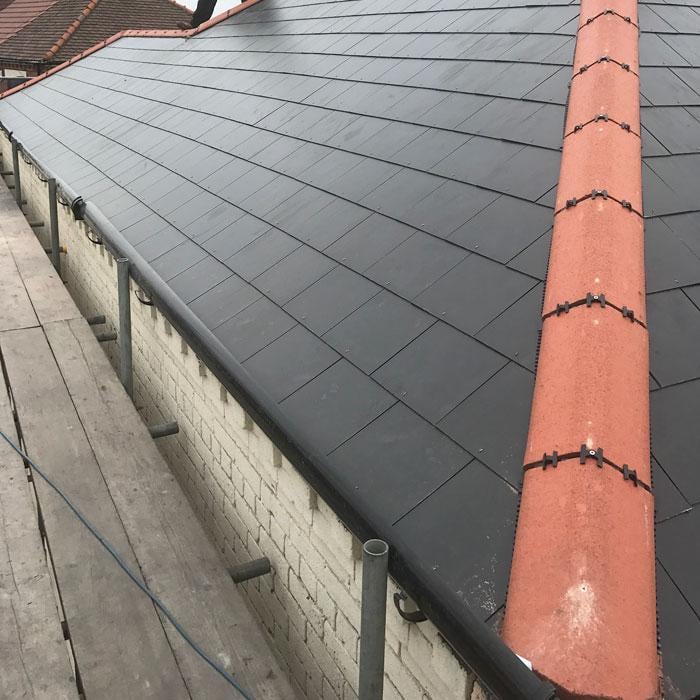
Slate re-roof
Questions
What people ask
about slate roofing
01What affects the cost of a slate roof?
The slate you choose and what we find in the timbers move the price more than anything else. Welsh slate costs more than Spanish, and the state of the timbers is not known until the slates are off. On a full re-slate, the scaffold is part of the bill too.
02How long does a slate roof last?
Welsh slate commonly runs to 100 years and often well beyond. Good Spanish slate does 50 to 80, fibre-cement 25 to 40. The fixings are the shorter life: nails, battens and mortar typically give out somewhere between 60 and 100 years, which is why old roofs get stripped and re-laid with slate that is still perfectly good.
03My slates keep slipping. Do I need a new roof?
Not necessarily, but slates coming down in a different place each winter usually means nail sickness — the nails have corroded across the slope while the slate itself is sound. If it is confined to one area we repair it. If it is happening everywhere, repeating that repair costs more over ten years than stripping and re-laying the slope once.
04Can you match my existing slates?
Nearly always. Most London terraces are laid in 500 × 250 mm or 600 × 300 mm slate, and both sizes are still quarried and widely reclaimed. We match size, thickness and colour. If a new slate is going to sit obviously proud of the old ones, we tell you before it goes on the roof rather than after.
05Can my old slates be re-used?
Often. On a Welsh slate roof, half to two-thirds typically survive a careful strip. We sort them, re-hole them and lay the best on the elevation that is seen from the street, topping up with new slate on the rear. Anything cracked or delaminating goes in the skip rather than back on your roof.
06Welsh or Spanish slate?
Welsh if the house is period, the front elevation is on show, or you are in a conservation area — it is the material the roof was designed around and it lasts longest. Good Spanish slate is a sound choice for a rear slope or a whole roof on a tighter budget, but the grade matters. Ask for the BS EN 12326 classification; W1/T1/S1 is the top of it.
07Do I need permission to re-slate my roof?
Putting the same slate back is normally permitted development. Changing the material is not, and neither is anything on a listed building. Much of Dulwich, Herne Hill, Clapham and Brixton sits in conservation areas or under Article 4 directions where the council can require matching slate, so check with your borough before anything is ordered. Re-covering more than about a quarter of a roof also needs a Building Control notice.
08Can slate be repaired without scaffolding?
A few slates within reach of a roof ladder, usually yes. Anything along a valley, a parapet gutter, a ridge or a full slope needs a scaffold. Slate is brittle and walking about on it breaks more than it fixes, so the scaffold is as much about your roof as about our safety. We tell you which you need at the survey, not afterwards.
09Will my roof be open to the weather while you work?
No. We strip and re-lay in sections and sheet the roof watertight at the end of each day. A terrace re-slate typically runs 7 to 14 days including the scaffold going up and coming down. Heavy rain stops slating for a few hours; it does not leave your house open.
10Do you guarantee slate work?
Ask us for the terms in writing when you get your quote, and keep the paperwork with the deeds — it matters when you sell. The slate carries its own manufacturer's warranty separately, which is a different document and a different promise.
Free quote
We match the slate first.
We will come and look, photograph what we find, and give you a fixed price in writing. No call-out fee, no obligation.