New Roofs and Re-Roofing in South London
A re-roof is the biggest job most houses ever need. Ours starts by telling you honestly if you need one.
- Free survey, with photographs, and a fixed itemised price in writing
- Not VAT registered — no VAT added to your bill
- The roof is sheeted every night it is open
- 9.45/10 on Checkatrade from 53 reviews
Roofs rarely wear out from the top down. On most South London houses the slate or tile is in better shape than the things holding it up — the nails, the battens and the underlay. That is how a roof can look sound from the pavement and still be finished.
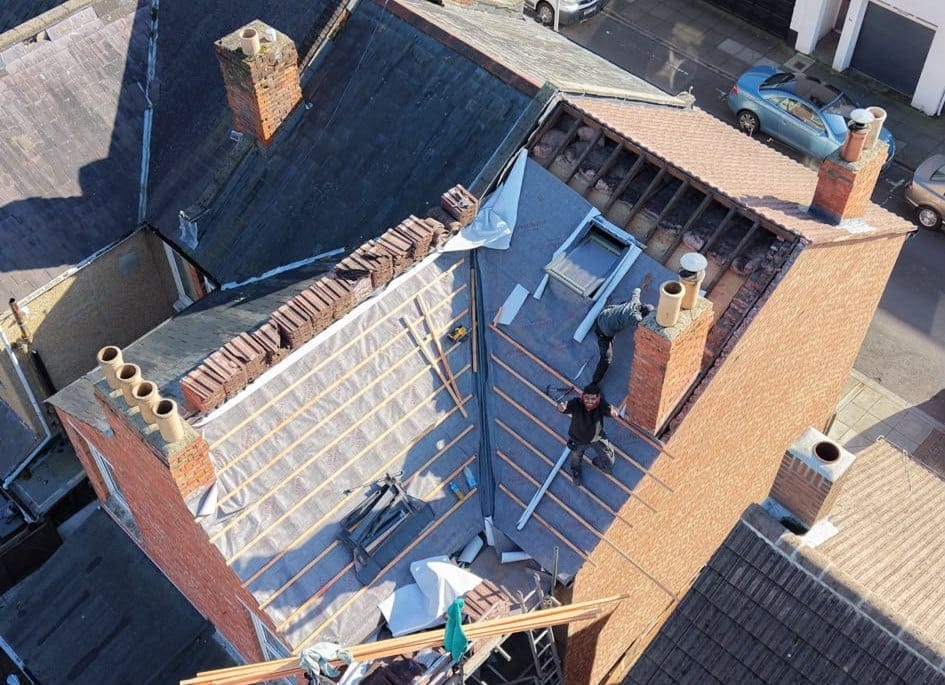
We re-roof houses across Camberwell, Peckham, Dulwich, Brixton, Clapham and the rest of South London: strip to the rafters, put right whatever the timbers need, then new membrane, new battens, new covering, new leadwork, back down to the gutters. A fair number of the roofs we are asked to price do not need any of that, and we say so on the day. Selling somebody a new roof when a slating repair would do is the quickest way to lose a street.
When a roof is genuinely past repair
Age on its own proves nothing. What matters is how many different things have failed and how widely they have failed across the slope. Three failures we see over and over decide it.
Nail sickness comes first. Welsh slate will outlast everyone reading this; the nail through it will not. Once the fixings have corroded, slates start dropping from all over the roof rather than from one corner — slates on the path after every gale, off three different slopes, is the tell. You can re-hook them for years, and people do, but you are buying months at a time.
Then the underlay. Bituminous felt laid from the 1930s onwards was never meant to outlast the covering. It goes brittle, tears along the batten line and sags into pockets that hold water between the rafters. Tiles and slates are not waterproof and never were — they shed water, and the layer beneath catches what gets past. Lose it and there is no second line.
Battens are the third. Softwood splits around old nails and rots wherever the felt above it has gone. A batten that will not hold a nail cannot hold a tile, and you find that out the moment somebody tries a repair.
Our working rule: once failures are spread across more than about a third of a slope, or the battens and underlay have gone, re-covering costs less over ten years than the third and fourth repair. Below that we patch it and tell you in writing roughly how long you have left, so you can plan for the money instead of being surprised by it.
What a re-roof actually includes
This is the list your quote should itemise. If a price arrives as one number with no breakdown, you cannot tell what has been left out — and what usually gets left out is the leadwork, the ventilation or the scaffold.
- Scaffold and protection
- A full scaffold with edge protection and a working lift at the eaves. A re-roof is not a ladder job.
- Strip to the rafters
- Covering, battens and old underlay all come off. Sound slate is sorted and stacked; the rest goes in the skip. Nothing gets left on to save a day.
- Timber repairs
- Rotten rafter ends over an old leaking gutter, a soft wall plate, a sagging purlin. None of it is visible until the roof is open, so it is priced as found and agreed with you before anything is cut.
- Breathable membrane
- Laid with a drape between rafters so water that gets past a slate runs down it to the gutter. This is the layer doing the real work in driving rain.
- Graded treated battens
- To BS 5534 — commonly 25 × 50 mm where rafters are up to 600 mm apart — set out to the gauge the covering needs, not to whatever the old marks were.
- The covering, fixed to standard
- New or salvaged slate, clay or concrete tile. BS 5534 fixes every perimeter tile and a calculated proportion of the field, which is more fixings than most old roofs ever had.
- Dry-fixed ridge and hips
- Mortar alone has not been an acceptable fixing for ridges and hips since the 2014 revision of BS 5534. They are mechanically fixed, usually on a dry ridge system that ventilates at the same time.
- New leadwork
- Code 4 and Code 5 lead to BS 6915 at chimneys, abutments and valleys, in pieces of about 1.5 m so it can expand and contract without splitting along the fold.
- Ventilation
- Continuous airflow at the eaves, and at the ridge where the roof needs it, so moisture from the house leaves the loft instead of condensing on the back of the membrane.
- Gutters, fascias and verges
- The cheapest time you will ever renew them is while the scaffold is standing. We price them separately.
Slate, clay or concrete
The covering sets the price, the weight and how long the roof lasts. It also sets whether the house still looks like itself, which matters on a terrace where every roof is part of one run.
Weight decides whether a swap is even possible. Natural slate runs about 30 kg per square metre, concrete interlocking tiles about 45 and clay plain tiles around 70. Putting concrete on rafters that carried slate for a century is how roofs come to sag, so where a change of covering is on the table we check rafter size, span and spacing first and say plainly if it needs strengthening. Going the other way, heavy to light, is rarely a problem.
- Welsh natural slate
- A hundred years and more. Fine-grained, splits thin, keeps its edge. It is what most Victorian and Edwardian South London houses were built with, and what a conservation area is most likely to insist on.
- Spanish natural slate
- Fifty to eighty years, and most new slate work in Britain uses it. Quality varies by quarry far more than by country, so ask which grade — a T1 slate to BS EN 12326 is a different product from the cheap end.
- Clay plain tiles
- Sixty to a hundred years. Small format, double-lapped, and they weather rather than fade. The right answer on Edwardian and inter-war houses that were built with them.
- Concrete interlocking tiles
- Forty to sixty years. Large format, so quickest and cheapest to lay, but the heaviest common covering and the surface colour goes chalky after twenty years or so.
- Fibre-cement slate
- Twenty-five to forty years. Flat, uniform, and much cheaper than stone. Sensible on a rear slope, an outbuilding or a garage; wrong on a Victorian front elevation.
What happens on site
We survey before we quote: outside, and in the loft where there is one, with a torch on the rafter ends and the wall plates. You get the photographs whether or not you use us, and the quote lists every item above with a price against it.
On site we strip one slope at a time so the house is never fully open, and everything gets sheeted before we go each evening. You will have a skip and a scaffold outside for the duration, and you can live in the house throughout — it is noisy for the strip and the batten-out, and quieter after that.
If we open a slope and find worse timber than the survey suggested, we stop, photograph it and ring you with a price before anything is cut. The quote carries a stated allowance for battens and small repairs, so ordinary finds do not become a phone call; anything past it is yours to approve. At the end the gutters are tested with a hose and the ground is swept with a magnet for nails.
Permissions, scaffold and paperwork
Re-covering more than a quarter of a roof is notifiable work in England, so a full re-roof always is. We are not on the Competent Roofer scheme, so the notice goes to your council's building control rather than being self-certified. That means an inspection while the roof is open and a completion certificate at the end — the document a buyer's solicitor asks for when you come to sell.
Insulation comes with it. Where more than half of a roof is renovated, Part L treats it as a renovated thermal element and the insulation has to be brought up to the current standard, 0.16 W/m²K for a pitched roof. In an empty loft that usually means topping up to around 300 mm of mineral wool, which is cheap while the access is already there. If your loft is a room, it is a bigger conversation and we would rather have it before you commit than after.
Like-for-like re-covering is normally permitted development. Changing the material on a front slope in a conservation area often is not, and Southwark, Lambeth, Lewisham and Wandsworth all have conservation areas and Article 4 directions covering ordinary terraced streets. We check the borough map before quoting, not after the scaffold is up. Scaffold on the footway needs a council licence and a street skip needs a permit; both take days to arrange and both are in the quote.
One more thing can stop a re-roof, and it is not the council. Bats roost under slates, in the gap behind a bargeboard and in open lofts, and every British bat species and every roost is protected whether or not a bat is in it at the time — disturbing one is a criminal offence regardless of intent. If we find droppings or a roost while the roof is open, work on that part stops and the route is the Bat Conservation Trust helpline and Natural England, who will say what can go ahead and when. It is much cheaper to find out in April than in the middle of a strip, so tell us at the survey if you have ever seen bats around the house at dusk.
New Roofs & Re-Roofing work we have done
All projects →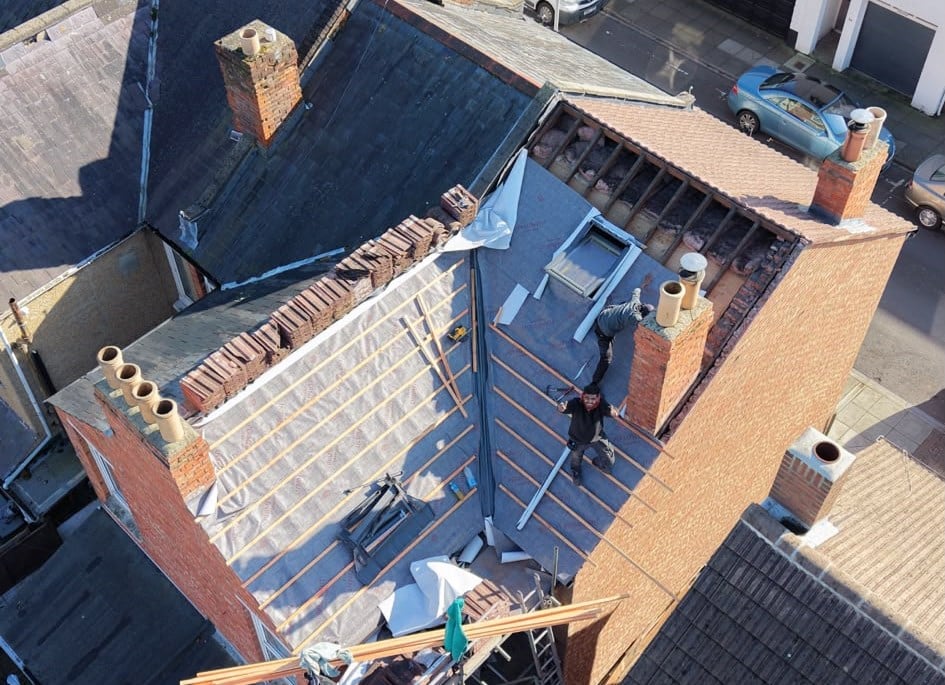
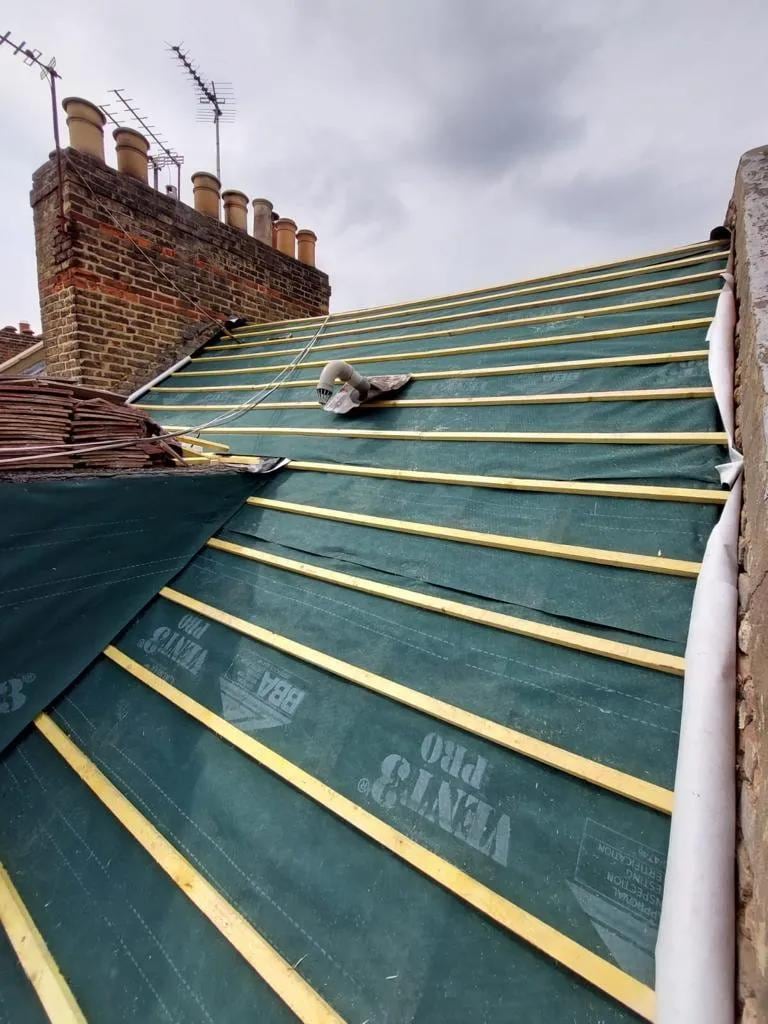
Re-roof, in progress
Questions
What people ask
about new roofs & re-roofing
01What affects the cost of a new roof in South London?
Three things move the price most: the covering you choose, the scaffold the house needs, and what the timbers look like once the roof is open. Nothing is added for VAT, because the firm is not registered for it.
02How do I know if I need a re-roof rather than a repair?
Spread rather than age. One slipped slate on a roof that is otherwise tight is a repair, whatever year the house was built. Slates coming off several different slopes, battens that will not hold a nail, and underlay that tears when you touch it in the loft mean the roof has reached the end. As a rule, once more than about a third of a slope has failed, replacing it beats repairing it again.
03Do you have to strip the whole roof?
For a re-roof, yes. The battens and underlay under the covering are usually the actual problem, and you cannot renew them without taking the covering off. If only one slope has gone we can re-roof that slope on its own and tie it into the rest, which is common on the rear addition of a terrace.
04Can you re-use my existing slates?
Often a good proportion of them. Welsh slate routinely outlives the nails and battens holding it, so we sort what comes off, re-hole the sound ones and re-lay them — usually on the front elevation where the roof is seen, with new slate on the rear. Spanish slate and old concrete tiles survive a strip far less well. We will not know the exact split until the roof is off, so the quote says what happens either way.
05Do I need Building Control approval?
Yes for a full re-roof. Re-covering more than a quarter of a roof is notifiable work in England, and a change of material or a heavier covering brings structure into it as well. We are not on the Competent Roofer scheme, so the work is notified to your council's building control and inspected by them, and you get a completion certificate at the end. Keep it — it is the paper your buyer's solicitor will want.
06Will I have to upgrade the loft insulation?
If more than half the roof is being renovated, Part L of the Building Regulations treats the roof as a renovated thermal element and asks for the insulation to be brought up to 0.16 W/m²K. In an open loft that is normally topping up to about 300 mm of mineral wool and costs very little alongside a re-roof. If the loft has been converted into a room, the insulation sits at rafter level and the work is more involved, so we price it separately and explain the options before you decide.
07I live in a conservation area. Does that change what I can have?
It can. Replacing like for like is usually permitted development anywhere. Changing the covering on a slope that faces the street — slate to concrete tile, most often — may need consent in a conservation area, and Article 4 directions in parts of Southwark, Lambeth, Lewisham and Wandsworth remove permitted development rights from ordinary terraced streets. Roof windows are the other common question: a flush one within 150 mm of the slope is normally permitted development on any slope, and it is an Article 4 direction or a listing that changes that. We check your address against the borough's map before quoting.
08How long does it take, and can I stay in the house?
Five to eight days for a terrace, one to two weeks for a semi, two to three weeks for a detached house, plus days lost to weather. You can live in the house the whole time. We strip one slope at a time and sheet everything before we leave each evening, so the house is never left open overnight. Scaffold goes up a day or two before and comes down within a few days of finishing.
09What happens if you find rotten timbers once the roof is open?
We stop, photograph it, and phone you with a price before we cut anything. The quote includes a stated allowance for battens and small timber repairs so that the ordinary finds are already covered. Anything beyond that allowance is yours to approve or refuse, in writing, and the roof stays sheeted while you decide. Nobody should be handed a bigger bill at the end of a job they did not agree to during it.
10Is a new roof guaranteed?
Ask us for the guarantee terms when you get your quote — the length and the scope, in writing, in front of you before you commit. A guarantee you have not read is not worth much. It is separate from the manufacturer's warranty on the slate or tile itself, which is its own document and yours to keep.
Free quote
Book the survey. It is free.
We will come and look, photograph what we find, and give you a fixed price in writing. No call-out fee, no obligation.