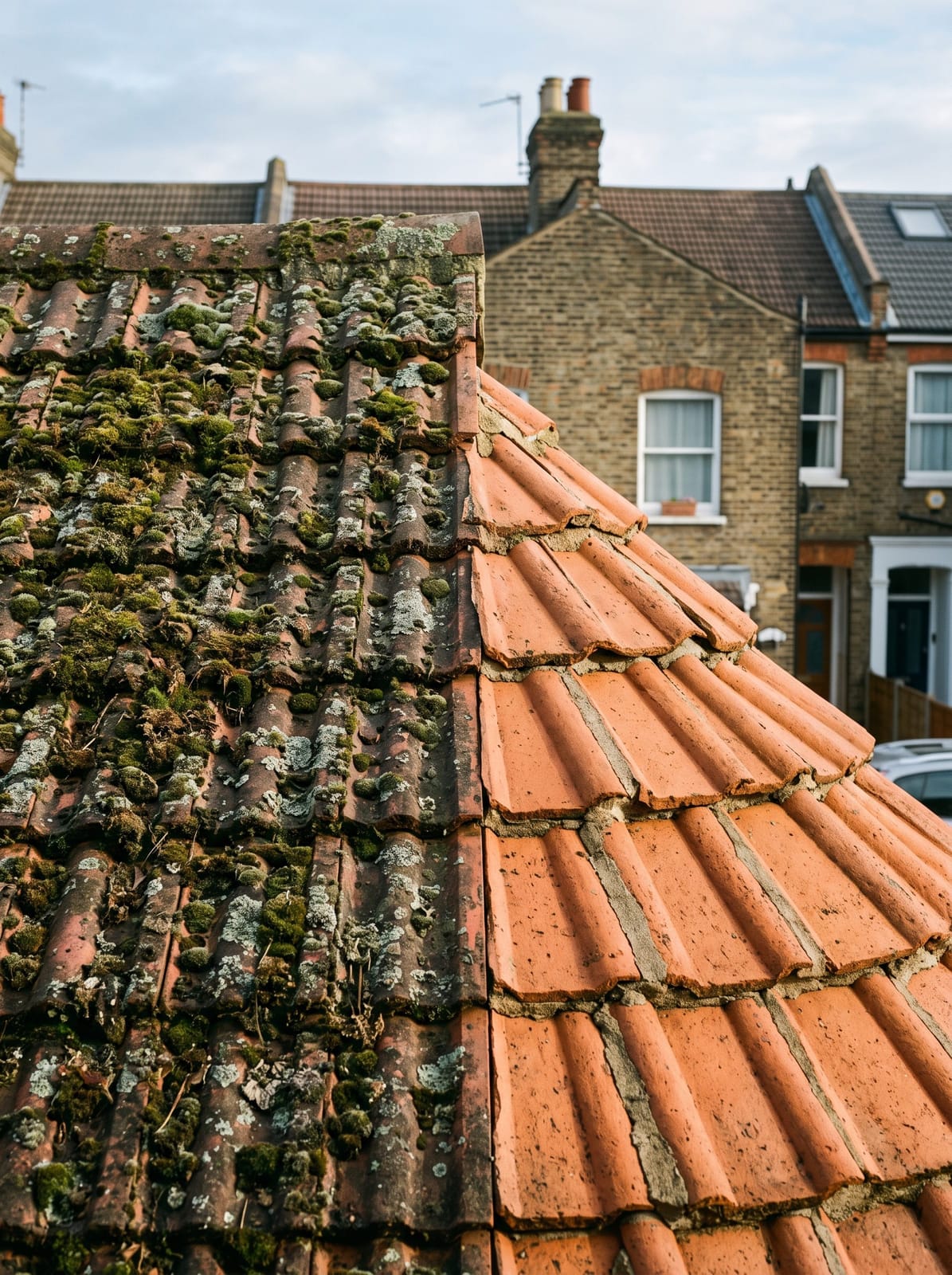
Roof Moss Removal and Roof Cleaning in South London
We take moss off by hand, never with a jet wash. On some roofs that matters a great deal; on others it is only a colour, and we will tell you which yours is.
- Free survey and a fixed price in writing
- Not VAT registered — no VAT added to the price you are given
- Before and after photographs of the parts you cannot see from the ground
- 9.45/10 on Checkatrade from 53 reviews
Moss does not spread evenly. It takes the north slope, the side shaded by next door's sycamore, and the bottom two or three courses where the tiles stay damp longest. By the time it is obvious from the pavement there is usually a mat forty or fifty millimetres thick sitting in the tile laps, and it has been holding water against those tiles through every frost for years.
We clean roofs across Camberwell, Peckham, Dulwich, Herne Hill, Brixton, Streatham and the rest of South London, worked by hand from a roof ladder rather than from the ground with a lance. Some of the roofs we are called to genuinely need it. Some do not, and on those we would rather say so than take the money.
What moss actually does up there
The moss itself is not the problem. What it does with water is. A saturated mat behaves like a sponge held permanently against the head of the tile and up inside the lap, so that part of the roof never dries out. Water sitting in a porous tile expands by about nine per cent when it freezes, and the face of the tile comes off a flake at a time.
The bigger damage happens lower down. Clumps break off in wind and heavy rain, wash down the slope and pack the gutters, the hopper heads and the valleys. That is where most moss-related water damage comes from — not through the tiles, but over the back of a full gutter and down the wall, or backed up in a valley until it passes the lead. On a Victorian butterfly roof, with its central valley gutter hidden behind the front parapet, a packed valley puts water straight into the roof space.
- Concrete interlocking tiles
- The worst affected. The fine cement-rich face weathers open, the moss grips into it, and a porous tile plus trapped water plus frost is how a 1960s roof loses its surface. Worth clearing every few years.
- Clay plain tiles and pantiles
- Denser and smoother, so moss sits on top rather than gripping in. It still fills the gutters and valleys and is still worth clearing, but the tiles themselves are rarely harmed by it.
- Natural slate
- Slate does not absorb water. A green tinge, or a crust of grey and orange lichen on a Welsh slate roof, is a colour rather than a fault. Cleaning it is a cosmetic choice, and scraping hard at lichen does more harm than the lichen ever will.
- Low-pitched roofs
- A shallow slope gives water time. On anything under about 25 degrees a mat of moss can pond it against the head lap for long enough to work past, and where the underlay under that lap is perished bitumen felt, what gets past has nothing left to stop it.
- Gutters, valleys and hoppers
- Where the moss ends up, and where the actual water damage starts. Clearing them is half the value of the job.
- The weight
- Usually overstated. A wet moss mat does add load, but on a sound roof it is not what makes timbers sag. Anyone opening with structural collapse is selling something.
Why we do not jet wash a roof
A pressure washer takes the moss off in minutes. It takes the surface of the tile with it. Concrete tiles are made with a fine cement-rich face that carries the colour; a lance strips that back to the aggregate and leaves a rougher, more porous tile than the one you started with. The moss then returns faster and thicker, because it has been given a better surface to grip.
The second problem is where the water goes. A roof sheds downwards and relies on the head lap between courses to stop water travelling back up. A jet aimed uphill defeats that lap and puts water onto the underlay. On an older roof with perished felt underneath, that is how a clean becomes a ceiling stain a fortnight later. On slate it breaks the fragile edges and works the fixings loose.
Several tile manufacturers exclude pressure-washing damage from their warranty, which tells you what the trade thinks of it. Jet washing has its place on a patio, a path or a driveway. A roof is not one of them. We scrape by hand and brush down instead, which takes longer and leaves the roof in the condition it was in before the moss arrived rather than worse.
What the job involves
The order matters. There is no point treating a roof before the mat is off it, or clearing the gutters before the debris has come down. The work runs the same way every time.
- Look first, from a ladder
- The pitch, the tile type, the state of the laps, and whether anything under the moss is already broken. If the roof does not need cleaning, that is the point at which we say so.
- Hand scraping and soft brushing
- Worked off a roof ladder, which spreads the load over the ridge. Nobody walks directly on clay plain tiles or slate — they crack under a boot.
- Gutters, valleys, hoppers and outlets cleared
- After the roof, not before, then flushed and watched to make sure they run. This is where the moss has been going for years.
- Lifted and slipped tiles refixed
- A thick mat lifts tiles at the tail. What we lift goes back mechanically fixed rather than rested in place — the standard BS 5534 sets for new and re-covered roofs is the sensible one to work to here as well.
- Anything broken photographed and priced on its own
- Cracked tiles, a split valley lining, a gutter that has rotted the fascia behind it. We show you and quote it separately rather than folding it into the clean.
- Treatment applied
- Once the roof is clear and dry enough to take it. Applied to the roof, not sprayed around the garden.
- Debris bagged and taken away
- Moss out of a gutter is heavy, wet and acidic, and a heap of it left on a lawn will kill the grass under it.
- Photographs before and after
- The only way you will see the parts of the job you cannot get to yourself.
The treatment, and what it does not do
Once the mat is off, the roof still carries what is left in the surface: spores, root and a film of algae that no brush reaches. A biocide deals with that. Most roof biocides sold in the UK are built on a quaternary ammonium compound, applied dilute and left to work. Ask which product we are using and for its safety data sheet before anything goes on; it belongs in the quote.
It is not instant. The treatment kills what is left over days and weeks, and the dead residue weathers off with the rain over the following months. A roof still looking patchy a fortnight after a clean is behaving normally. It is also not a coating and not waterproofing. It changes nothing about how the roof sheds water.
Expect three to five years on a shaded slope before it needs looking at again, and longer on an open, sunny roof. Two things extend that more than any product: cutting back whatever overhangs the roof, and keeping the gutters clear so the bottom courses can dry between showers. A strip of copper or zinc along the ridge helps as well — rain carries trace metal down the slope and suppresses regrowth — though it works on the top third of a slope and does little by the time it reaches the eaves.
When a clean is worth it, and when it is not
Worth doing: a concrete or clay tile roof with a real mat on it, gutters that fill every autumn, a valley you cannot see the bottom of. Every three to five years on a shaded South London rear slope is a sensible rhythm, and it is cheap set against the gutter, fascia and damp work that follows if it is left.
Not worth doing: a slate roof with a green tinge, unless you simply want it gone for the look of it. Nor a roof you already know is being replaced within a couple of years — hold the money for the re-roof. And if the reason you are asking is water coming in, a clean is not the answer. That is a repair, and the leak wants finding first.
We do not sell a roof coating after a clean, and we would advise against buying one. A sprayed acrylic seals a tile that needs to dry out, bridges the laps so a single tile can no longer be lifted for a repair, and does nothing about the nails and the underlay, which are what actually end a tiled roof. Surveyors tend to treat a coated roof as something with a problem hidden under it, which can cost you at a sale. If there is money left after a clean, the gutters or a tired flashing is the better place for it.
Questions
What people ask
about moss removal
01What affects the cost of roof moss removal in London?
Access moves it most: a rear slope that needs a tower rather than a ladder adds to the price. After that it is the size of the roof, from a terrace to a semi to a large detached house. The price covers hand scraping, the gutters and valleys cleared, and the treatment.
02Is moss actually damaging my roof, or is it just untidy?
It depends what the roof is made of. On concrete tiles it does real harm over time, because it holds water against a face that is already going porous and frost then takes that face off a flake at a time. On clay it is much less serious. On natural slate it is close to cosmetic, since slate does not absorb water. What moss does on every roof is fill the gutters and valleys, and that is where water damage starts.
03Can moss cause a leak?
Usually indirectly. It washes off the slope and packs the gutters, hoppers and valleys, and water then runs over the back of a full gutter and down the wall, or backs up in a valley until it passes the lead. On a low-pitched roof it can also dam water above the tile lap long enough for it to creep past onto the underlay. If water is coming in now, that is a repair rather than a clean, and the cause is worth finding first.
04Do you pressure wash roofs?
No. A jet wash strips the cement-rich face off concrete tiles and leaves them rougher and more porous than before, so the moss returns quicker. It also drives water up under the head lap and onto the underlay, which on an older roof with perished felt is how a clean turns into a ceiling stain. Several tile makers exclude pressure-washing damage from their warranty. We scrape and brush by hand instead.
05Will the moss come back?
On a shaded slope, yes, eventually. The treatment usually buys three to five years, and an open sunny roof goes longer. Cutting back whatever overhangs the roof does more for it than any product, and keeping the gutters clear lets the bottom courses dry out between showers.
06Is the treatment safe around pets, plants and a pond?
Roof biocides are applied dilute and to the roof only. The sensible precautions are to keep pets and children off the paths underneath until it has dried, and to divert or cover any water butt or pond that the downpipes feed. Every product carries its own safety data sheet with the exact figures on it. Ask which one we are using and you can read the sheet before anything is applied.
07Do you clear the gutters as part of it?
Yes. Clearing the gutters, hoppers and valleys is part of a roof clean, because that is where the moss has been ending up and it is the half of the job that actually prevents water damage. We do it after the roof rather than before, then flush it and watch it run. If the gutters themselves are cracked, sagging or pulling off the fascia, we show you and price that separately.
08Should I have the roof coated or sealed afterwards?
We would say no, and we do not sell it. A sprayed coating seals a tile that needs to dry out, bridges the laps so a single tile can no longer be lifted for a repair, and does nothing about the nails and the underlay, which are what actually end a tiled roof. Surveyors also treat a coated roof as suspicious on a homebuyer's report. If there is money spare after a clean, the gutters or a tired flashing is the better place for it.
09Do I need scaffolding for a roof clean?
Usually not. Most of this work is done from a ladder and a roof ladder, which spreads the load over the ridge so nobody stands on the tiles themselves. A rear slope with no ladder position, or a third-storey roof, normally needs a tower, and we say which at the survey rather than afterwards. A full scaffold is rare for a clean and would appear as its own line on the quote.
Free quote
One look from the garden.
We will come and look, photograph what we find, and give you a fixed price in writing. No call-out fee, no obligation.