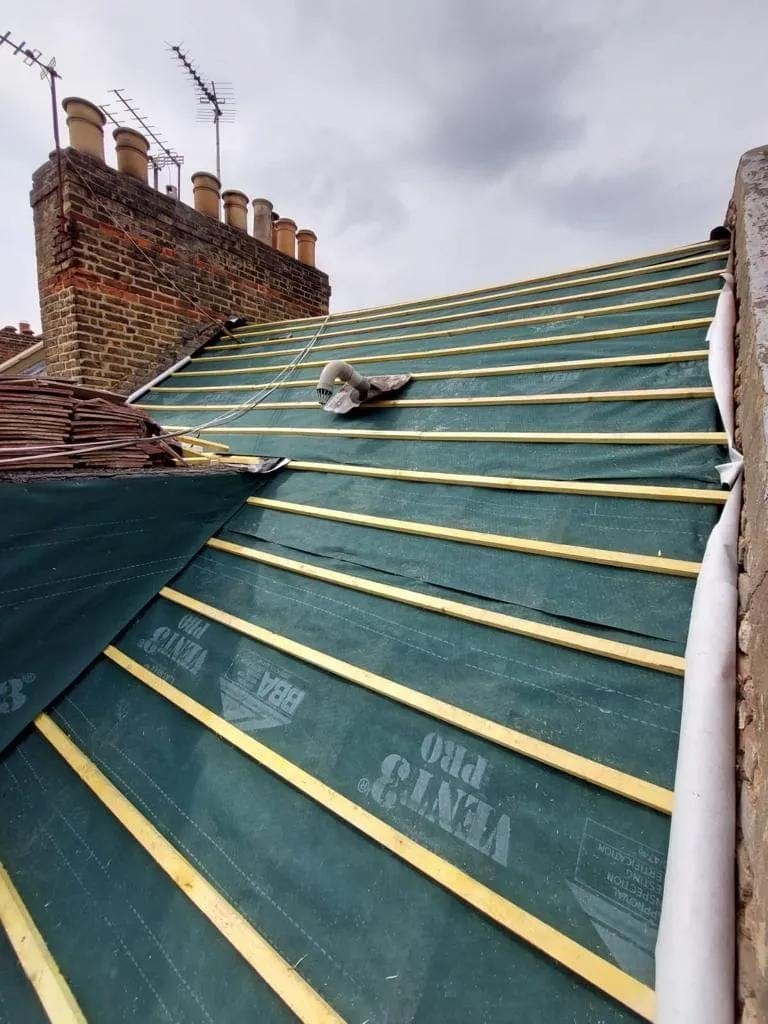
Emergency Roof Repairs in South London
Stopping the water and repairing the roof are two different jobs, and tonight only the first one is possible.
Or the mobile, 07377 267850.
- 24-hour call-out, listed on our Checkatrade profile
- Photographs of everything we find, taken before we touch it
- Free quote and a fixed written price for the permanent repair
- Cards accepted, and no VAT to add
- 9.45/10 on Checkatrade from 53 reviews
A roof emergency is nearly always smaller than it feels from inside. A slate has gone, a length of lead has split, a valley gutter has silted up — and the water has found a rafter to run down and a ceiling to drop through. The damage indoors looks enormous. The hole outside is usually about the size of a hand.
We cover South London from Camberwell: Peckham, Dulwich, Herne Hill, Brixton, Clapham, Streatham, Tooting, Wandsworth and the postcodes around them. On an urgent call the first job is to get the water out of your house, not to sell you a roof. We will tell you on the phone what to do in the next ten minutes, and we will tell you honestly whether the weather that night allows anything more than covering it.
The first ten minutes, before anyone arrives
Most of the damage a roof leak does is done indoors, and most of it can be prevented in the time it takes us to load the van. None of this needs a ladder.
- Electrics first
- If water is anywhere near a light fitting, a ceiling rose or a socket, switch that circuit off at the consumer unit. Water tracks along cables and comes out a long way from where it got in.
- A bulging ceiling
- Sagging plasterboard can hold several litres. Put a bucket underneath and pierce the bulge once, in the middle, with a screwdriver. It drains in a controlled stream. Left alone it lets go all at once and takes the whole sheet with it.
- Catch and dampen the drips
- A towel in the bottom of each bucket stops the splashing. Something waterproof over anything you cannot move, and lift what you can off the floor.
- Photograph it now
- The stain, the ceiling, the room and the outside of the roof from the ground. Insurers ask for exactly this, and it is far harder to produce once the mess has been cleared up.
- Stay off the roof
- Wet slate is as slippery as ice and a ladder in a gust is how people get killed. Nothing up there is worth going after in bad weather.
What we actually do when we arrive
An emergency visit has one purpose: get the water out and keep it out until the roof can be repaired properly. What that takes depends entirely on what has failed.
The stain on your ceiling is rarely underneath the hole. Water runs along a batten and down a rafter before it drops, which is why leaks get chased and half-fixed for years. We work back from the stain — into the loft where there is one, along the run, then up onto the roof — and we photograph the path before we change anything.
- Slipped or missing slates and tiles
- Where the slope can be reached safely, the emergency repair is also the permanent one: the slate goes back, a copper tingle or clip holds it, and it is done inside an hour.
- Split lead flashing
- Lead moves every day with the temperature. Bays much longer than about 1.5 metres have nowhere to go and fatigue along the fold. We can seal a split to get you through the night; new lead laid to BS 6915 in properly sized bays is the actual fix.
- A flooded valley or parapet gutter
- The commonest emergency on a South London butterfly roof. The central gutter behind the front parapet silts up with leaves and grit, water backs up over the lead upstand and goes straight into the bedroom below. Clearing it often stops the leak in twenty minutes.
- Flat roof splits and blisters
- Moisture trapped under the cap sheet turns to vapour in the sun, lifts a blister and the blister splits at its edge. We dry what we can, patch it and come back to bond properly once the deck is dry.
- Storm-stripped slopes
- Where a run of tiles has gone we batten a heavy-duty sheet over the slope and fix it down. A tarpaulin held by bricks lifts in the next gust and takes more tiles with it on the way.
- Water in the electrics
- We are roofers, not electricians. If the leak has reached a circuit we will say so, and that circuit stays off until an electrician has seen it.
What the weather stops us doing
Several repairs cannot be made in the wet, and a roofer who says otherwise is selling you a failure with a longer fuse. Bitumen will not bond to a damp surface. Mortar bedded in standing water, or below about 3°C, never reaches its strength. Resin and liquid coatings need a dry, primed substrate and hours of cure time. Torching felt onto a wet deck just steams the water and lets go a season later.
Wind is the harder limit. Much above 25 mph a sheet of covering becomes a sail and a roof ladder becomes dangerous, and we will not put anyone on a slope in that. When it is blowing like that the honest answer is that we make the inside safe, cover what can be covered from a ladder, and come back at first light.
Temporary cover now, proper repair later
A make-safe and a repair are two jobs, and we quote them as two jobs. Temporary cover is there to keep the house dry for days or a couple of weeks. It is not a season's worth of roof: sheeting degrades in UV, works loose at its fixings and eventually leaks on its own account.
Where the emergency repair can be the permanent one, we do it there and then and you pay once. That covers most slipped slates, most blocked valleys and a good number of flashings. Where it cannot — a stripped slope, a saturated flat-roof deck, anything that needs a scaffold — we cover it, quote the permanent work in writing with photographs, and book it for the first dry day.
Whether the call-out charge comes off the repair is worth asking when you ring. You should hear the answer before we set off, not read it on the invoice.
Storm damage and what your insurer will want
Sudden storm damage is normally within a buildings policy; gradual deterioration normally is not. The line between them is the state of the roof beforehand. A slate lifted clean off in a named storm reads as storm damage. A slope that has been shedding concrete tiles for three winters because the steel nails have rusted through reads as maintenance, and a loss adjuster can tell which is which from the fixings alone.
Most policies also require you to limit further damage, which is exactly what a make-safe is, so keep that invoice. We photograph the damage, the debris and the wider roof before we touch anything, and write the report in the terms insurers ask for. Harrington takes on insurance work regularly. Do not let anybody clear or strip the roof before the photographs exist, and that includes us.
What does not need a night call-out
We would rather tell you to go back to bed than charge you for a visit in the dark that changes nothing. Four things get reported as emergencies and almost never are.
- A stain that has stopped growing
- If nothing is dripping and the edge of the mark is dry, it will keep until morning. Draw round it in pencil, photograph it, and ring us in daylight.
- A leak that only shows in driving rain
- Wind-driven rain getting past pointing or the lap of a flashing stops when the wind turns. That is a daylight repair, and a cheaper one.
- Condensation in a cold loft
- Water running down the underside of the felt on a cold morning, after days with no rain, is moisture from the house rather than a leak. Ventilation solves it. A roofer at midnight does not.
- A gutter overflowing down the wall
- It will stain the brickwork and it needs doing, but it is not coming through the ceiling tonight. Book it in for a dry day and pay far less for it.
Questions
What people ask
about emergency roof repairs
01How quickly can you get to an emergency?
Both numbers ring through to the 24-hour call-out line. In daylight, across SE5 and the SE and SW postcodes next to it, we can usually be with you the same day and often within a couple of hours. Overnight, and during a storm when every roofer in London is already out, it takes longer. You will get a real time when you ring rather than a promise printed on a web page.
02What affects the cost of an emergency roof repair?
The hour, and whether the roof can be reached from a ladder. If the emergency repair is also the permanent one — a slipped slate, a blocked valley — that is generally the whole bill. Where a stripped slope has to be sheeted, the permanent repair is quoted separately.
03Do you charge more at night or at the weekend?
Out-of-hours attendance costs more right across the London trade, because it is two people working at antisocial hours. What matters is that you know the rate before we set off. Ask when you ring and you will be told the figure, and whether the call-out charge is credited against the permanent repair if you go ahead with it.
04Can a roof be repaired in the rain?
Parts of one. Slates go back, gutters get cleared, sheeting gets battened down and a split flashing can be sealed temporarily. Bitumen, mortar and liquid coatings all need a dry surface to bond or cure, so those repairs wait for weather. Anyone torching felt onto a soaking deck in a downpour is building you a leak for next year.
05How long will a temporary cover last?
Days to a few weeks. Sheeting starts losing to UV and wind the moment it goes on, and its fixings work loose. What it buys is time — time for the roof to dry out, for a scaffold to go up if one is needed, and for the repair to be done properly. It is not a substitute for a roof and we will not sell it as one.
06My ceiling is bulging with water. What should I do?
Turn off the lighting circuit at the consumer unit if the water is near a fitting. Put a bucket under the lowest point of the bulge and pierce it once, in the middle, with a screwdriver. It will drain steadily. Plasterboard can hold several litres and then drops the entire sheet, which turns a ceiling stain into a ceiling replacement.
07Will my insurance pay for it?
Sudden storm damage is usually covered and wear and tear usually is not. Most policies also oblige you to limit further damage, which is what a make-safe does, so keep the invoice and send it in with the claim. We photograph everything before we touch the roof and write the report in the terms insurers ask for. We take on insurance work regularly.
08Do I need to be at home?
For work on the outside, usually not — we can attend, make the roof safe and photograph what we found. We do need to get to whatever the water is coming through, so if the leak is in a flat, a loft or above a locked room, somebody with a key has to be there. On a converted house with a shared roof, the freeholder needs telling as well.
09Which areas do you reach at short notice?
Camberwell is the base, and the quickest roofs to reach are in SE5 and the postcodes around it — Peckham, Dulwich, East Dulwich, Herne Hill, West Norwood, Brockley, Brixton, Clapham, Streatham, Tooting, Balham, Wandsworth and Battersea. We also work Putney, Fulham and Wimbledon, and out to Kingston and New Malden, which take longer at night.
Free quote
Ring first. Photo after.
We will come and look, photograph what we find, and give you a fixed price in writing. No call-out fee, no obligation.
Water coming in now? Do not fill this in — ring 020 7205 4188.