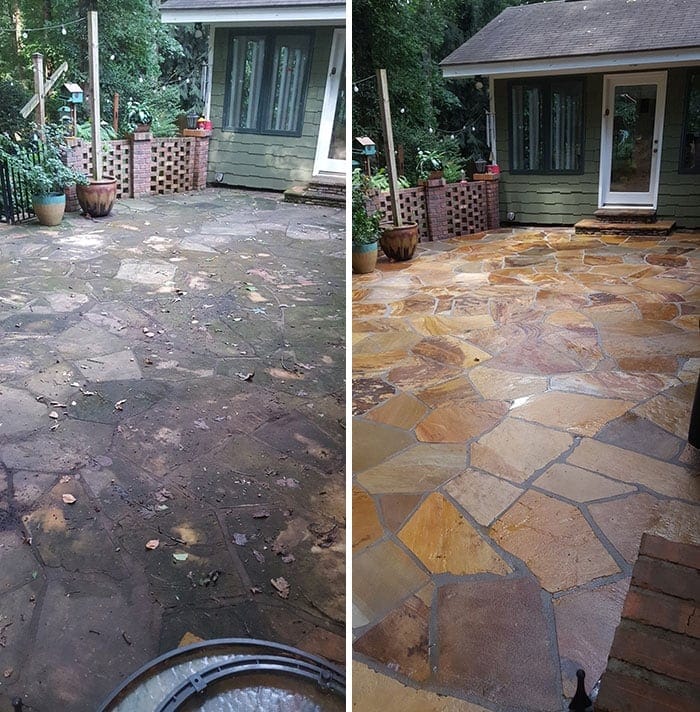
Pressure Washing and Jet Washing in South London
A wash is easy to sell and easy to get wrong. The nozzle and what goes back into the joints matter more than the pressure does.
- Free quote and a fixed price in writing
- Block paving re-sanded as part of the price, not as an extra
- Not VAT registered — no VAT added to your quote
- 9.45/10 on Checkatrade from 53 reviews
Outside surfaces go dirty in an order. A patio greens over first, because algae needs nothing but damp and shade. Then moss packs into the joints and holds water there all winter. Then lichen arrives, and that is the black spotting you cannot brush off, because it has taken a physical hold on the stone. By the time a slab is slippery underfoot there are three things living on it, and only one comes off with water alone.
We clean patios, block paving, drives, paths, decking and brickwork across Camberwell, Peckham, Dulwich, Herne Hill, Brixton and the rest of South London. Harrington is a roofing firm; this is work we take on around the same houses, usually while we are already there for the roof.
What we wash
Most of what we are called to is hard surfacing gone green over a winter or two. Some of it is a job in its own right; much of it is half a day added to something we are on site for anyway.
- Patios and terraces
- Indian sandstone, limestone, porcelain, York stone and concrete flags, cleaned with a rotary head so the finish comes out even rather than striped.
- Block paving and drives
- Cleaned and then re-sanded. The re-sanding is the half most quotes leave out, and the half that decides whether the drive is better or worse in two years.
- Paths, steps and side returns
- The shaded strip down the side of a terrace is usually the greenest and most slippery thing on the property.
- Decking
- Timber and composite, at low pressure and along the grain. A lance held square to a softwood board tears the grain straight out of it.
- Brickwork, render and low walls
- Washed down rather than blasted, and on old lime-mortared brick sometimes not washed at all. More on that below.
- Garden furniture, bins and play equipment
- Plastic and painted timber, done while the machine is already set up. It adds very little to a job we are on site for.
What is actually growing on it
The green film is algae. Single-celled, it needs only moisture and shade, so it lives on north-facing paving, under trees and against fences. It rinses off easily and comes back quickly, because nothing about a wash changes the shade or the damp.
Moss is the one that does structural damage. It colonises the joints, holds water against the pointing all winter, and when that water freezes it levers the joint apart. Once the pointing has gone, water gets under the slabs, and after that it is only frost and time before one lifts or starts to rock. Clearing moss out of the joints is worth doing for that reason alone.
Black spotting on sandstone is lichen, and a different problem entirely. Lichen anchors itself into the surface of the stone, so it cannot be washed off at any pressure the stone will survive. It needs a biocide left on long enough to kill it, then a rinse, and the marks keep fading for a week or two afterwards. Anyone promising to take black spot off in one pass with a lance is promising to take the top of your stone off with it.
Two marks that look like dirt are not. Red-brown staining under a tree is tannin from leaf fall, and it usually lifts. A white bloom on newish block paving is efflorescence — salts drying out of the cement — and washing does not cure it. It weathers off on its own over a season or two, so paying to clean it is money wasted.
Pressure is the least useful setting on the machine
What shifts dirt is pressure, water volume, the nozzle and how far that nozzle sits off the surface. Volume matters more than people expect: a machine moving twelve to fifteen litres a minute clears a patio faster than a hire machine at the same pressure and half the flow, with less risk to the stone.
The nozzle is what causes damage. A turbo or dirt-blaster nozzle spins a pencil jet in a tight circle and will cut a visible line into sandstone, old concrete flags or soft brick in about a second. That is where striped patios come from. For open areas we use a rotary flat-surface cleaner — an enclosed head with nozzles on a spinning arm, held at a fixed height so every square metre gets the same treatment — and a fan nozzle by hand at edges and steps.
Some surfaces do not get a lance at all. Lime-mortared Victorian brickwork, which is most of the garden walls and rear elevations around here, has soft joints and a fired skin on the brick face, and pressure removes both. Painted render and external wall insulation come apart the same way. Asbestos cement, still on plenty of old garages and sheds here, must never be pressure washed, because that is how fibres get released. Those surfaces get low pressure and a treatment, or they get left alone.
Roofs are on that list too. We do not jet wash tiles or slates: a lance strips the surface off concrete and clay, drives water under the laps and can void a tile maker's warranty. Roof moss comes off by hand from a roof ladder, and gets treated afterwards — a different method on a different page.
Block paving: the sand has to go back in
Washing block paving does something that washing a patio does not. It empties the joints. The kiln-dried sand between the blocks is not decoration — it transfers load from one block to the next, which is why the British paving standards, the BS 7533 series, treat jointing as part of the construction rather than as a finish.
Take that sand out and leave it out, and the blocks lose their interlock. They start to rock under a wheel, the edges chip where block meets block, weeds root far more readily in an empty joint than a full one, and the surface creeps out of line. A drive that was jet washed and never re-sanded routinely looks worse after two years than before anybody cleaned it.
So re-sanding is part of this job rather than an extra line on the bill. Kiln-dried sand is brushed in dry, worked down the full depth of the joint and topped up. It has to go in dry: sand brushed into damp joints bridges near the surface and leaves the joint hollow underneath, which looks finished and behaves as though nothing was done.
Where the water goes, and what it can reach
A wash puts a great deal of water somewhere. In most South London gardens the gully by the back door is a surface-water drain, and surface water here runs to the river rather than to a treatment works. Silt and dead algae are one thing. Detergent, oil lifted off a drive or a strong biocide going down the same gully is another, and it is not meant to happen. Where a job needs chemicals we keep the washings off the gully and soak them away on your own ground.
The wall is the other thing to watch. Pressure throws water and grit sideways, and paving that finishes level with or above the damp-proof course hands that water a route into the brickwork. On older houses whose gardens have been built up over the years this is common, and the honest answer is sometimes that the level is the problem rather than the dirt. We work away from the wall, keep the pressure down along that edge, and say so when what you need is a channel drain rather than a clean.
When a wash is the wrong job
Cleaning makes a sound surface look new. It does nothing for a surface that has failed. Concrete flags that have begun to spall — the face lifting off in thin plates — are frost-damaged, and washing takes more of the face with it. A patio that has dropped along one edge, or a drive sunk into two wheel ruts, has a base problem underneath; cleaning changes the colour, not the shape.
Where the joints have gone soft and crumbly, a wash and a re-point is the sensible pair of jobs, and it buys years. Where the base has moved, a lift-and-relay of that area is the answer, and we would rather quote for that than sell you a clean that looks good for a fortnight.
On sealing, we will not tell you it is essential, because on most surfaces it is not. Porcelain does not need it. An impregnating sealer on sandstone does slow staining and make the next clean easier, and it has to go onto genuinely dry stone — a separate visit days later, not the same afternoon. A film-forming wet-look sealer over paving still damp underneath traps that moisture and goes cloudy, and there is no cheap way back.
Questions
What people ask
about pressure washing
01What affects the cost of pressure washing in South London?
What moves the price most is how much moss and lichen there is, not the size of the area. Small jobs are priced as a visit rather than by the metre. On a block-paved drive the price covers re-sanding as well as the clean.
02Will jet washing damage my patio or driveway?
It can, and nearly all the damage people show us was done by the wrong nozzle. A spinning turbo jet cuts lines into sandstone, old concrete flags and soft brick almost instantly, and those lines are permanent. Done properly — a rotary head at a fixed height for the open areas, a fan nozzle by hand at the edges, pressure matched to the surface — it does not. Where a surface should not be lanced at all, we say so before we quote.
03Do you pressure wash roofs?
No. A lance takes the surface off concrete and clay tiles, forces water up under the laps and can void the tile maker's warranty. Roof moss should be scraped and brushed off by hand from a roof ladder and treated afterwards, and that is how we do it. Our moss removal and roof cleaning page explains the method.
04Do you re-sand block paving afterwards?
Yes, and it is in the price rather than an optional extra. Washing empties the joints, and the kiln-dried sand in those joints is what stops the blocks rocking, chipping and creeping under a car. The sand goes in dry and gets topped up, because sand brushed into damp joints bridges at the top and leaves the joint hollow underneath. If a quote you are comparing does not mention re-sanding, ask what it will cost.
05How long does it take, and can I walk on it afterwards?
A typical patio is half a day. A London drive is half a day to a full one, depending on how much moss is in the joints. You can walk on it as soon as we have finished. Give freshly re-sanded block paving a day or so before furniture and bins go back, so the sand beds down rather than getting dragged out again.
06Will the green come back?
Eventually, yes. Algae needs only shade and damp, and a north-facing patio under a tree has both, so a wash on its own might stay clean for a year. A wash followed by a biocide treatment holds noticeably longer, because the treatment kills what is left in the surface instead of just rinsing the growth off the top. Cutting back whatever is shading the area does more than either.
07Can you get rid of black spots, rust marks and oil?
Black spots are lichen and they come off with a biocide left to work, not with pressure — expect them to keep fading for a week or two after treatment. Oil on a drive usually lifts with a degreaser and hot water, though a stain that has soaked in for years may only ever fade. Rust and old cement smear need acid-based products, which we will not put on limestone or polished stone because they etch the surface. We tell you which marks we expect to shift before we start.
08Do you need my water and electricity, and what about a hosepipe ban?
We work from an outside tap, and some machines also need a socket. If there is no outside tap, say so when you call — it changes how the job is priced and occasionally whether we can do it at all. We do not run hoses through the house. During a drought, a hosepipe ban stops a householder washing their own patio with a hose; a firm doing it as part of its business is normally outside that restriction, but every notice is worded differently, so we check what the water company has actually published rather than assume.
09Is it safe on render, painted walls and decking?
Not at full pressure. Painted render, external wall insulation and lime-mortared Victorian brickwork all break up under a lance, and asbestos cement — still on plenty of old garages and sheds around here — must never be pressure washed, because that releases fibres. Those surfaces get low pressure and a treatment, or nothing. Timber decking is washed at low pressure along the grain; across it, the soft grain tears out and leaves a furry finish.
10Can you clean the patio while you are here for the roof?
Usually, yes — it is the same firm and largely the same crew. If we are already coming to quote a roof it costs nothing to have the patio, the path and the drive priced at the same time, and it saves a second set-up.
Free quote
Size and surface, then a price.
We will come and look, photograph what we find, and give you a fixed price in writing. No call-out fee, no obligation.