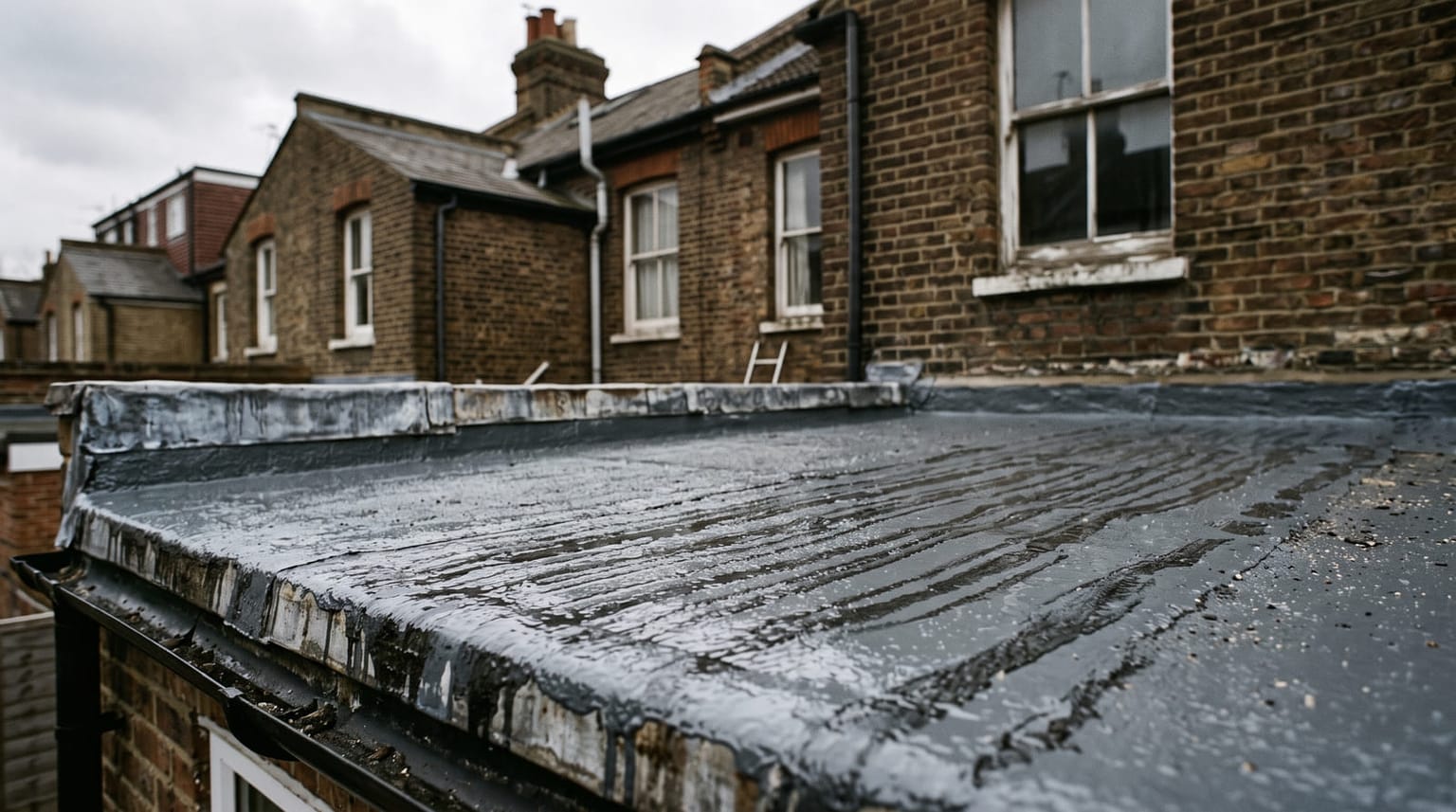
Liquid Roofing in South London
One continuous membrane, laid cold, over the parts of a flat roof that sheets never fit properly.
- Free survey and a fixed price in writing
- Cold applied — no torch, no hot works over your rooms
- We check the deck is dry before we quote a coating
- 9.45/10 on Checkatrade from 53 reviews
Flat roofs rarely fail in the middle. They fail at the edges — where the felt turns up against a parapet, where a soil pipe comes through the deck, around a rooflight kerb, at the join between a back addition and the main wall. Those are the places a sheet has to be cut, lapped and hoped over. They are also the places a liquid membrane simply goes round.
Liquid roofing is a resin laid on wet, with a reinforcing fleece bedded into it, that cures into one continuous skin with no joints anywhere. It goes on cold, so there is no torch on your roof. It will bond to a sound felt, asphalt or concrete surface without stripping anything off. We use it across Camberwell, Dulwich, Brixton, Clapham and the rest of South London, mostly on the awkward roofs that other systems handle badly — and we tell you plainly when yours is not one of them.
What a liquid roof actually is
It is a build-up, not a coat of paint. A primer chosen to suit whatever is underneath, a base coat, a fleece or matting rolled into the wet resin, then a top coat over that. The fleece is what turns a coating into a membrane: it gives the film a thickness you can measure and something to hold it together when the roof moves in the heat.
The resins are not interchangeable. PMMA systems tack off in under an hour and will cure in cold weather, which is why they get used where a roof cannot be left open for long. Polyurethanes cure more slowly, stretch further and smell far less, which matters on a balcony outside a bedroom window. Water-based acrylics are the cheapest and the shortest-lived, and are better understood as maintenance coatings than as roofs.
None of this is the tin of black liquid rubber from the builders' merchant. That is an unreinforced acrylic, perhaps half a millimetre thick once dry, and it buys a season or two on a roof already on its way out. A fleece-reinforced system laid to specification is closer to two millimetres and is a waterproofing layer in its own right, with a manufacturer's warranty standing behind it.
The roofs it suits
Liquid earns its money where a sheet has to be cut. The price per square metre is driven by the number of details, not by the area, so a plain rectangle on a new deck is usually cheaper in rubber or fibreglass — and we will say so rather than sell you the job we happen to be quoting.
- Parapet and box gutters
- The narrow gutter behind a Victorian parapet is the hardest thing on a London roof to keep watertight: two upstands, sharp internal corners, one outlet and no room to work. A liquid dresses into all of it in a single piece.
- Rooflight kerbs, pipes and vents
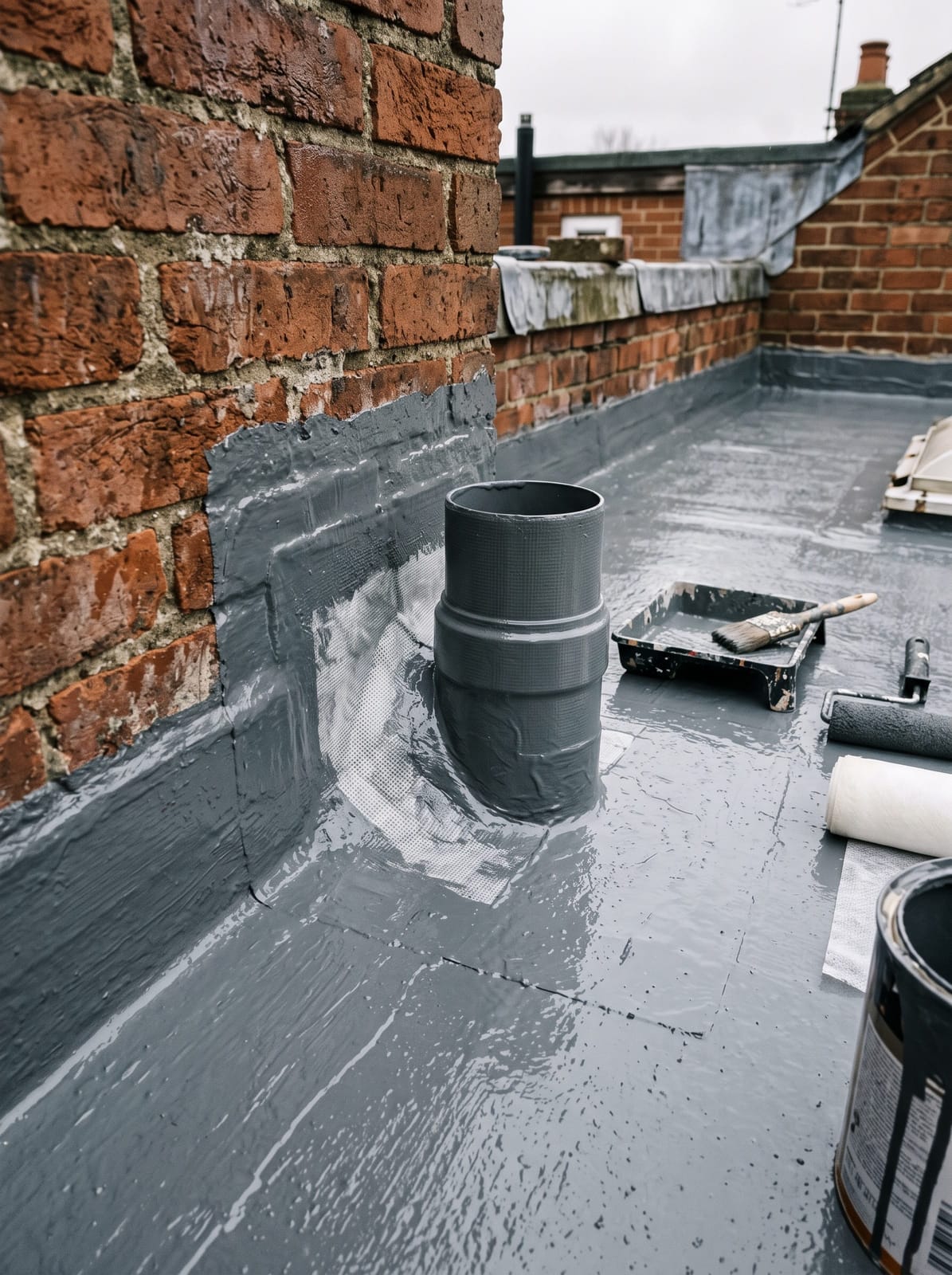
- Anything that comes up through the deck. The fleece is cut and worked up the kerb or around the pipe, so the waterproofing turns the corner without a joint to open later.
- Overlays on tired felt or asphalt
- Where the covering is worn but dry and firmly stuck down, coating over it saves the strip-out, the skip and the days the house stands open to the weather.
- Balconies and walkways
- Quartz broadcast into the top coat gives a non-slip finish that takes regular foot traffic. That is the normal specification for a balcony over a habitable room.
- Dormer tops and bay roofs
- Small, fiddly, and usually surrounded by tile, render and lead. A liquid ties them into the surrounding detail without a row of laps at every change of direction.
- Roofs where a flame is out of the question
- Over occupied rooms, hard against timber sash boxes, on a terrace with one way off it. Cold-applied means no torch and no hot-work risk to the building.
Before we coat anything
A liquid membrane is only ever as good as the thing it is stuck to. Coat a roof that has water sitting in the insulation and you seal that water in; it warms in the sun, turns to vapour and lifts the new membrane off in blisters within a couple of summers. That is the most common way these roofs fail, it is expensive, and it is entirely avoidable.
So four things get checked before we price anything. Is the deck firm underfoot, with no soft patches and no spring? Is the existing covering dry all the way through rather than dry on top — on a roof we are unsure about that means cutting a small core and looking at it? Is the covering still bonded down, or has it lifted and blistered across the field? And does water actually leave the roof: BS 6229 asks for a design fall of 1:40 so that 1:80 survives the build, and a great many London back-addition roofs were laid dead flat and have never drained properly since.
If those come back right, an overlay is the sensible and cheaper job. If the insulation is wet or the deck has gone, a coating is a full price for a year of cover, and we will quote you a strip and re-lay instead with photographs of what we found.
How the work goes
Preparation is most of it. We take the surface back to something sound, cut out and make good blisters and splits, clean off moss and degrease where bitumen has bled, and prime to suit the substrate — felt, asphalt, concrete and metal each want a different primer, and skipping that step is the reason coatings peel in strips.
Details go on first. Every upstand, kerb, outlet and pipe is reinforced with fleece and carried up at least 150 mm above the finished surface where the height allows. The flat field follows: base coat, fleece, top coat, worked wet on wet so the whole thing fuses into one layer rather than three.
Most domestic roofs are a day, sometimes two where there is a lot of detail or the preparation runs long. Cure is a separate question — rain-safe in about an hour on a fast system, several hours on others, full cure over a few days. We work to the datasheet and to the weather on the day. If the forecast will not allow a proper cure, we move the date rather than lay it and hope.
Liquid, rubber or fibreglass
For a plain rectangle with a new deck going in underneath, a single sheet of EPDM or a laid fibreglass roof is usually the better buy: fewer materials, less labour, and no argument about what the waterproofing is bonded to. Liquid comes into its own on detail and on overlays, which is most of the flat roofs on a Victorian terrace.
The honest difference nobody mentions is repairability. In ten years a liquid roof is the easiest of the three to put right — clean the area, re-prime, bed in a fleece patch and it is one piece again. A cut in an EPDM sheet needs a bonded patch that will always be a patch; a crack in fibreglass has to be ground back before anything new will hold.
Expected life is fifteen to twenty-five years depending on the resin and how much film thickness went on, which puts it alongside fibreglass and behind a good rubber sheet. What it has over both is the ending: at twenty years a liquid roof normally wants a clean and a fresh top coat, not a replacement.
Questions
What people ask
about liquid roofing
01What is liquid roofing, and is it the same as the roof paint from the merchant?
No. Liquid roofing is a resin waterproofing system applied cold in coats, with a reinforcing fleece bedded into it, which cures into one continuous membrane with no joints. The tins of roof seal or liquid rubber sold over the counter are thin unreinforced acrylics meant to buy a year or two on a failing roof. A proper system is around two millimetres thick, laid to a manufacturer's specification, and carries a warranty from the maker.
02What affects the cost of a liquid roof?
Area matters less than you would think — it is the metres of edge and the number of penetrations that take the time. Preparation counts as well: what has to come off, what has to dry out and what has to be primed. Then the resin: a cold-cure PMMA with a long manufacturer's warranty costs considerably more than a polyurethane, and both cost more than an acrylic maintenance coating. A plain overlay on a sound felt roof sits at the cheaper end and a heavily detailed roof on a top-tier resin at the dearer end. An overlay usually comes in below a full replacement because there is no strip-out and no skip.
03Can you put a liquid roof over my existing felt or asphalt?
Often, yes, and it is the case liquid does best. The old covering has to be firmly bonded, dry all the way through, and sitting on a deck with no soft spots. We test for that before quoting and cut a small core where the roof looks suspect. If the insulation underneath is wet, coating over it traps the water and the new membrane will blister within a couple of summers — in that case we quote a strip and re-lay and show you why.
04How long does a liquid roof last?
Fifteen to twenty-five years is the realistic range. Where you land in it depends on the resin, the film thickness that went on and how much sun the roof takes. Unlike a sheet system the end of that life is normally a clean and a fresh top coat rather than a replacement, provided the reinforced layer underneath is still sound.
05Can it be laid in winter?
Some systems, yes. PMMA-based resins cure at low temperatures and tolerate a damp start. Polyurethanes and acrylics want a dry surface, air above about five degrees and a dew point comfortably below the roof temperature, or the film will not form properly. We pick the system for the season and tell you which one we have specified. If the forecast will not allow a proper cure we move the date.
06Can I walk on it?
Yes, where it is specified for traffic. We broadcast a quartz aggregate into the top coat and seal over it, which gives a non-slip surface that takes regular use — the standard finish for a balcony, a walkway or a terrace with a door onto it. Tell us at the survey if the roof will be walked on, because it changes both the system and the price.
07Is the work guaranteed?
There are two guarantees and you should ask any roofer for both. The system carries a manufacturer's warranty; on liquid systems these commonly run from ten to twenty-five years, set by the resin, the coat thickness and, on the longest ones, an inspection of the finished roof by the maker's own surveyor. Those longest warranties are only issued through a maker's approved installers, so ask directly whether the firm quoting you can actually offer one. Our workmanship guarantee is separate and written into your quote — ask us for the term before you accept.
08Would EPDM or fibreglass be better for my roof?
If the roof is a plain rectangle and the deck is coming off anyway, usually yes — a rubber sheet or a laid fibreglass laminate on an open deck is quicker work and normally cheaper. Liquid wins where there are details to go round, where the existing roof is sound enough to overlay, or where no flame can be used near the building. On a typical back-addition roof with a parapet gutter and a soil pipe through it, liquid is often both the neater and the cheaper answer. We will price both if you want to compare.
09Does it need building regulations approval?
Renewing a roof covering counts as renovating a thermal element under Part L, which can bring a duty to upgrade the insulation to current standards. A liquid overlay leaves the existing build-up in place and is normally treated as a repair, so it usually does not. A strip and re-lay over a heated room usually does, and that changes the design and the cost. We will tell you which side of the line your job sits on, and where it is a close call your borough's building control team will confirm it.
10Which areas do you cover?
Most liquid work is on the Victorian back additions and parapet roofs of inner South London: Camberwell, Peckham, Dulwich, Herne Hill, Brixton, Clapham, Streatham, Balham, Tooting, Brockley and West Norwood. We also work across Wandsworth, Battersea, Putney, Fulham and Wimbledon, and travel out towards Kingston and New Malden for a larger roof.
Free quote
We look at what is failing.
We will come and look, photograph what we find, and give you a fixed price in writing. No call-out fee, no obligation.