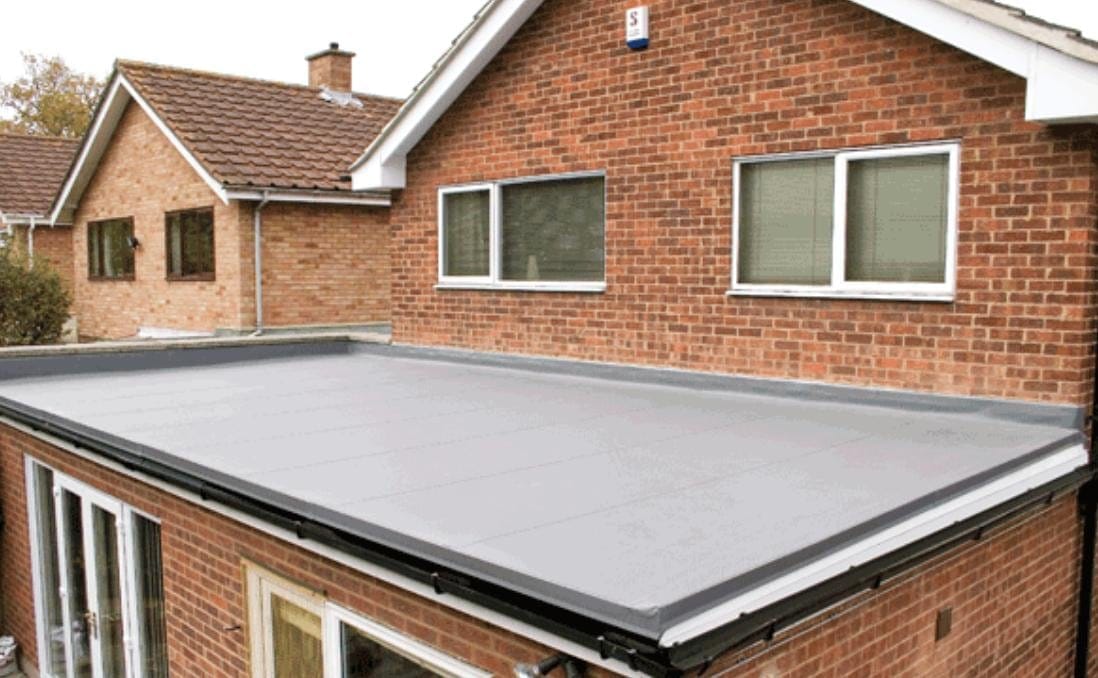
GRP Fibreglass Roofing in South London
A fibreglass roof is only as good as the deck under it. That is where we start, and where nearly every failure begins.
- Free survey and a fixed price in writing
- No VAT added — Harrington is not VAT registered
- Photographs of the opened deck before anything covers it
- 9.45/10 on Checkatrade from 53 reviews
GRP stands for glass-reinforced plastic. On a roof it means a mat of glass fibre laid over a timber deck and soaked through with resin, which then sets hard into one continuous sheet with no joints, no laps and nothing stuck down with mastic. Once it has cured you can walk on it. That is why it ends up on balconies, terraces, dormer tops and any roof that has to carry a ladder or a window cleaner.
We lay GRP roofs on extensions, garages, outbuildings and bay tops across Camberwell, Peckham, Dulwich, Brixton, Clapham and the rest of South London. Most are two to four days on site. The part that decides whether the roof lasts twenty-five years or cracks in three happens before any resin comes out of the tin, and it is the part most quotes say least about.
What a fibreglass roof actually is
Four things go down, in order, and each does a different job.
- The deck
- 18 mm OSB3 board, laid with a small expansion gap at every joint and screwed rather than nailed. It is the structure the laminate takes its shape from. Nails work loose, boards move, and the laminate above them splits along the line.
- The trims
- GRP edge trims are bonded and over-laminated at the eaves, the verges and against walls, so the water leaves the roof over a hard edge rather than creeping back under one. They are part of the laminate, not a strip of metal screwed on afterwards.
- The laminate
- Chopped strand mat, usually 450 g/m², rolled out and wetted through with catalysed polyester resin, then consolidated with a roller until no air is left in it. Trapped air is a weak spot that shows up years later as a blister.
- The topcoat
- A pigmented resin coat with a wax in it. The wax floats to the surface as it cures, which is what leaves the roof dry to the touch instead of tacky. Laid too thin, it stays sticky and holds dirt for the rest of its life.
When fibreglass is the right system, and when it is not
GRP earns its keep on roofs that get walked on and roofs with a lot going on. Balconies, roof terraces, small rear extensions with a rooflight, dormer tops, bay roofs, anything with pipes and corners and an abutment on two sides. Because it is laid wet, it follows shapes that a sheet material has to be cut and joined around, and the finished surface is hard enough to take foot traffic without a paving layer over it.
It is the wrong choice in three situations, and we will say so rather than sell it to you. A large plain rectangle — a whole garage block, a flat over a shop — is better and cheaper in EPDM rubber, which goes down in one sheet. If you want to keep an existing sound covering rather than strip it, a liquid system overlays it without the tear-off. And on a Victorian valley gutter behind a parapet, the sort that runs down the middle of a butterfly roof in SE5 or SE22, we would generally line it in lead. That gutter moves with the building. Lead moves with it. Cured GRP does not move at all, and something has to give.
The deck decides whether it lasts
Fibreglass is rigid. That is its strength on a walkable roof and its weakness everywhere else, because it cannot absorb movement — it can only crack. So the deck under it has to be still. New OSB3 screwed to sound joists is still. Old boards that flex when you stand on them are not, and no amount of resin over the top will change that.
The other thing we cannot know from the ground is what is under your existing covering. Rot under an old felt roof is common and invisible until the felt is off, because felt fails at a seam and the water then tracks sideways through the boards. When we open a roof up and find soft timber, we photograph it and ring you before we go any further. Nobody should find out about a new deck from the final invoice.
Two more things get set at this stage. The fall, because standing water shortens the life of any flat roof and GRP is no exception — BS 6229 has flat roofs designed to a fall of 1:40 so that they finish at no less than 1:80 after everything has settled. And the insulation: building regulations treat a flat roof covering as a thermal element, so replacing most of one usually means bringing it up to around 0.18 W/m²K. In practice that means a warm deck — insulation board over a vapour control layer, then the OSB, then the GRP. It adds height at the edges and cost to the quote, and it stops the deck sweating from underneath.
Laying it, and why the weather gets a vote
Resin cures by chemical reaction, not by drying. It is mixed with a catalyst on the roof, and the amount of catalyst changes with the temperature — more when it is cold, less when it is warm — but either way the mix is workable for about fifteen minutes. So the roof is laid in bays, wet edge into wet edge, and once a bay is started it gets finished.
That is why we watch the forecast. The deck has to be dry, and the day has to be above about 5 °C for the resin to go off properly. A wet fortnight in February moves your date; it does not usually move your price. If you need a flat roof covered during a bad spell, EPDM will go down in weather that GRP will not, and we would rather tell you that than lay a roof that never cures properly.
The upside of a cold-applied system is that there is no gas torch on your roof. No naked flame near a timber fascia, a neighbour's fence or a loft full of insulation, and no hot-works risk to argue about with an insurer. On a terraced street where the roof is a metre from someone else's woodwork, that matters more than it sounds.
What goes wrong with GRP roofs
When we are called to a failed fibreglass roof, it is almost always one of a short list, and almost never the resin itself.
- A hairline crack in a straight line
- That is a board joint underneath. The deck was nailed, or butted tight with no expansion gap, or laid over old boards that still move. It can be cut out and re-laminated, but if the deck is moving it will come back somewhere else.
- Cracks at the upstand
- Where the roof turns up a wall it is stiff in two directions at once. If the upstand is under 150 mm, or the deck was not tied properly to the wall detail, it splits at the corner and water runs down inside the wall.
- Blisters and delamination
- Air rolled into the laminate, or resin laid on a damp deck. The bond never formed. The patch sounds hollow when you tap it, and it has to come out rather than be coated over.
- A chalky, crazed surface
- The topcoat weathering out after twenty-odd years. The laminate below is often still sound, and a re-coat buys many more years for a fraction of a new roof.
- Standing water
- A fall that was never there, or an outlet in the wrong corner. GRP tolerates it better than felt but it is still a defect, and it usually means the deck needs re-firring rather than the covering re-doing.
Repairs, re-coats and how long it really lasts
One genuinely good thing about fibreglass: it repairs into itself. Grind the damaged area back, key the surface around it, lay fresh mat and resin over the top and re-coat, and the repair becomes part of the original laminate rather than a patch sitting on it. A split at an upstand or a cracked board joint is usually half a day, not a new roof.
On lifespan, treat the advertising with some caution. Manufacturers quote thirty years and more; the independent certificates behind those systems are worded more carefully. Twenty-five to thirty years is what we would plan around for a properly built roof, with a topcoat re-coat somewhere in the middle of that if it faces south. A GRP roof that fails at five years did not fail because of the material.
If your existing fibreglass roof is crazed but sound, ask us about a re-coat before you ask us for a replacement. It is a fraction of the money and we would rather do the honest job than the big one.
GRP Fibreglass Roofing work we have done
All projects →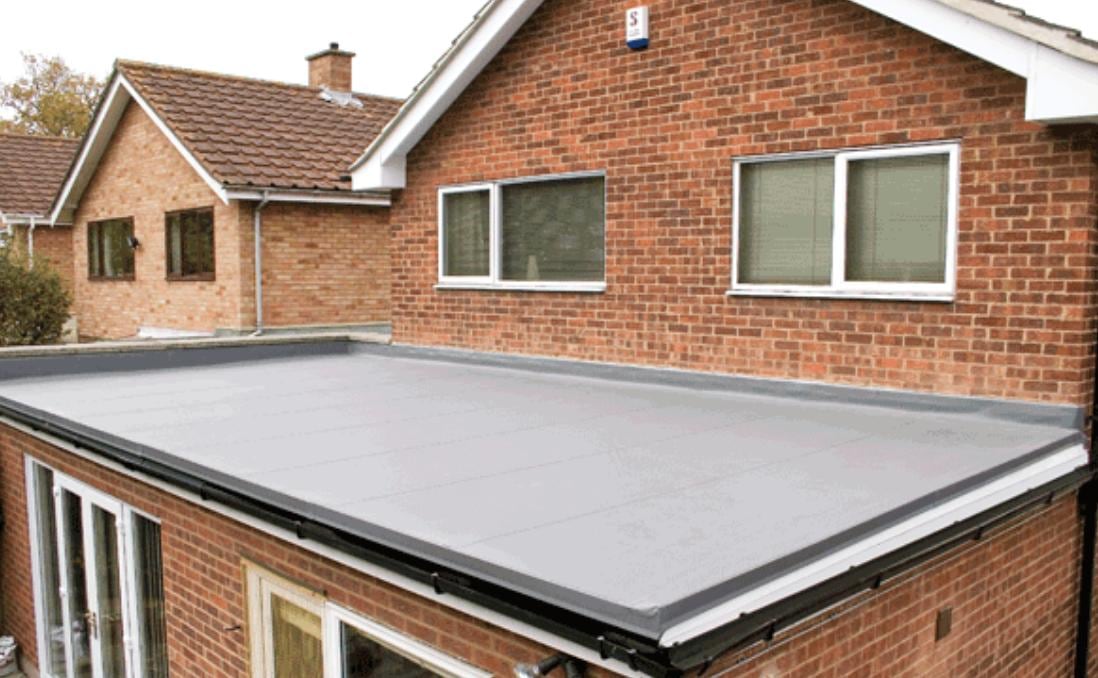
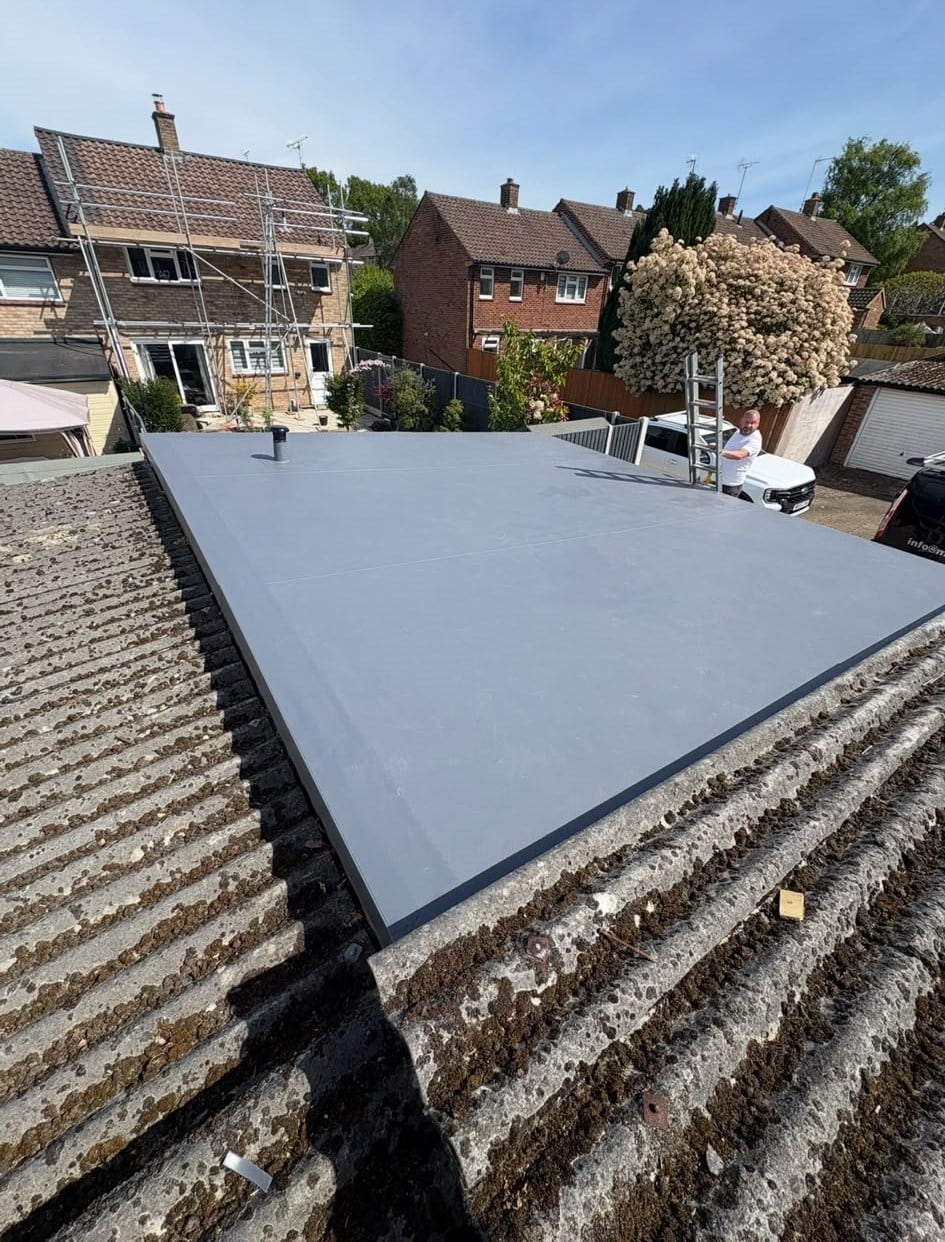
GRP flat roof
Questions
What people ask
about grp fibreglass roofing
01What affects the cost of a GRP fibreglass roof?
Whether the old deck can stay, which we cannot tell you until the covering is up. A warm deck is normally required if we are replacing most of the covering, and it is the biggest single add-on on an extension roof. Rooflight kerbs, soil pipes, corners and abutments take longer than open area, so a fiddly 12 m² roof can cost more than a plain 20 m² one. In London, access, skips and parking all count, and access is the biggest single variable. We give you a fixed figure in writing after we have been up and looked.
02How long does a fibreglass roof last?
Twenty-five to thirty years is a realistic figure for a properly built one, with a topcoat re-coat somewhere in the middle if it gets full sun. Manufacturers advertise longer. What actually determines the number is the deck: a rigid, dry, screwed-down deck lasts decades, and a flexing one cracks the laminate in a few years.
03Can you walk on a GRP roof?
Yes. That is the main reason to choose it. It takes maintenance traffic without paving pads, and for a balcony or roof terrace we broadcast an anti-slip grit into the topcoat so it is not lethal when wet. If a roof is going to be used as a floor, GRP is usually the right system.
04Should I have fibreglass or EPDM rubber?
GRP if the roof will be walked on, or it is full of corners, pipes and rooflights. EPDM if it is a big plain rectangle, or the work has to happen in cold or unsettled weather — rubber goes down in conditions where resin will not cure. Both outlast felt by a long way. We will tell you which your roof wants.
05Can you lay fibreglass over my existing felt roof?
No. GRP has to be laid on a clean, dry, rigid deck, and old felt is none of those things. Anything sound enough to keep is better overlaid with a liquid system, which is designed for exactly that. If you want fibreglass, the old covering comes off and we see what the boards are like underneath.
06Can a fibreglass roof be laid in winter?
Sometimes. The resin needs a dry deck and a temperature above about 5 °C to cure properly, so a cold, wet spell stops work rather than slowing it. We watch the forecast and book accordingly. If the roof has to be covered now and the weather will not allow GRP, we would fit EPDM instead and say why.
07My fibreglass roof has cracked. Does it all need replacing?
Usually not. GRP repairs into itself: the area is ground back, fresh mat and resin laid over it and the topcoat made good, and the repair becomes part of the original sheet. A straight-line crack normally means a board joint moving underneath, so we check the deck before repairing — otherwise it reappears a metre away.
08Do I need building regulations approval for a new flat roof?
Replacing most of a roof covering is normally notifiable, and the insulation has to be brought up to current standards — for a flat roof that is around 0.18 W/m²K, which in practice means a warm deck. We will tell you at the survey whether your job crosses that line, and what it adds to the price.
09Is the work guaranteed?
Ask us for the current terms with your quote, in writing. Resin manufacturers also offer system warranties, but those only apply where the installer is registered on their scheme, and we do not claim that status — so what is on offer here is a workmanship guarantee on our own work rather than a manufacturer's.
10Which areas do you cover?
We lay fibreglass from a base in Camberwell, and most of it is in SE5 and the postcodes touching it — Peckham, East Dulwich, Herne Hill, Brockley and West Norwood — and over towards Brixton, Clapham, Streatham, Balham and Tooting. Wandsworth, Battersea, Putney, Fulham and Wimbledon are a regular run, and we go out as far as Kingston and New Malden for a whole roof rather than a bay top.
Free quote
Size and access, then a figure.
We will come and look, photograph what we find, and give you a fixed price in writing. No call-out fee, no obligation.