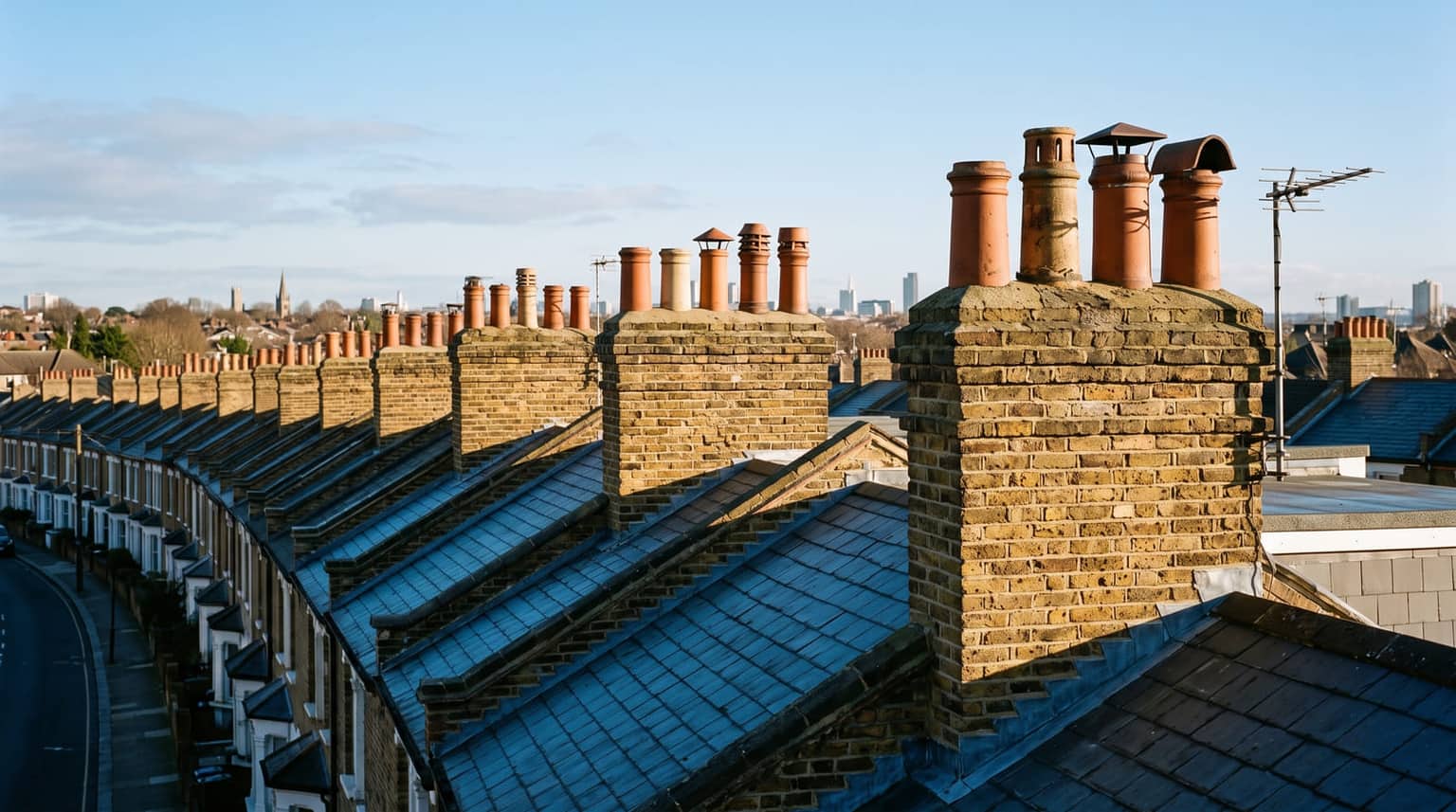
The short answer
If the joints have gone soft but the bricks are still hard and their faces are intact, repointing is the fix and it is the cheapest of the three. If the stack leans, cracks in steps or sheds brick faces, the part above the roofline comes down and goes back up. Removal is worth considering only where no flue in that stack is still used — and it brings structural, party wall and ventilation work with it.
How a stack fails, from the top down
A chimney is the most exposed masonry on the house. It is wet on all four sides, nothing shelters it, it dries slower than a wall, and it takes the full wind at the highest point of the roof. Almost everything that goes wrong with one starts at the top and works down.
The flaunching goes first. That is the sloped mortar cap the pots sit in — a thin bed of mortar with nothing supporting it, baking in the sun and shrinking at night until it cracks. Water gets into the crack, freezes, and levers the crack wider. Below it the joints erode: rain washes the fines out of the mortar a fraction at a time and wind-driven grit does the rest, until the joints are hollow and each brick is bearing on its middle instead of its bed.
Then the bricks themselves come under attack from two directions. From outside, freeze-thaw: water sits in the face of a soft London stock brick, freezes overnight, and pops the face off in flakes. From inside, sulphates — decades of flue gases condensing in an unlined flue leave salts in the mortar, the salts take up water and swell, and the joints on the weather side slowly grow. That is why an old stack usually leans away from the direction the rain comes from rather than falling straight.
Repointing: when the mortar has gone but the bricks have not
The test is simple enough to do from a loft window with a car key. Scrape a joint. If the mortar crumbles to sand and you can get 10mm in without effort, the pointing has failed. Then look at the bricks either side: if they are hard, square at the edges and their faces are intact, the brickwork is fine and repointing is the whole job.
Done properly it means raking the joints out to at least twice their width — 20mm or more, by hand — and filling them in two passes so the mortar is compacted rather than smeared on. A joint scratched out to 5mm and skimmed over looks the same on the day and falls out in three winters.
The mix matters more than most people are told. Most Victorian and Edwardian stacks around Camberwell are soft London stock bricks laid in lime mortar. Point them in a hard cement mix and the mortar ends up stronger than the brick, so when the wall moves or salts push outwards, they come out through the brick face instead of the soft joint. The bricks spall, and in ten years you have a rebuild instead of a repoint. A lime or weak hybrid mix is the right answer on old stock brick and it does not cost more.
One thing repointing will not do is stop a leak coming through the lead. If the damp patch is in the ceiling beside the stack rather than in the chimney breast itself, the flashing is the more likely cause and it is a separate job.
When the stack has to come down and go back up
Rebuilding is not about age. Plenty of 130-year-old stacks are sound. It is about whether the brickwork can still be relied on to stand, and there is a short list of signs that say it cannot.
- It leans
- A visible tilt, or courses that are no longer parallel with the roof. Sulphate growth in the joints, and it does not reverse.
- Stepped cracking
- Cracks that run diagonally through the joints in a staircase pattern. The stack is moving as two pieces rather than one.
- Brick faces on the roof
- Flakes of brick in the gutter or on the slope below. Frost damage that has got past the face and into the body of the brick.
- Mortar you can pull out with a finger
- Not eroded joints — no mortar. At that point pointing has nothing to key into.
- Movement in a gale
- If a stack visibly moves, stop and get it made safe. A falling stack goes through a roof and two ceilings.
What a rebuild above the roofline actually involves
The stack is taken down course by course to a level where the brickwork is sound — usually a course or two below the roofline, because the masonry inside the roof space stays warm and dry and is nearly always in better condition than the part in the weather. Then it goes back up in reclaimed or matched brick, with new flaunching and either new pots or the old ones re-set.
Budget for new lead at the same time. The flashings have to come off to take the brickwork down, and old lead that has been dressed once, lifted and re-dressed is not worth putting back on a stack you have just paid to rebuild. Doing the flashing while the stack is open and the scaffold is up is far cheaper than coming back for it.
Scaffold is not optional for this. A single slipped slate is a ladder job; dismantling and rebuilding masonry at ridge height with materials going up and rubble coming down is not.
Removing a chimney is three different jobs
People say 'take the chimney out' and mean very different amounts of work. The cost and the paperwork change completely depending on how far down you go.
- Above the roofline only
- The stack comes off to just below the tiles, the opening is capped and the roof is closed up with matching tiles or slates and new lead. A day or two. No structural work inside the house. This is the sensible option for most dead stacks.
- The stack in the loft as well
- Taken down to ceiling level and supported above the remaining breast. This needs proper structural support, and 'gallows brackets' — the old method of hanging the remaining stack off the party wall on two steel brackets — are frequently refused by Building Control now, because they rely on the neighbour's half of a wall you do not own. Expect a beam and a calculation instead.
- The chimney breasts in the rooms
- The biggest job. Everything above whatever you remove has to be carried on something, floors and skirtings get made good, and each room needs re-plastering and decorating. You get roughly half a square metre of floor back per room and a fair amount of dust in exchange.
The party wall, and why removals stall
In a South London terrace the stack usually straddles the party wall and serves flues from both houses. Cutting away from a party structure is work covered by the Party Wall etc. Act 1996, which means written notice to the neighbour — normally two months before work starts — and, if they do not consent, a surveyor appointed to settle an award. That is a legal step rather than a courtesy, and it is the single most common reason a chimney removal is still not booked three months after the quote.
There is a practical side to it too. If a flue on the neighbour's side is still in use, you cannot leave it unsupported, unweathered or half a stack tall. Sometimes the answer is that only your half comes down and the exposed face is rebuilt and weathered; sometimes it is that the removal is not worth the trouble and a rebuild is the better buy. We would rather say that at the survey than find it out on the scaffold.
Capping and ventilation, which is the bit people skip
A flue is a shaft of damp masonry running through the middle of your house. While the fire was in use, air moving up it carried that moisture away. Seal it top and bottom and the moisture has nowhere to go, so it moves sideways into the breast.
It gets worse than plain damp. Old soot and flue salts are hygroscopic — they pull water out of the air — and they wick through to the plaster, where they show as brown-yellow tide marks that come back through fresh emulsion again and again. People repaint three times before anyone mentions the capped flue.
The fix is airflow, not a better seal. A capped stack wants a vented cap or capping slab at the top and an airbrick or vent into the flue at the bottom, in the room. A stack that stays up but goes out of use wants a vented cowl on the pot rather than a solid cap. It is a small amount of money at the time and a very large amount of decorating avoided later.
How chimney work is priced
Chimney work is priced per job, not per hour. On smaller jobs the biggest number on the quote is usually not the brickwork.
- Recasting the flaunching and re-bedding the pots
- The cheapest thing on this list and the one that stops most of the water.
- Repointing a stack
- Less for a short stack, more for a tall one raked out and pointed on all four faces.
- Rebuild above the roofline
- Depends on the size of the stack and the brick.
- New lead flashing to the stack
- Depends on whether a back gutter is involved, and much cheaper done at the same time as brickwork.
- A bird guard or cowl fitted
- Cheaper where somebody is already up there for something else.
- Full removal including the loft stack and breasts
- Plastering and decorating come on top, and are usually separate trades.
- Scaffold to a stack
- Priced to erect, hire and strike. Dearer where the stack sits high above the ridge, or where the scaffold stands on the footway and needs a council licence.
- Party wall surveyor
- A cost only where the neighbour does not simply consent.
What changes the price
Access first. A stack at the ridge of a three-storey terrace with rear access only through a neighbour's garden costs more to reach than to repair, and no honest quote can be given for it over the phone.
After that: the size of the stack and how many pots it carries; whether the bricks can be matched, because reclaimed London stocks cost real money and modern equivalents look wrong on a front elevation; whether any flue is still live, which decides how much of the work is masonry and how much is capping, venting and lining; and how much plastering and decorating follows the work indoors.
One more, worth saying plainly: on a stack that is only tired, repointing and re-flaunching is the right answer and it is a fraction of the cost of the rebuild you may have been quoted. We will tell you when that is what we can see.
Questions
01Can a chimney be repointed without scaffolding?
Sometimes, on a low stack close to an eaves where a roof ladder reaches it safely. More often not. Repointing means working with both hands, a bucket of mortar and a rake, at the highest point on the house, for most of a day. That is a scaffold or a tower job, and a roofer who says otherwise is cutting a corner you cannot see from the ground.
02How long should repointing last?
Twenty to thirty years on soft stock brick if the joints were raked out properly and the mix suits the brick. A hard cement mix on old stock brick can look fine for five years and then start taking brick faces off with it, which costs more to put right than the original job did.
03My chimney is shared with next door. Can I remove my half?
Often yes, but not unilaterally. A stack straddling the party wall is a party structure, so you serve written notice on the neighbour, normally two months ahead, and if they do not consent a surveyor settles the terms. Their flues have to be left supported and weathered. Get that conversation started before you book anything.
04Do I need building control approval to remove a chimney breast?
Yes for the internal work — you are removing part of a load-bearing wall and something has to carry what is above it. That normally means a structural calculation and a Building Control application. Taking the stack off above the roofline and capping it does not usually need approval, though the roof still has to be made watertight properly.
05We capped our chimney and now there is a damp patch on the breast. Why?
Almost certainly because it was capped without ventilation. Sealed top and bottom, the flue cannot dry, and old soot salts pull moisture out of the air and carry it into the plaster as staining that keeps returning through paint. Fitting a vented cap and an airbrick at the bottom usually cures it, though badly salted plaster may need hacking off and replacing.
06Is a leaning chimney dangerous?
It depends how far and how fast. A slight lean that has been there for decades and shows no fresh cracking is usually a job to plan rather than an emergency. A stack that has moved recently, has open stepped cracks, or shifts in wind needs making safe now. If you are unsure, keep out from under it and ring someone the same day.
07Do I have to do anything with an unused chimney at all?
If the flaunching is sound, the pointing is holding and the flashing is watertight, no. An intact stack is not a problem. What causes trouble is a stack left until the flaunching has broken up, because then water runs straight into the brickwork and the flue, and a repoint turns into a rebuild.
08Will removing the chimney affect the value of the house?
Estate agents differ on it, and we are roofers rather than valuers. What we can say is that buyers' surveyors do note chimney breasts removed without visible structural support or without any paperwork, and it turns into a question at sale. If the internal work is done, keep the calculation and the completion certificate.