The short answer
Welsh slate lasts a century and often a good deal more, graded Spanish slate 50 to 80 years, clay tiles 60 to 100, concrete tiles 40 to 60, and a good flat roof 25 years and up. But the covering almost never fails first. Nails, battens, underlay and bedding mortar wear out decades sooner, and it is one of those — usually the nails on a Victorian slate roof — that decides when your roof is finished.
The covering outlives everything holding it up
A roof is not one thing with one lifespan. It is a covering, the nails that hold it, the battens those nails go into, a layer of underlay, and mortar or lead at every edge and joint. Each has its own clock. The roof is finished when the shortest clock runs out.
That is why a slate quarried in 1890 can be perfectly sound in the skip. The slate did not fail. The nail did, or the batten did, and every slate on that slope had to come off to reach them.
So the useful question is never how old the roof is. It is which layer has gone, and across how much of the slope.
Realistic lifespans, by covering
These are working lifespans on London houses rather than manufacturer figures. A sheltered rear slope facing north-east will beat them. A front slope facing south over a main road, with a plane tree dropping on it every autumn, will not.
- Natural slate
- Welsh slate a century and often a good deal more; good graded Spanish slate 50 to 80 years. The stone is close to inert. Expect to renew the fixings, battens and underlay once in that time rather than the slate itself.
- Clay plain tiles and pantiles
- 60 to 100 years. They fail by frost. Water soaks into the face, freezes, and lifts a flake off. You see it as laminating tiles on the slope and orange crumbs in the gutter.
- Concrete interlocking tiles
- 40 to 60 years. The coloured surface wears off in the first twenty or so, and the bare concrete underneath then holds water, grows moss and gets heavier. Most re-roofs we price in 2026 are 1960s and 1970s concrete.
- Fibre cement slate
- 25 to 40 years. It passes for natural slate for about a decade, then goes chalky and brittle at the edges, and it does not take a repair well.
- Lead, zinc and copper
- 60 to 100 years where each piece is the right size. Lead on a chimney can see out two coverings. Lead run too long in one piece can split within fifteen.
- Three-layer torch-on felt
- 15 to 25 years on a deck with proper falls. A single layer of mineral felt on a garage is 8 to 15.
- EPDM rubber
- Past forty years on the makers' figures. The rubber is barely aged at thirty, so the date on a rubber roof is set by the seams, the upstands and the outlet rather than by the sheet.
- GRP fibreglass
- 25 to 30 years, with a fresh topcoat somewhere in the middle of that on a south-facing roof. It cracks over joints in the deck below and at the trims, not in the middle of the field.
- Liquid systems
- 15 to 25 years, depending entirely on the system and how much of it went on. This is the one where a thin job and a proper job look identical for the first two years.
- uPVC gutters, fascias and soffits
- 20 to 25 years. They go brittle and chalky in sunlight before they leak.
Nail fatigue: how a Victorian slate roof ends
A slate is not fixed down. It hangs on two nails driven through holes near its head, and the slate above covers those nails. Nothing else holds it on the roof.
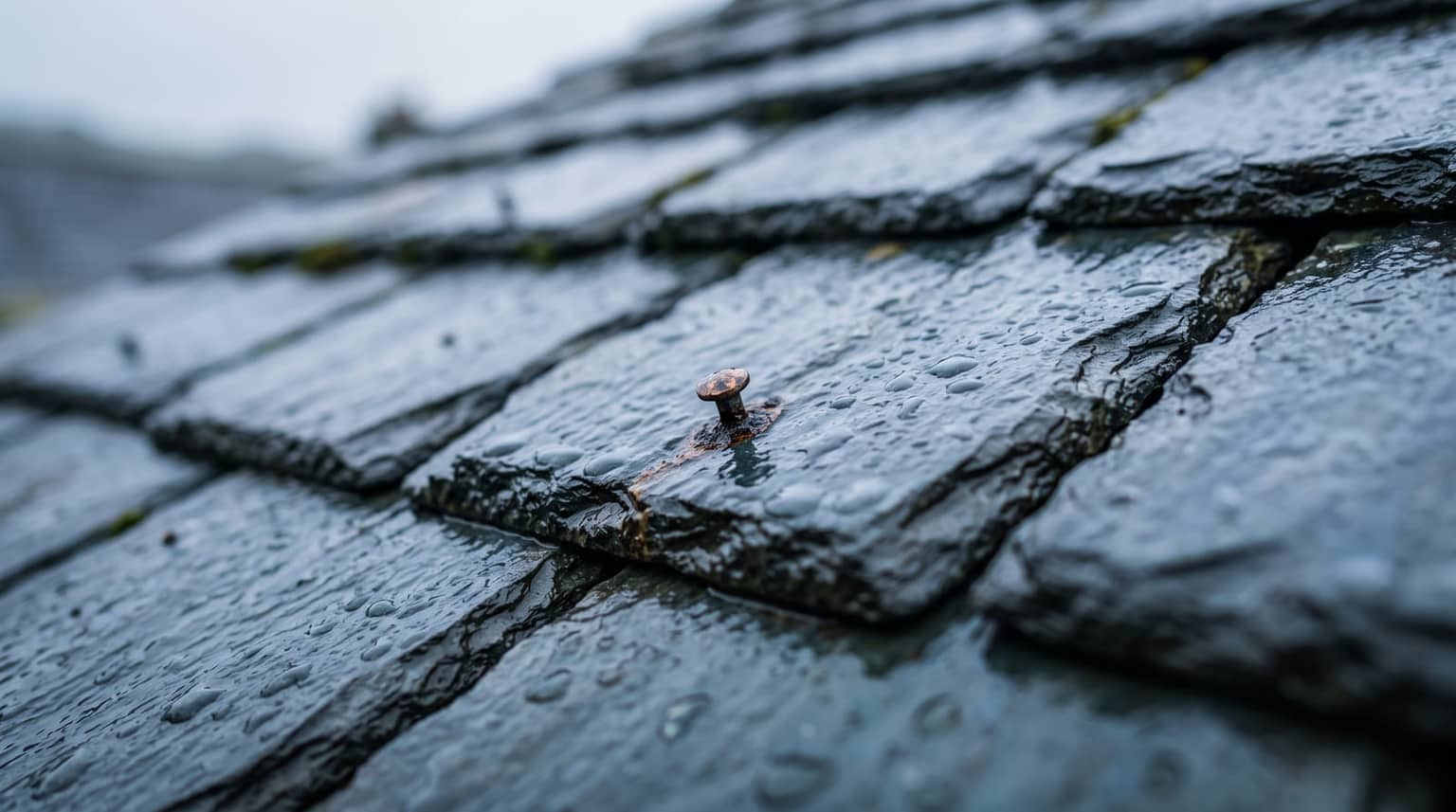
Victorian and Edwardian slaters used iron or galvanised nails. Iron rusts. Galvanising is a thin zinc coat that corrodes first, on purpose, to protect the steel beneath — and once the zinc has gone the steel has nothing left. Either way the shank thins in the damp air of the roof space until it can no longer carry the weight of the slate plus the lift of a gust. Then the slate slides out, almost always during the first proper winter gale.
That is nail fatigue, and the point about it is that it does not happen to one nail. Every nail on that slope went in the same week, from the same keg, and has had the same hundred and thirty winters since. When one goes, the rest are exactly as old.
So the pattern of the drops tells you more than the date on the deeds, and the questions below set out how to read it. What matters here is that the clock is a shared one: the moment a slope starts shedding sound slates in more than one place, every remaining nail on it is exactly as old as the ones that went.
The stone, though, is usually fine. Because the slate outlives its fixings, most of a re-slate goes back on the roof as your own slates, on new graded battens, a new membrane and copper or stainless nails that will not corrode the same way.
Battens and underlay, the layer nobody sees
Battens are the timber the slates and tiles nail to. Until the 1970s they were whatever sawn softwood came off the lorry, often ungraded, often full of sapwood, and rarely treated. They fail at the nail holes, because that is where damp sits longest, and a batten that has gone soft around a fixing will not hold a nail no matter how good the nail is. The lowest metre of a slope goes first, since it stays wet the longest.
Battens today are graded to BS 5534, treated, and dyed blue or green so anyone can see at a glance that the correct timber went on. It is worth looking for that colour in the photographs a roofer sends you.
Most London houses built before about 1930 have no underlay at all. The slates were the waterproof layer, and the gap beneath was sometimes torched — lime mortar buttered along the underside of the slates to stop wind-blown snow. Torching crumbles with age, and by now a good deal of it is on your loft floor.
Roofs from the 1930s to the 1980s have bitumen felt underlay, hanging in a shallow drape between the rafters. Over thirty or forty years the bitumen loses the oils that keep it flexible, goes brittle, and tears along the fold at the bottom of the drape. You can often see that tear from inside the loft with a torch. Once it has gone, any rain that gets past a tile has nothing to catch it.
Mortar and lead: the joints go first
Bedding mortar on a ridge or a hip is sand and cement. It shrinks as it cures, then freezes and thaws every winter for twenty years, and twenty years is a decent run. Cracked bedding is the single most common source of a leak that has nothing at all wrong with the tiles.
The standard has required ridge and hip tiles to be mechanically fixed since 2014, not simply bedded. A dry ridge system screws them down over a ventilated roll. It costs more on the day and removes a job you would otherwise pay for again in two decades.
Lead gets blamed for failing when it was really fitted wrong. Lead moves a lot with temperature: a long piece grows several millimetres on a hot afternoon and shrinks back overnight. Fix it at both ends and make it too long, and it cannot move, so it works itself thin along one line and splits — a straight crack running the length of the sheet, in the same place every time. The answer is not thicker lead. It is shorter pieces with proper laps, which is why the standard limits a single length of flashing to about a metre and a half.
Lead that is the right code, the right length and properly dressed will see out the roof it sits on. Lead patched with mortar fillet, mastic or a tin of black paint will be back within a few winters.
Flat roofs age from the top down and the edges in
Felt rarely dies of one thing. It blisters first and goes brittle afterwards, and on a roof of about the right age the two arrive together. One blister is a half-day repair; a slope of them is the deck below saying it is wet.
Felt also goes brittle. Bitumen holds oils that keep it flexible and sunlight drives them off. The mineral chippings on the top layer exist to shade it, so once they have washed down into the gutter the felt below has a few summers left. It splits where the deck flexes most, usually along a joint between the boards.
Rubber and fibreglass do not go brittle the same way, but they are only as good as their edges. Nearly every EPDM or GRP failure we attend is a seam, an upstand where the roof meets a wall, or the trim along the front. Ponding on its own rarely kills a modern flat roof, but a standing puddle does tell you the falls are wrong, and it will find any weak detail there is.
What shortens a roof's life
Very little of this is weather. Most of the roofs that die early were helped along.
- Foot traffic
- Aerial fitters, window cleaners and solar installers walking a slate slope break more slates in an afternoon than a decade of weather. Ask anyone going up how they plan to spread their weight.
- Moss
- Moss does not eat the roof. It holds water against it and blocks the gaps between tiles, which matters most when that water freezes. Scraping it off with a pressure washer strips the surface of concrete tiles and does more harm than the moss did.
- Repairs made of sealant
- Mastic, expanding foam and bitumen paint over a failing joint buy one winter, hide the cause, and make the proper repair harder and dearer when it finally happens.
- Blocked gutters
- Water backing up over the fascia keeps the batten ends and rafter feet permanently wet. Rot at the eaves is the most avoidable roof problem there is.
- Extra holes
- Every new pipe, vent, satellite bracket or roof window is a penetration. Each is a straightforward detail done properly and a leak in ten years done badly.
What cannot be told from the ground
Nobody can date a roof accurately from the pavement, and nobody honest prices a re-roof from a photograph. From below we can read the covering, the ridge line, obvious slippage and the state of the mortar. What decides the job is underneath: whether the battens still hold a nail, whether there is any underlay left, and how much of the covering can go back on.
That needs a look in the loft, or a few slates lifted, and it takes about half an hour. It is also the difference between a repair and a re-roof.
If someone tells you the roof needs replacing without having been in the loft or on the slope, get a second opinion before you agree to anything.
Questions
01My roof is 90 years old. Does it need replacing?
Not because of its age. Plenty of 1930s roofs have another twenty years in them, and plenty of 1970s roofs do not. What matters is whether the battens still grip a nail, whether the underlay has torn, and how much of the covering has slipped. All three are visible in half an hour on site.
02How do I tell nail fatigue from a one-off slipped slate?
Look at where the slates come from. A cluster in one area, usually low on the slope, points to damage or one bad batch, and that is a repair. Slates dropping from across the whole plane, a few more every winter, means the fixings have reached the end together. At that point patching costs more over ten years than re-slating the slope.
03How do I tell whether the underlay has gone?
Look up between the rafters in daylight with a torch. Felt that is still flexible and unbroken is doing its job. Felt that has gone hard, split along the fold at the bottom of each drape, or torn away at the nail line has stopped, and the next slipped tile puts water on your ceiling rather than into a gutter. Torn underlay is one of the few findings that turns a repair into a re-cover, because it cannot be replaced without taking the covering off. A house built before about 1930 often has no underlay at all, which is how it was built rather than a fault.
04What affects the cost of re-roofing in London?
The covering sets the starting point. Concrete interlocking tile is the least expensive, then clay plain tile, then graded Spanish slate, with Welsh slate the dearest. The size of the roof matters, and the scaffold comes on top. From there, access, the number of chimneys and valleys, and whether the existing covering can be salvaged move it more than anything else.
05Does a new roof need building regulations approval?
Past about a quarter of the roof area, yes, so a full re-roof always is. Renew more than half of it and Part L brings the insulation up with it — 0.16 W/m²K on a pitched roof, which in an open loft usually means topping up to around 300 mm of mineral wool while the access is already there. Some roofers are on a self-certification scheme and sign the work off themselves. We are not, so ours goes to your borough's building control and the completion certificate comes back from them.
06How often should a roof be looked at?
Every couple of years, and after any serious gale. Most of it can be done from the ground with a pair of binoculars: slipped or missing units, a ridge line that is no longer straight, cracked mortar, plants in the gutter. Then go into the loft in daylight after heavy rain and look for wet trails and daylight.
07Does the guarantee on a new roof match the lifespan of the material?
No, and be wary of anyone implying it does. Materials carry the manufacturer's own warranty, which is theirs and not the roofer's, while the workmanship is covered separately for a stated period. Ask for both in writing and read what each one actually covers.