The short answer
Lead does not wear out — it fails at details. Every piece expands and contracts by a couple of millimetres each day as the sun crosses it, so a length cut too long, chased in along both edges, or pointed solid so it cannot slide will fatigue and split in a straight line.
What the lead is doing up there
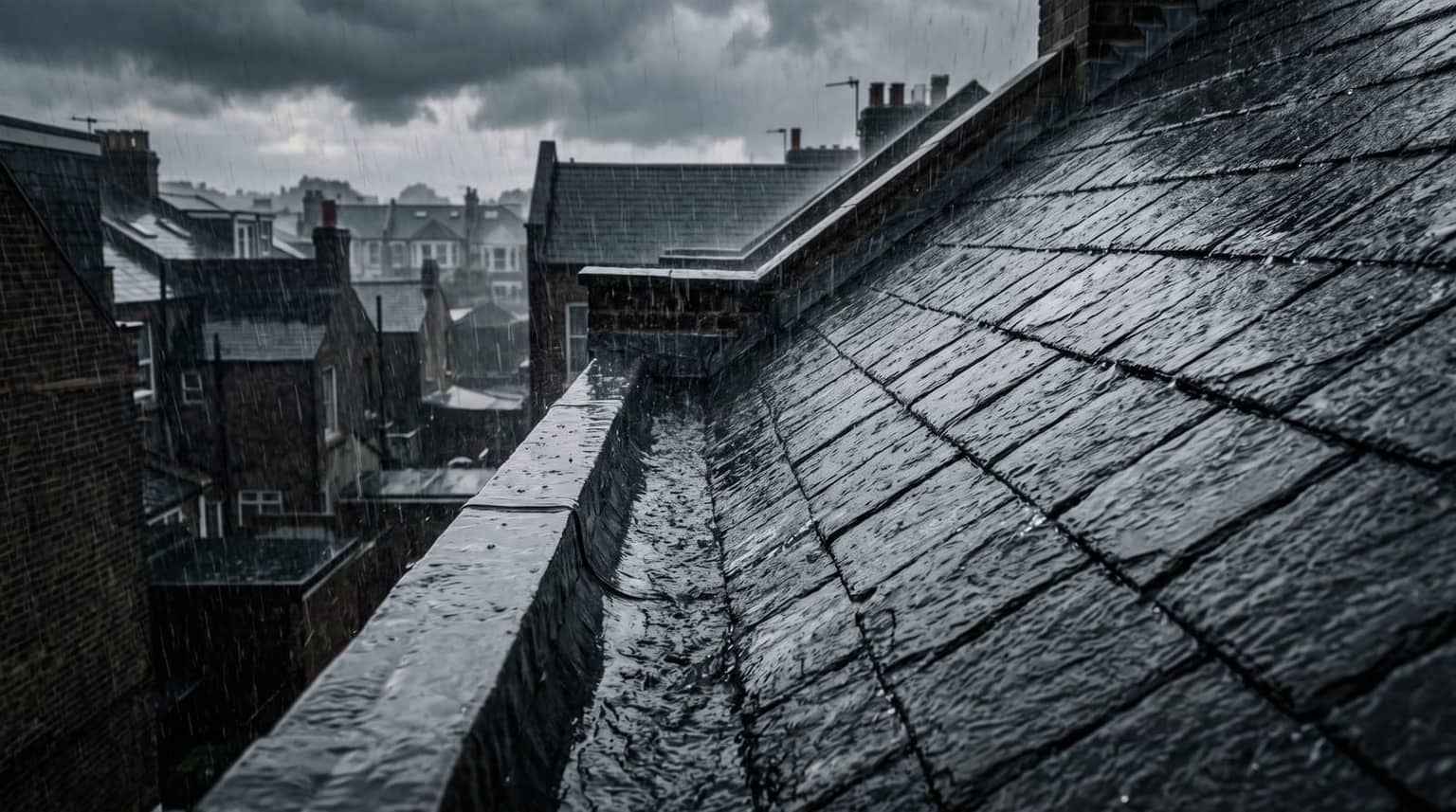
A pitched roof is watertight because each slate or tile sheds water onto the one below it. That run is broken wherever something interrupts the slope — a chimney pushing through, a wall butting into it, two planes meeting in a valley, a parapet at the front of a butterfly roof. Lead covers those breaks.
It is used because it can be dressed. A sheet is beaten over a wooden stick until it takes the shape of a tile roll or turns a corner in one piece with no joint, and it holds that shape for decades. The same softness is why lead comes with rules attached: a metal you can form with a mallet keeps moving once it is up there.
Which of two jobs a piece is doing decides how thick it needs to be.
- Shedding water
- Aprons, step flashings and soakers. Water crosses them and is gone in seconds. Exposed, but never holding anything.
- Carrying water
- Valleys, the back gutter behind a stack, parapet and box gutter linings, dormer tops. These carry the run-off from whole slopes and hold standing water in heavy rain. Heavier metal, more careful jointing.
Codes: the number that decides how long it lasts
Rolled lead sheet is sold by code, and the code is thickness. It is set by BS EN 12588, and every roll is colour-marked at the mill so it can be checked on site before anyone cuts it: Code 4 blue, Code 5 red, Code 6 black.
- Code 3
- 1.32 mm, about 15 kg per square metre. Soakers only. Too thin for anything exposed.
- Code 4
- 1.80 mm, about 20 kg. The standard for apron and step flashings on a house.
- Code 5
- 2.24 mm, about 25 kg. Valleys, back gutters, parapet linings, dormer tops — anything that carries water.
- Code 6
- 2.65 mm, about 30 kg. Large linings, exposed heritage work, wide gutters with long bays.
- Code 7
- 3.15 mm, about 36 kg. Church and public-building work, often sandcast rather than milled.
Why dropping a code costs you years
Lead is bought by weight, so Code 4 in place of Code 5 saves a little on the material for a chimney. The sheet has to absorb the same movement either way, and thinner metal has less of itself to spread that strain across, so the same run of hot days does more damage to it. Code 4 in a valley crazes and splits while the same detail in Code 5 is still sound. It is invisible from the ground once the roof is finished, which is why the code belongs on the quote in writing.
Why lead splits
Lead expands about 0.03 mm per metre for every degree Celsius. A south-facing flashing sits at freezing on a January night and reaches 50 to 60 degrees under direct July sun. A 1.5 metre piece therefore changes length by roughly 2.5 mm across the year, and by more than a millimetre between breakfast and mid-afternoon on a sunny day.
Given somewhere to go, it slides a fraction and slides back, and does that for a century without complaint. Held at top and bottom, or pointed in solid along its whole length, the movement has to be absorbed inside the metal instead. Each cycle hardens the grain along the line where the strain concentrates, and after some thousands of cycles a crack starts there and runs along it.
That is why failed flashings split in a straight line — parallel to the wall, or across the middle of an over-long piece — rather than corroding into holes. The metal did not let you down. The way it was fixed did.
The rules all exist to give lead room. Pieces of about 1.5 metres, no longer. Laps of at least 100 mm, more at a shallow pitch. Fixed along the top edge only, wedged into the chase at about 450 mm centres, with clips holding the bottom edge against wind lift but never pinning its length.
The details that guarantee a split
Almost every early failure we lift off a South London roof is one of these six. All six were decisions, not accidents.
- One long piece instead of several
- A four metre valley cut from one length, or a flashing run in a single strip across a wide stack. Several times the movement of a correctly sized piece, with nowhere to put it. These fail on a predictable clock, often inside ten years.
- A chased-in gutter
- A lining whose upstands are cut into the brickwork on both sides and pointed solid. The sheet is pinned across its width as well as its length, so it fatigues along the arris where the flat meets the upstand. Done properly the upstand is left free, with a separate cover flashing in the chase over the top of it.
- No drips in a long gutter
- A parapet or box gutter is lined in bays of about 1.5 metres with a step or a drip between them, so each bay moves on its own. A twelve metre run lined in one sheet can only expand upwards into a ripple, and the ripple cracks.
- A mortar fillet where lead belongs
- A cement triangle at the junction of roof and stack. Brick, cement and slate move at different rates, so the fillet cracks — often within five years — and then funnels water into the joint it was covering.
- Short laps
- Two pieces overlapped by 50 mm instead of 100 look identical from a ladder. On a shallow pitch, wind drives rain uphill far enough to cross the lap and get behind the flashing, so the leak shows only in a storm from one direction.
- Tape and mastic over a split
- Flashing tape sticks to a hot dry surface and holds through one summer. UV and thermal cycling break the bond down the edges, then water gets underneath and cannot get out again. It also hides the split from the next person up there.
The failures that are not splits
Two other mechanisms account for most of the rest, and both catch people out because the lead looks perfect from above.
The first is underside corrosion. Lead in a closed, unventilated space — the boxed-in top of a dormer, a lining laid straight onto boards — gets condensation on its cold underside. Add organic acids off unseasoned softwood or oak and the metal converts to a white powder from below, thinning until it perforates while the top surface still looks like new work. The prevention is air behind the sheet and a separating layer, so lead never lies directly on timber.
The second is alkali attack. Fresh cement and lime mortar are strongly alkaline and eat into lead in contact with them, so the leg buried in a new chase should be painted with bituminous paint first. It takes minutes and is routinely skipped.
There is also a cosmetic one. New lead sheds a white carbonate as it weathers, which washes down the wall and stains it. Patination oil wiped on the day it goes up stops that forming; cleaning the stain off soft London stock brick afterwards is a job in itself.
And there is theft. Lead has a scrap value by the kilo, and a bay roof, a porch or a low parapet is a target — common enough across South London to weigh up before new metal goes anywhere reachable from a garden wall.
Where the cheaper alternatives really stand
Lead substitutes are usually a polymer laminate over an aluminium mesh, sold in rolls and fitted with adhesive and sealant. They cost less, have no scrap value and so do not get stolen, and on a simple straight abutment a well-fitted one lasts something like fifteen to twenty years rather than a lifetime.
The limits are real. They cannot be bossed round a complex corner or a curved dormer cheek the way lead can. They rely on adhesive and sealed joints, which are consumable parts. And they are not accepted on a listed building or, usually, on a visible slope in a conservation area.
So there is an honest split. On a garage, an outbuilding, a rear extension abutment, or anywhere lead has been stolen once, a substitute is a sensible answer and we will price it. On a chimney, a valley, a parapet gutter or a front dormer it is a false economy: the labour of getting up there and stripping out is most of the cost, and you pay it again sooner.
A cement fillet, a paint-on coating and a roll of flashing tape are not alternatives at all. Each covers a junction rather than weatherproofing it, and each buys a winter or two.
What each job involves, and what moves the cost
The jobs below assume the work can be reached from a ladder or a tower. Scaffold is a separate cost, and a bigger one where a whole elevation must be reached rather than a single stack, or where the scaffold stands on the footway and needs a licence.
- Welded patch to sound lead
- New metal fused into the split rather than stuck over it — permanent, not a holding repair.
- Apron flashing renewed to a chimney
- Half a day.
- Chimney fully re-leaded
- Apron, steps, soakers and back gutter. Repointing the stack is a separate job on top.
- Lead valley renewed
- About a day for a typical four to six metre valley.
- Parapet or box gutter relined
- The price depends on whether the boards underneath are sound. Nobody can know that until it is opened up.
- Dormer cheeks and top re-leaded
- One to two days.
How to read a leadwork quote
Access moves the price more than the lead does, and after that it is how much has to come off to reach the detail — slates lifted and re-hooked, a chase raked out and repointed, a tile course reset. A stack needing repointing is a job before the lead job. None of that prices honestly over the phone.
A quote that says only 'renew lead flashing' with a number after it gives you nothing to check. Four questions make it comparable: what code, how many pieces, how long is each, and is the chase being raked out and repointed or the lead going back into the old joint. Ask a fifth — is patination oil applied — because the answer tells you how the rest will be done.
There is no VAT on our quotes, because we are not registered for it. Our quotes name the code and the piece lengths, and we would rather you put the same five questions to everyone else quoting.
Questions
01What code of lead should be used on a house roof?
Code 4 for apron and step flashings, which only shed water. Code 5 for anything that carries it — valleys, the back gutter behind a chimney, parapet and box gutter linings, dormer tops. Code 3 is for soakers under slates and nothing else. The roll is colour-marked at the mill, so the code can be checked on site before it is cut.
02How long should lead flashing last?
Detailed correctly, longer than the slates around it — sixty years and beyond is normal, and lead on churches lasts centuries. Detailed badly, the clock is much shorter: an over-long piece often splits within ten years, and a cement fillet used in place of a flashing tends to crack within five. Age alone tells you very little.
03Can a split flashing be repaired instead of replaced?
Often, yes. Lead can be welded — new metal of the same code fused into the sheet, which is a permanent repair rather than a patch. It is worth doing when the rest of the piece is the right code and the right length. Replacement is the honest answer when the piece was too long or too thin to start with, or when the surface is crazed with fine cracks across a whole face.
04Are lead substitutes worth using?
In the right place. On a garage, an outbuilding, a simple straight abutment, or anywhere lead has already been stolen, a substitute costs less, has no scrap value and lasts perhaps fifteen to twenty years. It cannot be dressed round complex shapes, it depends on adhesive joints, and it is not accepted on listed buildings or on visible slopes in most conservation areas.
05Why has new lead stained my brickwork white?
That is lead carbonate. New lead weathers by forming a chalky surface layer, and rain washes it down the wall as a white streak. It is preventable rather than inevitable: patination oil wiped over the sheet on the day of fitting stops the carbonate forming. The stain can usually be cleaned off brick afterwards, but it is far more work than the ten minutes of oil would have been.
06How can lead be protected from theft?
Two practical routes. Mark it with a forensic property-marking kit and put up the scheme's signage, which makes it harder to sell on. Or fit a substitute on the parts reachable from a garden, a wall or a flat roof, and keep lead where nobody can get at it. Insurers sometimes ask for one or the other after a first theft.
07Is lead on a roof a health risk?
Not to live under. Rolled lead sheet is stable and sits outside the building. The sensible precautions are practical: wash your hands after handling offcuts, keep scrap away from children, and do not collect rainwater off a lead roof or a lead-lined gutter for drinking or for watering vegetables.